

186
The results presented show that the knowledge on the nanomaterials toxic effects
on phytoplanktonic and zooplaktonic offers subsidies for the establishment of public policies with regard to the use and delivery of such materials.
7.3.2 Nanotoxicity Investigation in Fishes
The adsorption of nanoparticles to fishes may occur through the gill surface, which
involves similar processes to other substances. After nanoparticle uptake, target
organs may include liver, spleen kidney, brain, etc., with toxic effects involving
oxidative stress, ionoregulatory disturbances, and organ pathologies (Handy et al.
2008). After absorption, nanoparticle internalization occurs via endocytosis. Their
toxic effects essentially depend on several factors such as the formation of aggregations, route of exposure, dose–response, exposure time, the response of the receptor
organisms, and the interactions in the mechanisms involved in the physiological
process of uptake (Pecoraro et al. 2018). Nanomaterial generally induces only mild
acute toxicity to most adult fish, but the sensitivity may be higher for certain species
and also depends on life stages. In adult animals, aquatic nanomaterial can cause
respiratory and digestive epithelia irritation and causes oxidative stress. Additionally,
interactions between nanomaterial (or dissolution products) and proteins can induce
regulatory stress and/or developmental toxicity (Callaghan and MacCormack 2017).
Considering these aspects, it is known that the toxicity mechanisms should be
studied for environmental parameters; however, there are not enough standardized
sampling and methods to measure environmental influence when exposed to nanomaterial. Nanoecotoxicology has increased the availability of published data, but
these are still scarce and inadequate for regulatory decision-making (Hjorth et al.
2017). Moreover, measuring and modeling of nanomaterials depend on more physicochemical parameters than conventional chemicals. Thus, standardization of dispersion methods and knowledge of dissolution kinetics are needed for interpretation
and comparability of data (Tantra et al. 2011; Baun et al. 2017; OECD 2017).
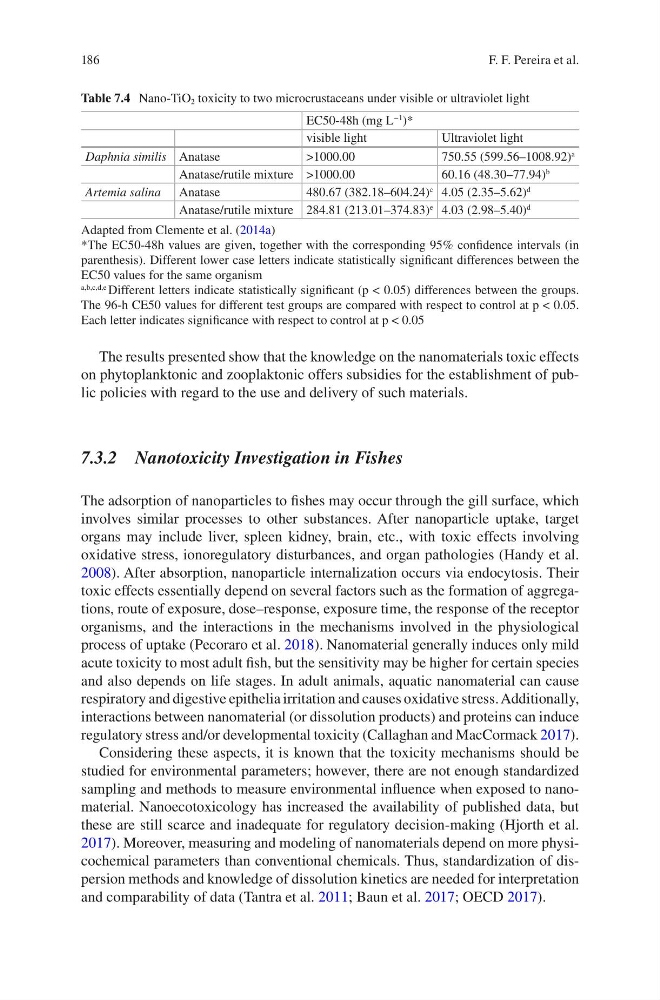
Table 7.4 Nano-TiO 2 toxicity to two microcrustaceans under visible or ultraviolet light
EC50-48h (mg L
−1 )*
visible light
Ultraviolet light
Daphnia similis Anatase
>1000.00
750.55 (599.56–1008.92)
a
Anatase/rutile mixture >1000.00
60.16 (48.30–77.94)
b
Artemia salina Anatase
480.67 (382.18–604.24)
c 4.05 (2.35–5.62)
d
Anatase/rutile mixture 284.81 (213.01–374.83)
e 4.03 (2.98–5.40)
d
Adapted from Clemente et al. (2014a)
*The EC50-48h values are given, together with the corresponding 95% confidence intervals (in
parenthesis). Different lower case letters indicate statistically significant differences between the
EC50 values for the same organism
a,b,c,d,e Different letters indicate statistically significant (p < 0.05) differences between the groups.
The 96-h CE50 values for different test groups are compared with respect to control at p < 0.05.
Each letter indicates significance with respect to control at p < 0.05
F. F. Pereira et al.
The results presented show that the knowledge on the nanomaterials toxic effects
on phytoplanktonic and zooplaktonic offers subsidies for the establishment of public policies with regard to the use and delivery of such materials.
7.3.2 Nanotoxicity Investigation in Fishes
The adsorption of nanoparticles to fishes may occur through the gill surface, which
involves similar processes to other substances. After nanoparticle uptake, target
organs may include liver, spleen kidney, brain, etc., with toxic effects involving
oxidative stress, ionoregulatory disturbances, and organ pathologies (Handy et al.
2008). After absorption, nanoparticle internalization occurs via endocytosis. Their
toxic effects essentially depend on several factors such as the formation of aggregations, route of exposure, dose–response, exposure time, the response of the receptor
organisms, and the interactions in the mechanisms involved in the physiological
process of uptake (Pecoraro et al. 2018). Nanomaterial generally induces only mild
acute toxicity to most adult fish, but the sensitivity may be higher for certain species
and also depends on life stages. In adult animals, aquatic nanomaterial can cause
respiratory and digestive epithelia irritation and causes oxidative stress. Additionally,
interactions between nanomaterial (or dissolution products) and proteins can induce
regulatory stress and/or developmental toxicity (Callaghan and MacCormack 2017).
Considering these aspects, it is known that the toxicity mechanisms should be
studied for environmental parameters; however, there are not enough standardized
sampling and methods to measure environmental influence when exposed to nanomaterial. Nanoecotoxicology has increased the availability of published data, but
these are still scarce and inadequate for regulatory decision-making (Hjorth et al.
2017). Moreover, measuring and modeling of nanomaterials depend on more physicochemical parameters than conventional chemicals. Thus, standardization of dispersion methods and knowledge of dissolution kinetics are needed for interpretation
and comparability of data (Tantra et al. 2011; Baun et al. 2017; OECD 2017).
Table 7.4 Nano-TiO 2 toxicity to two microcrustaceans under visible or ultraviolet light
EC50-48h (mg L
−1 )*
visible light
Ultraviolet light
Daphnia similis Anatase
>1000.00
750.55 (599.56–1008.92)
a
Anatase/rutile mixture >1000.00
60.16 (48.30–77.94)
b
Artemia salina Anatase
480.67 (382.18–604.24)
c 4.05 (2.35–5.62)
d
Anatase/rutile mixture 284.81 (213.01–374.83)
e 4.03 (2.98–5.40)
d
Adapted from Clemente et al. (2014a)
*The EC50-48h values are given, together with the corresponding 95% confidence intervals (in
parenthesis). Different lower case letters indicate statistically significant differences between the
EC50 values for the same organism
a,b,c,d,e Different letters indicate statistically significant (p < 0.05) differences between the groups.
The 96-h CE50 values for different test groups are compared with respect to control at p < 0.05.
Each letter indicates significance with respect to control at p < 0.05
F. F. Pereira et al.