

183
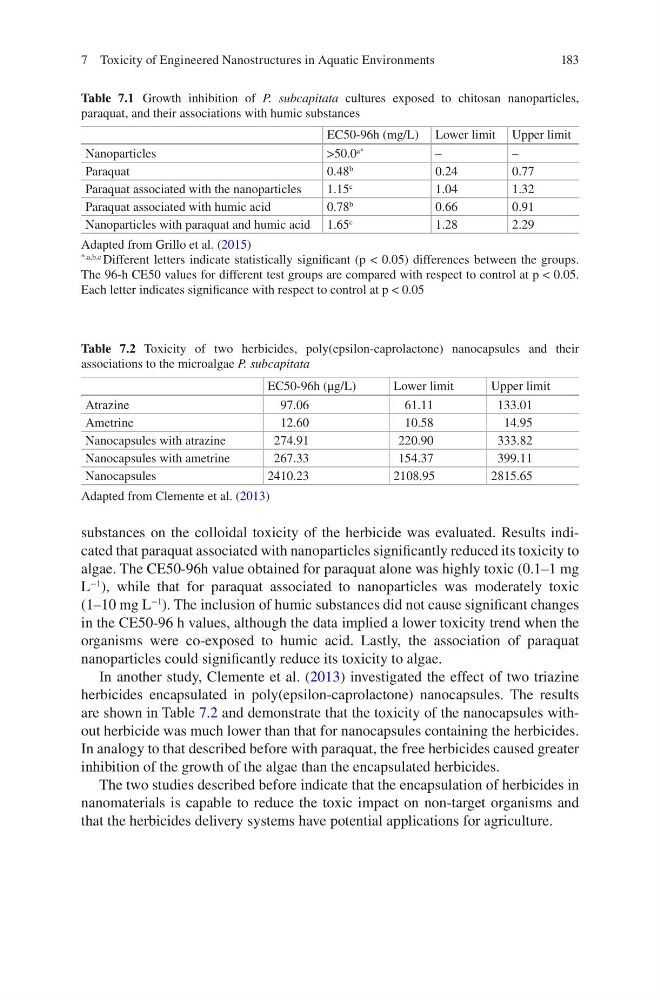
substances on the colloidal toxicity of the herbicide was evaluated. Results indicated that paraquat associated with nanoparticles significantly reduced its toxicity to
algae. The CE50-96h value obtained for paraquat alone was highly toxic (0.1–1 mg
L
−1
), while that for paraquat associated to nanoparticles was moderately toxic
(1–10 mg L
−1
). The inclusion of humic substances did not cause significant changes
in the CE50-96 h values, although the data implied a lower toxicity trend when the
organisms were co-exposed to humic acid. Lastly, the association of paraquat
nanoparticles could significantly reduce its toxicity to algae.
In another study, Clemente et al. (2013) investigated the effect of two triazine
herbicides encapsulated in poly(epsilon-caprolactone) nanocapsules. The results
are shown in Table 7.2 and demonstrate that the toxicity of the nanocapsules without herbicide was much lower than that for nanocapsules containing the herbicides.
In analogy to that described before with paraquat, the free herbicides caused greater
inhibition of the growth of the algae than the encapsulated herbicides.
The two studies described before indicate that the encapsulation of herbicides in
nanomaterials is capable to reduce the toxic impact on non-target organisms and
that the herbicides delivery systems have potential applications for agriculture.
Table 7.1 Growth inhibition of P. subcapitata cultures exposed to chitosan nanoparticles,
paraquat, and their associations with humic substances
EC50-96h (mg/L) Lower limit Upper limit
Nanoparticles
>50.0
a*
–
–
Paraquat
0.48
b
0.24
0.77
Paraquat associated with the nanoparticles
1.15
c
1.04
1.32
Paraquat associated with humic acid
0.78
b
0.66
0.91
Nanoparticles with paraquat and humic acid 1.65
c
1.28
2.29
Adapted from Grillo et al. (2015)
*,a,b,c Different letters indicate statistically significant (p < 0.05) differences between the groups.
The 96-h CE50 values for different test groups are compared with respect to control at p < 0.05.
Each letter indicates significance with respect to control at p < 0.05
Table 7.2 Toxicity of two herbicides, poly(epsilon-caprolactone) nanocapsules and their
associations to the microalgae P. subcapitata
EC50-96h (μg/L)
Lower limit
Upper limit
Atrazine
97.06
61.11
133.01
Ametrine
12.60
10.58
14.95
Nanocapsules with atrazine
274.91
220.90
333.82
Nanocapsules with ametrine
267.33
154.37
399.11
Nanocapsules
2410.23
2108.95
2815.65
Adapted from Clemente et al. (2013)
7 Toxicity of Engineered Nanostructures in Aquatic Environments
substances on the colloidal toxicity of the herbicide was evaluated. Results indicated that paraquat associated with nanoparticles significantly reduced its toxicity to
algae. The CE50-96h value obtained for paraquat alone was highly toxic (0.1–1 mg
L
−1
), while that for paraquat associated to nanoparticles was moderately toxic
(1–10 mg L
−1
). The inclusion of humic substances did not cause significant changes
in the CE50-96 h values, although the data implied a lower toxicity trend when the
organisms were co-exposed to humic acid. Lastly, the association of paraquat
nanoparticles could significantly reduce its toxicity to algae.
In another study, Clemente et al. (2013) investigated the effect of two triazine
herbicides encapsulated in poly(epsilon-caprolactone) nanocapsules. The results
are shown in Table 7.2 and demonstrate that the toxicity of the nanocapsules without herbicide was much lower than that for nanocapsules containing the herbicides.
In analogy to that described before with paraquat, the free herbicides caused greater
inhibition of the growth of the algae than the encapsulated herbicides.
The two studies described before indicate that the encapsulation of herbicides in
nanomaterials is capable to reduce the toxic impact on non-target organisms and
that the herbicides delivery systems have potential applications for agriculture.
Table 7.1 Growth inhibition of P. subcapitata cultures exposed to chitosan nanoparticles,
paraquat, and their associations with humic substances
EC50-96h (mg/L) Lower limit Upper limit
Nanoparticles
>50.0
a*
–
–
Paraquat
0.48
b
0.24
0.77
Paraquat associated with the nanoparticles
1.15
c
1.04
1.32
Paraquat associated with humic acid
0.78
b
0.66
0.91
Nanoparticles with paraquat and humic acid 1.65
c
1.28
2.29
Adapted from Grillo et al. (2015)
*,a,b,c Different letters indicate statistically significant (p < 0.05) differences between the groups.
The 96-h CE50 values for different test groups are compared with respect to control at p < 0.05.
Each letter indicates significance with respect to control at p < 0.05
Table 7.2 Toxicity of two herbicides, poly(epsilon-caprolactone) nanocapsules and their
associations to the microalgae P. subcapitata
EC50-96h (μg/L)
Lower limit
Upper limit
Atrazine
97.06
61.11
133.01
Ametrine
12.60
10.58
14.95
Nanocapsules with atrazine
274.91
220.90
333.82
Nanocapsules with ametrine
267.33
154.37
399.11
Nanocapsules
2410.23
2108.95
2815.65
Adapted from Clemente et al. (2013)
7 Toxicity of Engineered Nanostructures in Aquatic Environments