

161
photoexcited quantum dots could kill a wide range of multidrug-resistant bacterial
clinical isolates, including methicillin-resistant S. aureus, carbapenem-resistant
E. coli, and extended-spectrum β-lactamase-producing K. pneumoniae and
S. typhimurium. Quantum dots were able to kill 92% of bacterial cells in monoculture, as well as in a co-culture of E. coli and HEK 293 T cells, without affecting
other mammalian cells. In another study, the same research group showed that lightactivated, superoxide- producing cadmium telluride quantum dots could enhance the
activity of antibiotics against clinical multidrug-resistant isolates of E. coli,
S. enterica, and K. pneumoniae through quantum dot–antibiotic synergistic
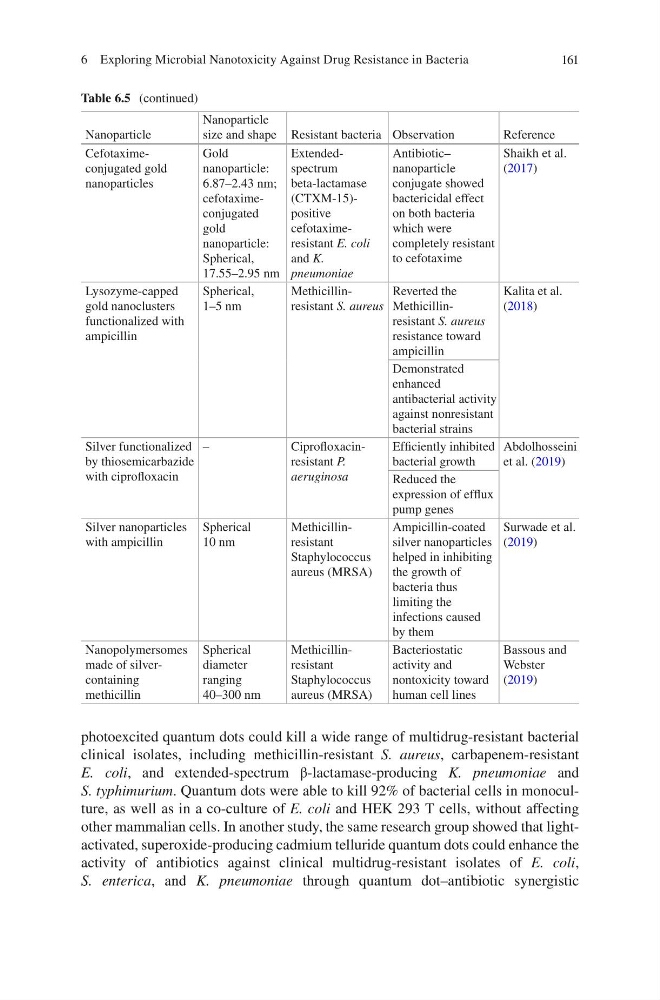
Table 6.5 (continued)
Nanoparticle
Nanoparticle
size and shape Resistant bacteria Observation
Reference
Cefotaximeconjugated gold
nanoparticles
Gold
nanoparticle:
6.87–2.43 nm;
cefotaximeconjugated
gold
nanoparticle:
Spherical,
17.55–2.95 nm
Extendedspectrum
beta-lactamase
(CTXM-15)positive
cefotaximeresistant E. coli
and K.
pneumoniae
Antibiotic–
nanoparticle
conjugate showed
bactericidal effect
on both bacteria
which were
completely resistant
to cefotaxime
Shaikh et al.
(2017)
Lysozyme-capped
gold nanoclusters
functionalized with
ampicillin
Spherical,
1–5 nm
Methicillinresistant S. aureus
Reverted the
Methicillinresistant S. aureus
resistance toward
ampicillin
Kalita et al.
(2018)
Demonstrated
enhanced
antibacterial activity
against nonresistant
bacterial strains
Silver functionalized
by thiosemicarbazide
with ciprofloxacin
–
Ciprofloxacinresistant P.
aeruginosa
Efficiently inhibited
bacterial growth
Abdolhosseini
et al. (2019)
Reduced the
expression of efflux
pump genes
Silver nanoparticles
with ampicillin
Spherical
10 nm
Methicillinresistant
Staphylococcus
aureus (MRSA)
Ampicillin-coated
silver nanoparticles
helped in inhibiting
the growth of
bacteria thus
limiting the
infections caused
by them
Surwade et al.
(2019)
Nanopolymersomes
made of silvercontaining
methicillin
Spherical
diameter
ranging
40–300 nm
Methicillinresistant
Staphylococcus
aureus (MRSA)
Bacteriostatic
activity and
nontoxicity toward
human cell lines
Bassous and
Webster
(2019)
6 Exploring Microbial Nanotoxicity Against Drug Resistance in Bacteria
photoexcited quantum dots could kill a wide range of multidrug-resistant bacterial
clinical isolates, including methicillin-resistant S. aureus, carbapenem-resistant
E. coli, and extended-spectrum β-lactamase-producing K. pneumoniae and
S. typhimurium. Quantum dots were able to kill 92% of bacterial cells in monoculture, as well as in a co-culture of E. coli and HEK 293 T cells, without affecting
other mammalian cells. In another study, the same research group showed that lightactivated, superoxide- producing cadmium telluride quantum dots could enhance the
activity of antibiotics against clinical multidrug-resistant isolates of E. coli,
S. enterica, and K. pneumoniae through quantum dot–antibiotic synergistic
Table 6.5 (continued)
Nanoparticle
Nanoparticle
size and shape Resistant bacteria Observation
Reference
Cefotaximeconjugated gold
nanoparticles
Gold
nanoparticle:
6.87–2.43 nm;
cefotaximeconjugated
gold
nanoparticle:
Spherical,
17.55–2.95 nm
Extendedspectrum
beta-lactamase
(CTXM-15)positive
cefotaximeresistant E. coli
and K.
pneumoniae
Antibiotic–
nanoparticle
conjugate showed
bactericidal effect
on both bacteria
which were
completely resistant
to cefotaxime
Shaikh et al.
(2017)
Lysozyme-capped
gold nanoclusters
functionalized with
ampicillin
Spherical,
1–5 nm
Methicillinresistant S. aureus
Reverted the
Methicillinresistant S. aureus
resistance toward
ampicillin
Kalita et al.
(2018)
Demonstrated
enhanced
antibacterial activity
against nonresistant
bacterial strains
Silver functionalized
by thiosemicarbazide
with ciprofloxacin
–
Ciprofloxacinresistant P.
aeruginosa
Efficiently inhibited
bacterial growth
Abdolhosseini
et al. (2019)
Reduced the
expression of efflux
pump genes
Silver nanoparticles
with ampicillin
Spherical
10 nm
Methicillinresistant
Staphylococcus
aureus (MRSA)
Ampicillin-coated
silver nanoparticles
helped in inhibiting
the growth of
bacteria thus
limiting the
infections caused
by them
Surwade et al.
(2019)
Nanopolymersomes
made of silvercontaining
methicillin
Spherical
diameter
ranging
40–300 nm
Methicillinresistant
Staphylococcus
aureus (MRSA)
Bacteriostatic
activity and
nontoxicity toward
human cell lines
Bassous and
Webster
(2019)
6 Exploring Microbial Nanotoxicity Against Drug Resistance in Bacteria