

160
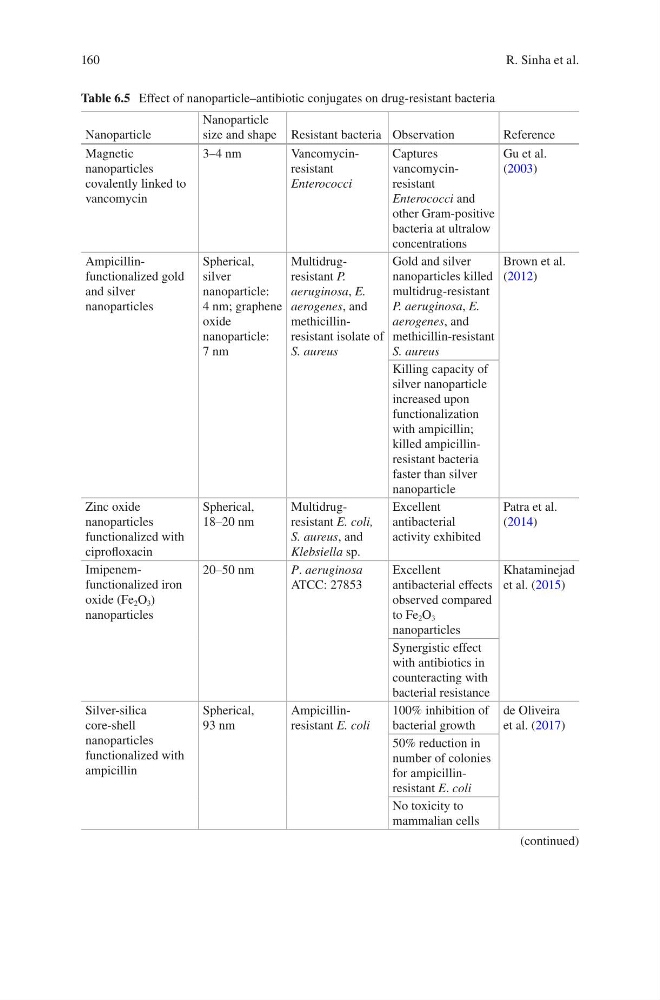
Table 6.5 Effect of nanoparticle–antibiotic conjugates on drug-resistant bacteria
Nanoparticle
Nanoparticle
size and shape Resistant bacteria Observation
Reference
Magnetic
nanoparticles
covalently linked to
vancomycin
3–4 nm
Vancomycinresistant
Enterococci
Captures
vancomycinresistant
Enterococci and
other Gram-positive
bacteria at ultralow
concentrations
Gu et al.
(2003)
Ampicillinfunctionalized gold
and silver
nanoparticles
Spherical,
silver
nanoparticle:
4 nm; graphene
oxide
nanoparticle:
7 nm
Multidrugresistant P.
aeruginosa, E.
aerogenes, and
methicillinresistant isolate of
S. aureus
Gold and silver
nanoparticles killed
multidrug-resistant
P. aeruginosa, E.
aerogenes, and
methicillin-resistant
S. aureus
Brown et al.
(2012)
Killing capacity of
silver nanoparticle
increased upon
functionalization
with ampicillin;
killed ampicillinresistant bacteria
faster than silver
nanoparticle
Zinc oxide
nanoparticles
functionalized with
ciprofloxacin
Spherical,
18–20 nm
Multidrugresistant E. coli,
S. aureus, and
Klebsiella sp.
Excellent
antibacterial
activity exhibited
Patra et al.
(2014)
Imipenemfunctionalized iron
oxide (Fe 2 O 3 )
nanoparticles
20–50 nm
P. aeruginosa
ATCC: 27853
Excellent
antibacterial effects
observed compared
to Fe 2 O 3
nanoparticles
Khataminejad
et al. (2015)
Synergistic effect
with antibiotics in
counteracting with
bacterial resistance
Silver-silica
core-shell
nanoparticles
functionalized with
ampicillin
Spherical,
93 nm
Ampicillinresistant E. coli
100% inhibition of
bacterial growth
de Oliveira
et al. (2017)
50% reduction in
number of colonies
for ampicillinresistant E. coli
No toxicity to
mammalian cells
(continued)
R. Sinha et al.
Table 6.5 Effect of nanoparticle–antibiotic conjugates on drug-resistant bacteria
Nanoparticle
Nanoparticle
size and shape Resistant bacteria Observation
Reference
Magnetic
nanoparticles
covalently linked to
vancomycin
3–4 nm
Vancomycinresistant
Enterococci
Captures
vancomycinresistant
Enterococci and
other Gram-positive
bacteria at ultralow
concentrations
Gu et al.
(2003)
Ampicillinfunctionalized gold
and silver
nanoparticles
Spherical,
silver
nanoparticle:
4 nm; graphene
oxide
nanoparticle:
7 nm
Multidrugresistant P.
aeruginosa, E.
aerogenes, and
methicillinresistant isolate of
S. aureus
Gold and silver
nanoparticles killed
multidrug-resistant
P. aeruginosa, E.
aerogenes, and
methicillin-resistant
S. aureus
Brown et al.
(2012)
Killing capacity of
silver nanoparticle
increased upon
functionalization
with ampicillin;
killed ampicillinresistant bacteria
faster than silver
nanoparticle
Zinc oxide
nanoparticles
functionalized with
ciprofloxacin
Spherical,
18–20 nm
Multidrugresistant E. coli,
S. aureus, and
Klebsiella sp.
Excellent
antibacterial
activity exhibited
Patra et al.
(2014)
Imipenemfunctionalized iron
oxide (Fe 2 O 3 )
nanoparticles
20–50 nm
P. aeruginosa
ATCC: 27853
Excellent
antibacterial effects
observed compared
to Fe 2 O 3
nanoparticles
Khataminejad
et al. (2015)
Synergistic effect
with antibiotics in
counteracting with
bacterial resistance
Silver-silica
core-shell
nanoparticles
functionalized with
ampicillin
Spherical,
93 nm
Ampicillinresistant E. coli
100% inhibition of
bacterial growth
de Oliveira
et al. (2017)
50% reduction in
number of colonies
for ampicillinresistant E. coli
No toxicity to
mammalian cells
(continued)
R. Sinha et al.