

151
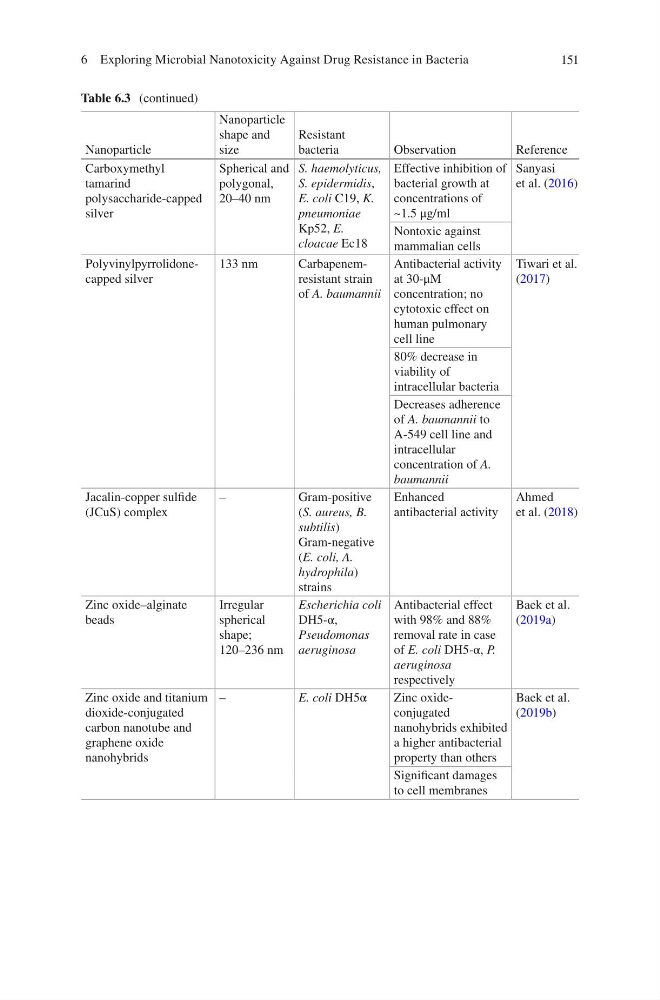
Table 6.3 (continued)
Nanoparticle
Nanoparticle
shape and
size
Resistant
bacteria
Observation
Reference
Carboxymethyl
tamarind
polysaccharide-capped
silver
Spherical and
polygonal,
20–40 nm
S. haemolyticus,
S. epidermidis,
E. coli C19, K.
pneumoniae
Kp52, E.
cloacae Ec18
Effective inhibition of
bacterial growth at
concentrations of
~1.5 μg/ml
Sanyasi
et al. (2016)
Nontoxic against
mammalian cells
Polyvinylpyrrolidonecapped silver
133 nm
Carbapenemresistant strain
of A. baumannii
Antibacterial activity
at 30-μM
concentration; no
cytotoxic effect on
human pulmonary
cell line
Tiwari et al.
(2017)
80% decrease in
viability of
intracellular bacteria
Decreases adherence
of A. baumannii to
A-549 cell line and
intracellular
concentration of A.
baumannii
Jacalin-copper sulfide
(JCuS) complex
–
Gram-positive
(S. aureus, B.
subtilis)
Gram-negative
(E. coli, A.
hydrophila)
strains
Enhanced
antibacterial activity
Ahmed
et al. (2018)
Zinc oxide–alginate
beads
Irregular
spherical
shape;
120–236 nm
Escherichia coli
DH5-α,
Pseudomonas
aeruginosa
Antibacterial effect
with 98% and 88%
removal rate in case
of E. coli DH5-α, P.
aeruginosa
respectively
Baek et al.
(2019a)
Zinc oxide and titanium
dioxide-conjugated
carbon nanotube and
graphene oxide
nanohybrids
–
E. coli DH5α
Zinc oxideconjugated
nanohybrids exhibited
a higher antibacterial
property than others
Baek et al.
(2019b)
Significant damages
to cell membranes
6 Exploring Microbial Nanotoxicity Against Drug Resistance in Bacteria
Table 6.3 (continued)
Nanoparticle
Nanoparticle
shape and
size
Resistant
bacteria
Observation
Reference
Carboxymethyl
tamarind
polysaccharide-capped
silver
Spherical and
polygonal,
20–40 nm
S. haemolyticus,
S. epidermidis,
E. coli C19, K.
pneumoniae
Kp52, E.
cloacae Ec18
Effective inhibition of
bacterial growth at
concentrations of
~1.5 μg/ml
Sanyasi
et al. (2016)
Nontoxic against
mammalian cells
Polyvinylpyrrolidonecapped silver
133 nm
Carbapenemresistant strain
of A. baumannii
Antibacterial activity
at 30-μM
concentration; no
cytotoxic effect on
human pulmonary
cell line
Tiwari et al.
(2017)
80% decrease in
viability of
intracellular bacteria
Decreases adherence
of A. baumannii to
A-549 cell line and
intracellular
concentration of A.
baumannii
Jacalin-copper sulfide
(JCuS) complex
–
Gram-positive
(S. aureus, B.
subtilis)
Gram-negative
(E. coli, A.
hydrophila)
strains
Enhanced
antibacterial activity
Ahmed
et al. (2018)
Zinc oxide–alginate
beads
Irregular
spherical
shape;
120–236 nm
Escherichia coli
DH5-α,
Pseudomonas
aeruginosa
Antibacterial effect
with 98% and 88%
removal rate in case
of E. coli DH5-α, P.
aeruginosa
respectively
Baek et al.
(2019a)
Zinc oxide and titanium
dioxide-conjugated
carbon nanotube and
graphene oxide
nanohybrids
–
E. coli DH5α
Zinc oxideconjugated
nanohybrids exhibited
a higher antibacterial
property than others
Baek et al.
(2019b)
Significant damages
to cell membranes
6 Exploring Microbial Nanotoxicity Against Drug Resistance in Bacteria