

150
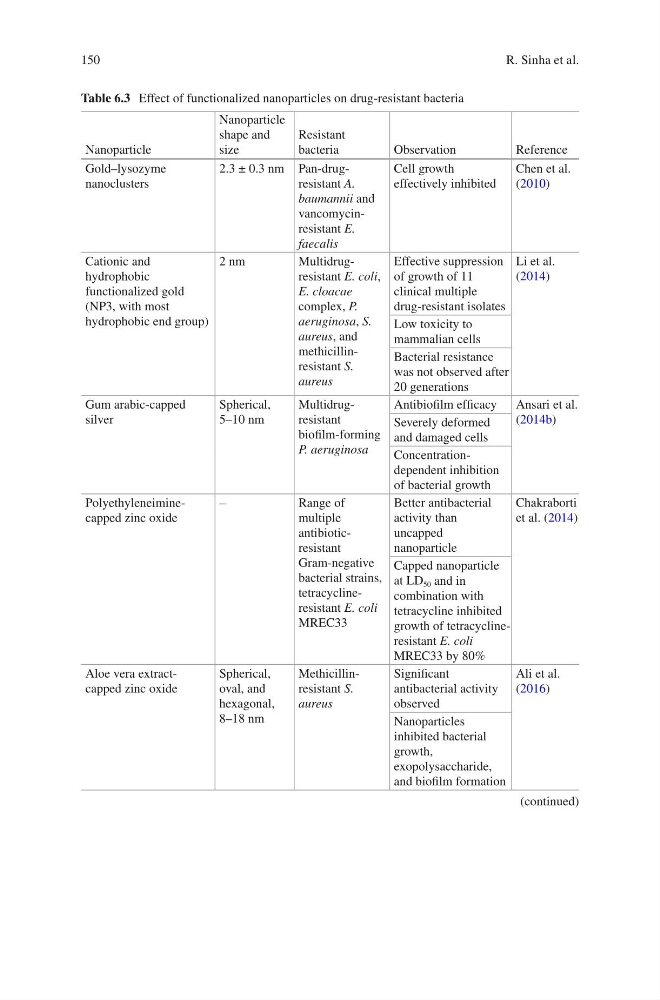
Table 6.3 Effect of functionalized nanoparticles on drug-resistant bacteria
Nanoparticle
Nanoparticle
shape and
size
Resistant
bacteria
Observation
Reference
Gold–lysozyme
nanoclusters
2.3 ± 0.3 nm Pan-drugresistant A.
baumannii and
vancomycinresistant E.
faecalis
Cell growth
effectively inhibited
Chen et al.
(2010)
Cationic and
hydrophobic
functionalized gold
(NP3, with most
hydrophobic end group)
2 nm
Multidrugresistant E. coli,
E. cloacae
complex, P.
aeruginosa, S.
aureus, and
methicillinresistant S.
aureus
Effective suppression
of growth of 11
clinical multiple
drug-resistant isolates
Li et al.
(2014)
Low toxicity to
mammalian cells
Bacterial resistance
was not observed after
20 generations
Gum arabic-capped
silver
Spherical,
5–10 nm
Multidrugresistant
biofilm-forming
P. aeruginosa
Antibiofilm efficacy Ansari et al.
(2014b)
Severely deformed
and damaged cells
Concentrationdependent inhibition
of bacterial growth
Polyethyleneiminecapped zinc oxide
–
Range of
multiple
antibioticresistant
Gram-negative
bacterial strains,
tetracyclineresistant E. coli
MREC33
Better antibacterial
activity than
uncapped
nanoparticle
Chakraborti
et al. (2014)
Capped nanoparticle
at LD 50 and in
combination with
tetracycline inhibited
growth of tetracyclineresistant E. coli
MREC33 by 80%
Aloe vera extractcapped zinc oxide
Spherical,
oval, and
hexagonal,
8–18 nm
Methicillinresistant S.
aureus
Significant
antibacterial activity
observed
Ali et al.
(2016)
Nanoparticles
inhibited bacterial
growth,
exopolysaccharide,
and biofilm formation
(continued)
R. Sinha et al.
Table 6.3 Effect of functionalized nanoparticles on drug-resistant bacteria
Nanoparticle
Nanoparticle
shape and
size
Resistant
bacteria
Observation
Reference
Gold–lysozyme
nanoclusters
2.3 ± 0.3 nm Pan-drugresistant A.
baumannii and
vancomycinresistant E.
faecalis
Cell growth
effectively inhibited
Chen et al.
(2010)
Cationic and
hydrophobic
functionalized gold
(NP3, with most
hydrophobic end group)
2 nm
Multidrugresistant E. coli,
E. cloacae
complex, P.
aeruginosa, S.
aureus, and
methicillinresistant S.
aureus
Effective suppression
of growth of 11
clinical multiple
drug-resistant isolates
Li et al.
(2014)
Low toxicity to
mammalian cells
Bacterial resistance
was not observed after
20 generations
Gum arabic-capped
silver
Spherical,
5–10 nm
Multidrugresistant
biofilm-forming
P. aeruginosa
Antibiofilm efficacy Ansari et al.
(2014b)
Severely deformed
and damaged cells
Concentrationdependent inhibition
of bacterial growth
Polyethyleneiminecapped zinc oxide
–
Range of
multiple
antibioticresistant
Gram-negative
bacterial strains,
tetracyclineresistant E. coli
MREC33
Better antibacterial
activity than
uncapped
nanoparticle
Chakraborti
et al. (2014)
Capped nanoparticle
at LD 50 and in
combination with
tetracycline inhibited
growth of tetracyclineresistant E. coli
MREC33 by 80%
Aloe vera extractcapped zinc oxide
Spherical,
oval, and
hexagonal,
8–18 nm
Methicillinresistant S.
aureus
Significant
antibacterial activity
observed
Ali et al.
(2016)
Nanoparticles
inhibited bacterial
growth,
exopolysaccharide,
and biofilm formation
(continued)
R. Sinha et al.