

142
6.2.1 Effects of Chemically Synthesized Nanoparticles
on Drug-Resistant Bacteria
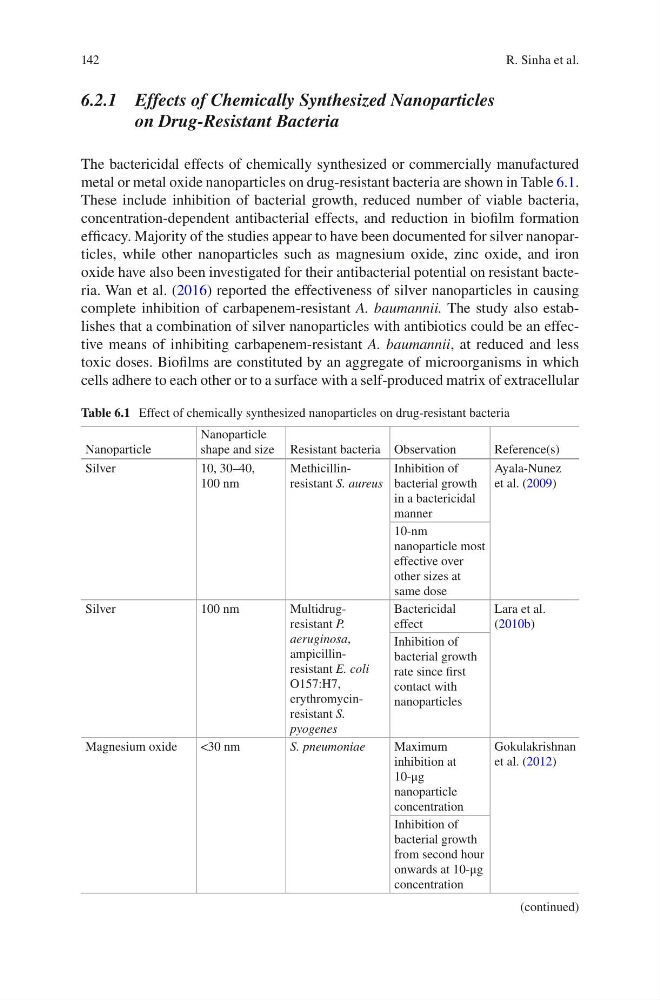
The bactericidal effects of chemically synthesized or commercially manufactured
metal or metal oxide nanoparticles on drug-resistant bacteria are shown in Table 6.1.
These include inhibition of bacterial growth, reduced number of viable bacteria,
concentration-dependent antibacterial effects, and reduction in biofilm formation
efficacy. Majority of the studies appear to have been documented for silver nanoparticles, while other nanoparticles such as magnesium oxide, zinc oxide, and iron
oxide have also been investigated for their antibacterial potential on resistant bacteria. Wan et al. (2016) reported the effectiveness of silver nanoparticles in causing
complete inhibition of carbapenem-resistant A. baumannii. The study also establishes that a combination of silver nanoparticles with antibiotics could be an effective means of inhibiting carbapenem-resistant A. baumannii, at reduced and less
toxic doses. Biofilms are constituted by an aggregate of microorganisms in which
cells adhere to each other or to a surface with a self-produced matrix of extracellular
Table 6.1 Effect of chemically synthesized nanoparticles on drug-resistant bacteria
Nanoparticle
Nanoparticle
shape and size Resistant bacteria Observation
Reference(s)
Silver
10, 30–40,
100 nm
Methicillinresistant S. aureus
Inhibition of
bacterial growth
in a bactericidal
manner
Ayala-Nunez
et al. (2009)
10-nm
nanoparticle most
effective over
other sizes at
same dose
Silver
100 nm
Multidrugresistant P.
aeruginosa,
ampicillinresistant E. coli
O157:H7,
erythromycinresistant S.
pyogenes
Bactericidal
effect
Lara et al.
(2010b)
Inhibition of
bacterial growth
rate since first
contact with
nanoparticles
Magnesium oxide
<30 nm
S. pneumoniae
Maximum
inhibition at
10-μg
nanoparticle
concentration
Gokulakrishnan
et al. (2012)
Inhibition of
bacterial growth
from second hour
onwards at 10-μg
concentration
(continued)
R. Sinha et al.
6.2.1 Effects of Chemically Synthesized Nanoparticles
on Drug-Resistant Bacteria
The bactericidal effects of chemically synthesized or commercially manufactured
metal or metal oxide nanoparticles on drug-resistant bacteria are shown in Table 6.1.
These include inhibition of bacterial growth, reduced number of viable bacteria,
concentration-dependent antibacterial effects, and reduction in biofilm formation
efficacy. Majority of the studies appear to have been documented for silver nanoparticles, while other nanoparticles such as magnesium oxide, zinc oxide, and iron
oxide have also been investigated for their antibacterial potential on resistant bacteria. Wan et al. (2016) reported the effectiveness of silver nanoparticles in causing
complete inhibition of carbapenem-resistant A. baumannii. The study also establishes that a combination of silver nanoparticles with antibiotics could be an effective means of inhibiting carbapenem-resistant A. baumannii, at reduced and less
toxic doses. Biofilms are constituted by an aggregate of microorganisms in which
cells adhere to each other or to a surface with a self-produced matrix of extracellular
Table 6.1 Effect of chemically synthesized nanoparticles on drug-resistant bacteria
Nanoparticle
Nanoparticle
shape and size Resistant bacteria Observation
Reference(s)
Silver
10, 30–40,
100 nm
Methicillinresistant S. aureus
Inhibition of
bacterial growth
in a bactericidal
manner
Ayala-Nunez
et al. (2009)
10-nm
nanoparticle most
effective over
other sizes at
same dose
Silver
100 nm
Multidrugresistant P.
aeruginosa,
ampicillinresistant E. coli
O157:H7,
erythromycinresistant S.
pyogenes
Bactericidal
effect
Lara et al.
(2010b)
Inhibition of
bacterial growth
rate since first
contact with
nanoparticles
Magnesium oxide
<30 nm
S. pneumoniae
Maximum
inhibition at
10-μg
nanoparticle
concentration
Gokulakrishnan
et al. (2012)
Inhibition of
bacterial growth
from second hour
onwards at 10-μg
concentration
(continued)
R. Sinha et al.