

106
strains showed different mechanisms of susceptibility toward different types of
nanoparticles. Ge et al. (2012) reported that nano zinc oxide and titanium oxide
showed dose-dependent toxicity in soil bacterial community. They observed that
Bradyrhizobium, Bradyrhizobiaceae, Rhizobiales, and Methylobacteriaceae taxa
were declined with increasing concentration of zinc oxide and titanium oxide
nanoparticles in the range of 0.05–0.5 ppm, while Sphingomonadaceae,
Streptomycetaceae, and Streptomyces were found abundant after nanomaterial
exposure. They revealed the changes in community structure with a decreasing
number of Bradyrhizobiaceae, Geodermatophilaceae, Methylobacteriaceae,
Micromonosporaceae,
Rhodospirillaceae,
Actinoplanes,
Balneimonas,
Blastococcus, Bradyrhizobium, and Skermanella after exposure of zinc oxide and
titanium oxide nanoparticles and found both nanoparticles also reduced the microbial biomass.
In another study, Fajardo et al. (2012) studied the impact of zero valent iron
(ZVF) nanoparticles in sandy loam clay and found that nanoparticles showed a
mixed effect on microbial community. The abundance of α-proteobacteria and
archaea was increased while β and γ-proteobacteria decreased at 34000 ppm concentration. Similarly, Pawlett et al. (2013) found a change in microbial community
structure after treatment with zero valent Fe nanoparticles in sandy, loam, and clay
soil. They reported negative impact on arbuscular mycorrhizal fungi and Gramnegative bacteria. The effect of Ag nanoparticles on symbiotic microorganism was
studied by Abd-Alla et al. (2016). They reported that at 800 ppm concentration,
silver nanoparticle inhibited the growth of Rhizobium leguminosarum and Glomus
aggregatum in soil. They measured slowdown in nodulation, nitrogenase activity,
colonization of mycorrhizal fungi, and deterioration of intracellular cytoplasmic
component.
Cerium oxide nanoparticles also altered microbial community composition at
0.1 ppm concentration, while zinc oxide altered them at 0.5 ppm. The bacterial
community Rhizobium and Sphingomonas was increased and Ensifer,
Rhodospirillaceae, Clostridium, and Azotobacter were decreased (Ge et al. 2018).
Similarly, Judy et al. (2015) also reported that the presence of silver, zinc oxide, and
titanium oxide nanoparticles reduced the nodulation frequency of symbiotic bacteria Sinorhizobium meliloti in Medicago truncatula and shifted the microbial community composition. Different metal oxides such as cerium oxide, silicon oxide,
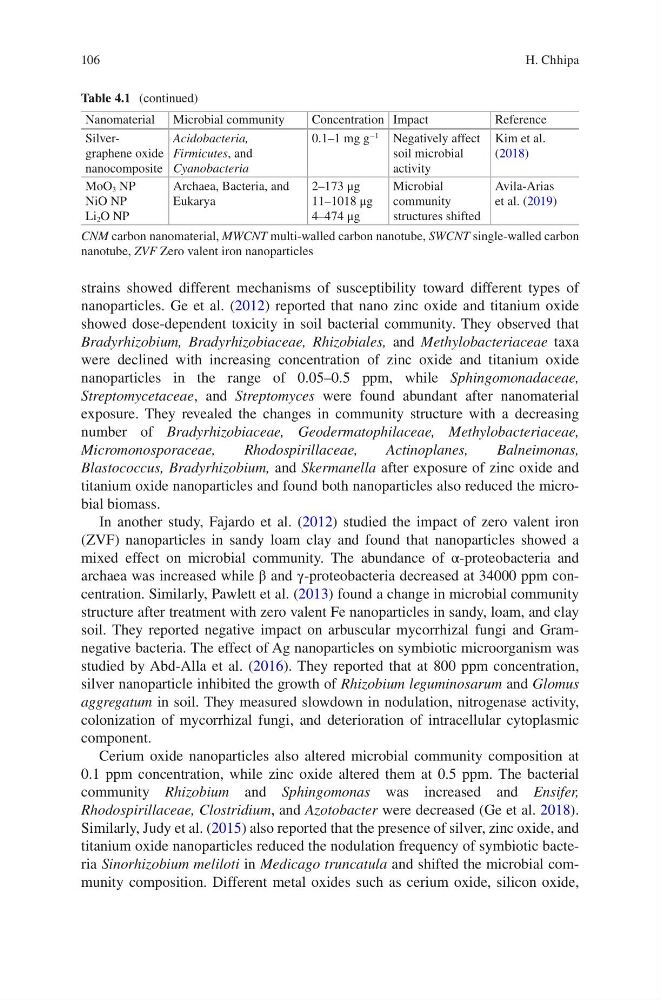
Table 4.1 (continued)
Nanomaterial Microbial community
Concentration Impact
Reference
Silvergraphene oxide
nanocomposite
Acidobacteria,
Firmicutes, and
Cyanobacteria
0.1–1 mg g
−1
Negatively affect
soil microbial
activity
Kim et al.
(2018)
MoO 3 NP
NiO NP
Li 2 O NP
Archaea, Bacteria, and
Eukarya
2–173 μg
11–1018 μg
4–474 μg
Microbial
community
structures shifted
Avila-Arias
et al. (2019)
CNM carbon nanomaterial, MWCNT multi-walled carbon nanotube, SWCNT single-walled carbon
nanotube, ZVF Zero valent iron nanoparticles
H. Chhipa
strains showed different mechanisms of susceptibility toward different types of
nanoparticles. Ge et al. (2012) reported that nano zinc oxide and titanium oxide
showed dose-dependent toxicity in soil bacterial community. They observed that
Bradyrhizobium, Bradyrhizobiaceae, Rhizobiales, and Methylobacteriaceae taxa
were declined with increasing concentration of zinc oxide and titanium oxide
nanoparticles in the range of 0.05–0.5 ppm, while Sphingomonadaceae,
Streptomycetaceae, and Streptomyces were found abundant after nanomaterial
exposure. They revealed the changes in community structure with a decreasing
number of Bradyrhizobiaceae, Geodermatophilaceae, Methylobacteriaceae,
Micromonosporaceae,
Rhodospirillaceae,
Actinoplanes,
Balneimonas,
Blastococcus, Bradyrhizobium, and Skermanella after exposure of zinc oxide and
titanium oxide nanoparticles and found both nanoparticles also reduced the microbial biomass.
In another study, Fajardo et al. (2012) studied the impact of zero valent iron
(ZVF) nanoparticles in sandy loam clay and found that nanoparticles showed a
mixed effect on microbial community. The abundance of α-proteobacteria and
archaea was increased while β and γ-proteobacteria decreased at 34000 ppm concentration. Similarly, Pawlett et al. (2013) found a change in microbial community
structure after treatment with zero valent Fe nanoparticles in sandy, loam, and clay
soil. They reported negative impact on arbuscular mycorrhizal fungi and Gramnegative bacteria. The effect of Ag nanoparticles on symbiotic microorganism was
studied by Abd-Alla et al. (2016). They reported that at 800 ppm concentration,
silver nanoparticle inhibited the growth of Rhizobium leguminosarum and Glomus
aggregatum in soil. They measured slowdown in nodulation, nitrogenase activity,
colonization of mycorrhizal fungi, and deterioration of intracellular cytoplasmic
component.
Cerium oxide nanoparticles also altered microbial community composition at
0.1 ppm concentration, while zinc oxide altered them at 0.5 ppm. The bacterial
community Rhizobium and Sphingomonas was increased and Ensifer,
Rhodospirillaceae, Clostridium, and Azotobacter were decreased (Ge et al. 2018).
Similarly, Judy et al. (2015) also reported that the presence of silver, zinc oxide, and
titanium oxide nanoparticles reduced the nodulation frequency of symbiotic bacteria Sinorhizobium meliloti in Medicago truncatula and shifted the microbial community composition. Different metal oxides such as cerium oxide, silicon oxide,
Table 4.1 (continued)
Nanomaterial Microbial community
Concentration Impact
Reference
Silvergraphene oxide
nanocomposite
Acidobacteria,
Firmicutes, and
Cyanobacteria
0.1–1 mg g
−1
Negatively affect
soil microbial
activity
Kim et al.
(2018)
MoO 3 NP
NiO NP
Li 2 O NP
Archaea, Bacteria, and
Eukarya
2–173 μg
11–1018 μg
4–474 μg
Microbial
community
structures shifted
Avila-Arias
et al. (2019)
CNM carbon nanomaterial, MWCNT multi-walled carbon nanotube, SWCNT single-walled carbon
nanotube, ZVF Zero valent iron nanoparticles
H. Chhipa