

105
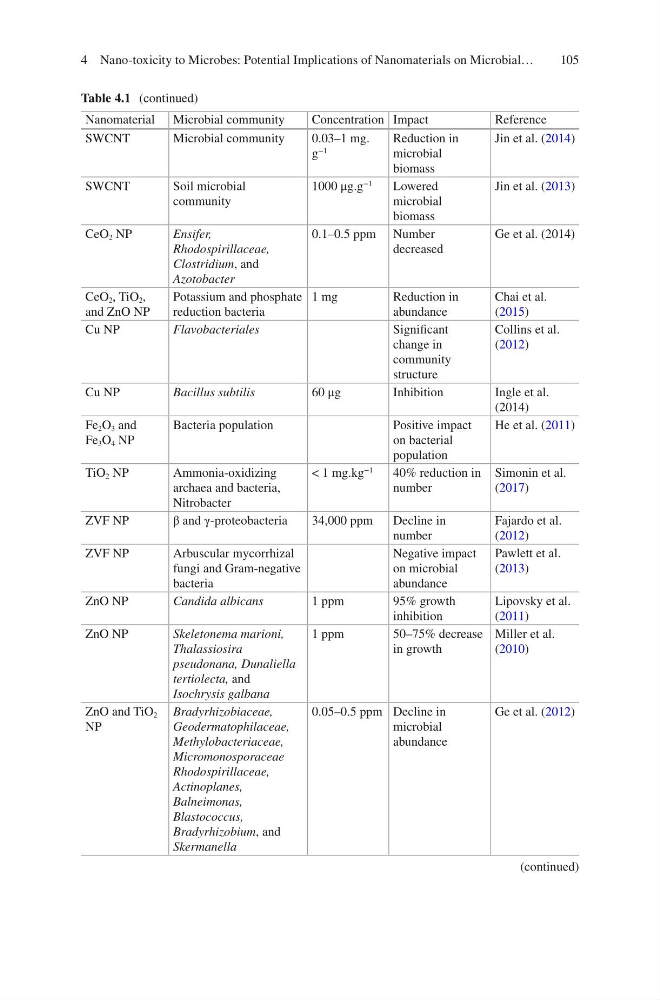
Table 4.1 (continued)
Nanomaterial Microbial community
Concentration Impact
Reference
SWCNT
Microbial community
0.03–1 mg.
g
−1
Reduction in
microbial
biomass
Jin et al. (2014)
SWCNT
Soil microbial
community
1000 μg.g
−1
Lowered
microbial
biomass
Jin et al. (2013)
CeO 2 NP
Ensifer,
Rhodospirillaceae,
Clostridium, and
Azotobacter
0.1–0.5 ppm Number
decreased
Ge et al. (2014)
CeO 2 , TiO 2 ,
and ZnO NP
Potassium and phosphate
reduction bacteria
1 mg
Reduction in
abundance
Chai et al.
(2015)
Cu NP
Flavobacteriales
Significant
change in
community
structure
Collins et al.
(2012)
Cu NP
Bacillus subtilis
60 μg
Inhibition
Ingle et al.
(2014)
Fe 2 O 3 and
Fe 3 O 4 NP
Bacteria population
Positive impact
on bacterial
population
He et al. (2011)
TiO 2 NP
Ammonia-oxidizing
archaea and bacteria,
Nitrobacter
< 1 mg.kg
−1
40% reduction in
number
Simonin et al.
(2017)
ZVF NP
β and γ-proteobacteria
34,000 ppm
Decline in
number
Fajardo et al.
(2012)
ZVF NP
Arbuscular mycorrhizal
fungi and Gram-negative
bacteria
Negative impact
on microbial
abundance
Pawlett et al.
(2013)
ZnO NP
Candida albicans
1 ppm
95% growth
inhibition
Lipovsky et al.
(2011)
ZnO NP
Skeletonema marioni,
Thalassiosira
pseudonana, Dunaliella
tertiolecta, and
Isochrysis galbana
1 ppm
50–75% decrease
in growth
Miller et al.
(2010)
ZnO and TiO 2
NP
Bradyrhizobiaceae,
Geodermatophilaceae,
Methylobacteriaceae,
Micromonosporaceae
Rhodospirillaceae,
Actinoplanes,
Balneimonas,
Blastococcus,
Bradyrhizobium, and
Skermanella
0.05–0.5 ppm Decline in
microbial
abundance
Ge et al. (2012)
(continued)
4 Nano-toxicity to Microbes: Potential Implications of Nanomaterials on Microbial…
Table 4.1 (continued)
Nanomaterial Microbial community
Concentration Impact
Reference
SWCNT
Microbial community
0.03–1 mg.
g
−1
Reduction in
microbial
biomass
Jin et al. (2014)
SWCNT
Soil microbial
community
1000 μg.g
−1
Lowered
microbial
biomass
Jin et al. (2013)
CeO 2 NP
Ensifer,
Rhodospirillaceae,
Clostridium, and
Azotobacter
0.1–0.5 ppm Number
decreased
Ge et al. (2014)
CeO 2 , TiO 2 ,
and ZnO NP
Potassium and phosphate
reduction bacteria
1 mg
Reduction in
abundance
Chai et al.
(2015)
Cu NP
Flavobacteriales
Significant
change in
community
structure
Collins et al.
(2012)
Cu NP
Bacillus subtilis
60 μg
Inhibition
Ingle et al.
(2014)
Fe 2 O 3 and
Fe 3 O 4 NP
Bacteria population
Positive impact
on bacterial
population
He et al. (2011)
TiO 2 NP
Ammonia-oxidizing
archaea and bacteria,
Nitrobacter
< 1 mg.kg
−1
40% reduction in
number
Simonin et al.
(2017)
ZVF NP
β and γ-proteobacteria
34,000 ppm
Decline in
number
Fajardo et al.
(2012)
ZVF NP
Arbuscular mycorrhizal
fungi and Gram-negative
bacteria
Negative impact
on microbial
abundance
Pawlett et al.
(2013)
ZnO NP
Candida albicans
1 ppm
95% growth
inhibition
Lipovsky et al.
(2011)
ZnO NP
Skeletonema marioni,
Thalassiosira
pseudonana, Dunaliella
tertiolecta, and
Isochrysis galbana
1 ppm
50–75% decrease
in growth
Miller et al.
(2010)
ZnO and TiO 2
NP
Bradyrhizobiaceae,
Geodermatophilaceae,
Methylobacteriaceae,
Micromonosporaceae
Rhodospirillaceae,
Actinoplanes,
Balneimonas,
Blastococcus,
Bradyrhizobium, and
Skermanella
0.05–0.5 ppm Decline in
microbial
abundance
Ge et al. (2012)
(continued)
4 Nano-toxicity to Microbes: Potential Implications of Nanomaterials on Microbial…