

84
V. L. Kotov et al.
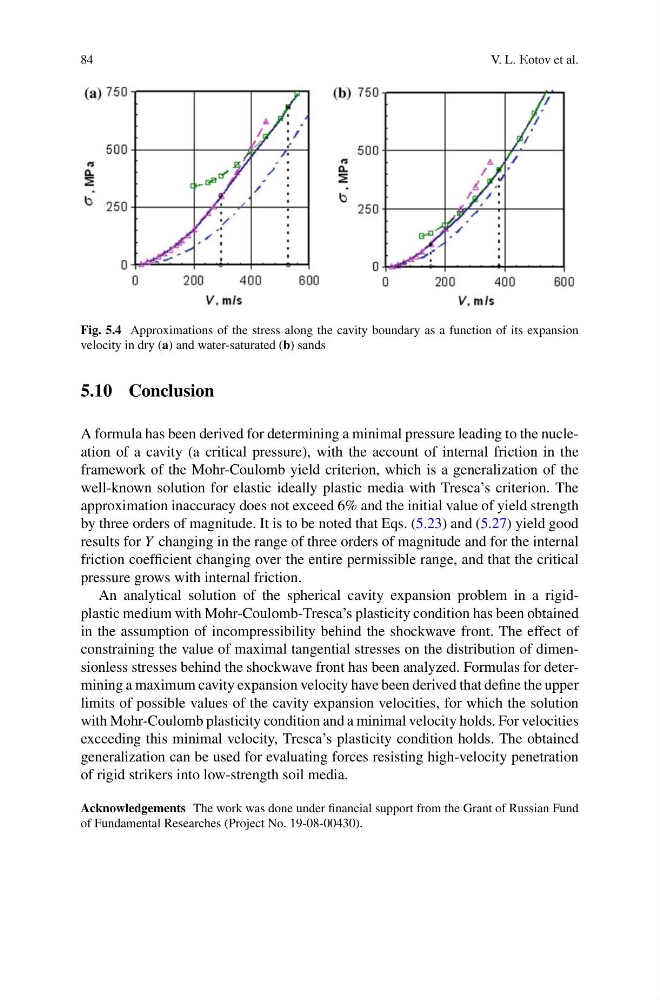
Fig. 5.4 Approximations of the stress along the cavity boundary as a function of its expansion
velocity in dry (a) and water-saturated (b) sands
5.10 Conclusion
A formula has been derived for determining a minimal pressure leading to the nucleation of a cavity (a critical pressure), with the account of internal friction in the
framework of the Mohr-Coulomb yield criterion, which is a generalization of the
well-known solution for elastic ideally plastic media with Tresca’s criterion. The
approximation inaccuracy does not exceed 6% and the initial value of yield strength
by three orders of magnitude. It is to be noted that Eqs. (5.23) and (5.27) yield good
results for Y changing in the range of three orders of magnitude and for the internal
friction coefficient changing over the entire permissible range, and that the critical
pressure grows with internal friction.
An analytical solution of the spherical cavity expansion problem in a rigidplastic medium with Mohr-Coulomb-Tresca’s plasticity condition has been obtained
in the assumption of incompressibility behind the shockwave front. The effect of
constraining the value of maximal tangential stresses on the distribution of dimensionless stresses behind the shockwave front has been analyzed. Formulas for determining a maximum cavity expansion velocity have been derived that define the upper
limits of possible values of the cavity expansion velocities, for which the solution
with Mohr-Coulomb plasticity condition and a minimal velocity holds. For velocities
exceeding this minimal velocity, Tresca’s plasticity condition holds. The obtained
generalization can be used for evaluating forces resisting high-velocity penetration
of rigid strikers into low-strength soil media.
Acknowledgements The work was done under financial support from the Grant of Russian Fund
of Fundamental Researches (Project No. 19-08-00430).
V. L. Kotov et al.
Fig. 5.4 Approximations of the stress along the cavity boundary as a function of its expansion
velocity in dry (a) and water-saturated (b) sands
5.10 Conclusion
A formula has been derived for determining a minimal pressure leading to the nucleation of a cavity (a critical pressure), with the account of internal friction in the
framework of the Mohr-Coulomb yield criterion, which is a generalization of the
well-known solution for elastic ideally plastic media with Tresca’s criterion. The
approximation inaccuracy does not exceed 6% and the initial value of yield strength
by three orders of magnitude. It is to be noted that Eqs. (5.23) and (5.27) yield good
results for Y changing in the range of three orders of magnitude and for the internal
friction coefficient changing over the entire permissible range, and that the critical
pressure grows with internal friction.
An analytical solution of the spherical cavity expansion problem in a rigidplastic medium with Mohr-Coulomb-Tresca’s plasticity condition has been obtained
in the assumption of incompressibility behind the shockwave front. The effect of
constraining the value of maximal tangential stresses on the distribution of dimensionless stresses behind the shockwave front has been analyzed. Formulas for determining a maximum cavity expansion velocity have been derived that define the upper
limits of possible values of the cavity expansion velocities, for which the solution
with Mohr-Coulomb plasticity condition and a minimal velocity holds. For velocities
exceeding this minimal velocity, Tresca’s plasticity condition holds. The obtained
generalization can be used for evaluating forces resisting high-velocity penetration
of rigid strikers into low-strength soil media.
Acknowledgements The work was done under financial support from the Grant of Russian Fund
of Fundamental Researches (Project No. 19-08-00430).