

5 Analyzing the Problem of a Spherical Cavity Expansion …
83
Finally, dimensional stress along the cavity boundary σ C ≡ S(ξ = ε)ρ s c
2
σ r (V ) =
⎧
⎪ ⎪ ⎪ ⎪ ⎪ ⎪ ⎨
⎪ ⎪ ⎪ ⎪ ⎪ ⎪ ⎩
τ 0
μ
ε
−2μ
− 1
+
ρ 0 V
2
1−ε 3
3
(μ−2)(2μ−1)
+
+
2μ+1
2μ−1
· ε
1−2μ
−
μ−1
μ−2
· ε
4−2μ
, 0 < V < V,
σ M + τ M ln
ξ M
ε
2 +
ρ 0 V
2
1−ε 3
3
2
−
2ε
ξ M
+
ε
4
2ξ
4
M
, V 0 ≤ V ≤ V M ,
−2τ M ln ε +
ρ 0 V
2
1−ε 3
3
2
− ε −
ε
4
2
, V > V M .
(5.46)
In Eq. (5.46), the value of ε is determined based on Eq. (5.36). Thus, closed forms
of relations have been obtained, that make it possible to determine stress in a medium
with the Mohr-Coulomb plasticity condition and Tresca’s condition.
5.9 Comparative Analysis of the Results of Analyzing
the Cavity Problem in Media with Tresca’s,
Mohr-Coulomb, and Mohr-Coulomb-Tresca’s
Plasticity Conditions
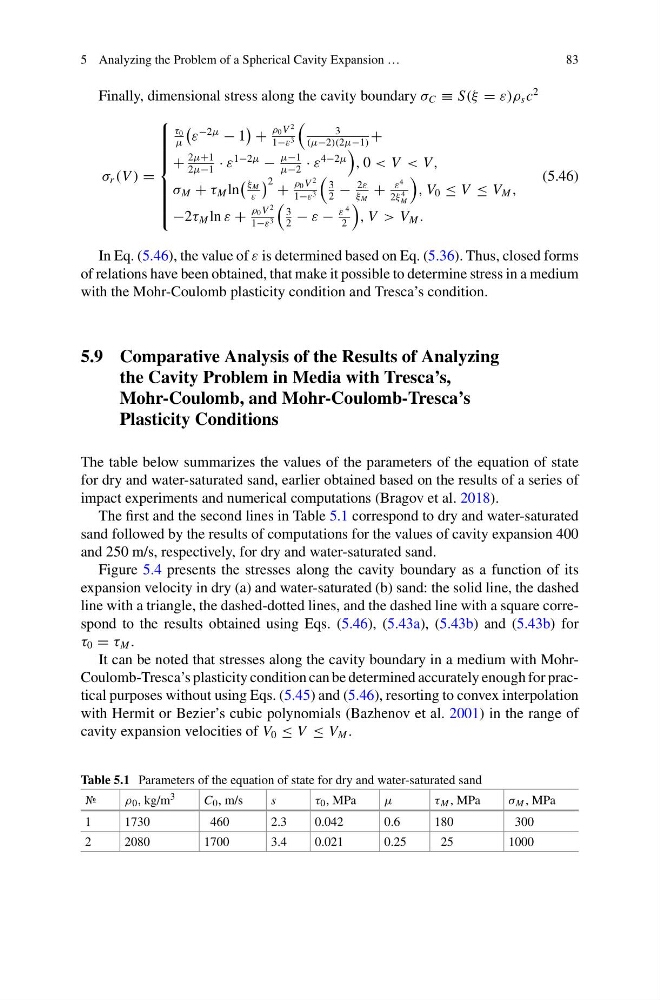
The table below summarizes the values of the parameters of the equation of state
for dry and water-saturated sand, earlier obtained based on the results of a series of
impact experiments and numerical computations (Bragov et al. 2018).
The first and the second lines in Table 5.1 correspond to dry and water-saturated
sand followed by the results of computations for the values of cavity expansion 400
and 250 m/s, respectively, for dry and water-saturated sand.
Figure 5.4 presents the stresses along the cavity boundary as a function of its
expansion velocity in dry (a) and water-saturated (b) sand: the solid line, the dashed
line with a triangle, the dashed-dotted lines, and the dashed line with a square correspond to the results obtained using Eqs. (5.46), (5.43a), (5.43b) and (5.43b) for
τ 0 = τ M .
It can be noted that stresses along the cavity boundary in a medium with MohrCoulomb-Tresca’s plasticity condition can be determined accurately enough for practical purposes without using Eqs. (5.45) and (5.46), resorting to convex interpolation
with Hermit or Bezier’s cubic polynomials (Bazhenov et al. 2001) in the range of
cavity expansion velocities of V 0 ≤ V ≤ V M .
Table 5.1 Parameters of the equation of state for dry and water-saturated sand
№
ρ 0 , kg/m 3
C 0 , m/s
s
τ 0 , MPa
μ
τ M , MPa
σ M , MPa
1
1730
460
2.3
0.042
0.6
180
300
2
2080
1700
3.4
0.021
0.25
25
1000
83
Finally, dimensional stress along the cavity boundary σ C ≡ S(ξ = ε)ρ s c
2
σ r (V ) =
⎧
⎪ ⎪ ⎪ ⎪ ⎪ ⎪ ⎨
⎪ ⎪ ⎪ ⎪ ⎪ ⎪ ⎩
τ 0
μ
ε
−2μ
− 1
+
ρ 0 V
2
1−ε 3
3
(μ−2)(2μ−1)
+
+
2μ+1
2μ−1
· ε
1−2μ
−
μ−1
μ−2
· ε
4−2μ
, 0 < V < V,
σ M + τ M ln
ξ M
ε
2 +
ρ 0 V
2
1−ε 3
3
2
−
2ε
ξ M
+
ε
4
2ξ
4
M
, V 0 ≤ V ≤ V M ,
−2τ M ln ε +
ρ 0 V
2
1−ε 3
3
2
− ε −
ε
4
2
, V > V M .
(5.46)
In Eq. (5.46), the value of ε is determined based on Eq. (5.36). Thus, closed forms
of relations have been obtained, that make it possible to determine stress in a medium
with the Mohr-Coulomb plasticity condition and Tresca’s condition.
5.9 Comparative Analysis of the Results of Analyzing
the Cavity Problem in Media with Tresca’s,
Mohr-Coulomb, and Mohr-Coulomb-Tresca’s
Plasticity Conditions
The table below summarizes the values of the parameters of the equation of state
for dry and water-saturated sand, earlier obtained based on the results of a series of
impact experiments and numerical computations (Bragov et al. 2018).
The first and the second lines in Table 5.1 correspond to dry and water-saturated
sand followed by the results of computations for the values of cavity expansion 400
and 250 m/s, respectively, for dry and water-saturated sand.
Figure 5.4 presents the stresses along the cavity boundary as a function of its
expansion velocity in dry (a) and water-saturated (b) sand: the solid line, the dashed
line with a triangle, the dashed-dotted lines, and the dashed line with a square correspond to the results obtained using Eqs. (5.46), (5.43a), (5.43b) and (5.43b) for
τ 0 = τ M .
It can be noted that stresses along the cavity boundary in a medium with MohrCoulomb-Tresca’s plasticity condition can be determined accurately enough for practical purposes without using Eqs. (5.45) and (5.46), resorting to convex interpolation
with Hermit or Bezier’s cubic polynomials (Bazhenov et al. 2001) in the range of
cavity expansion velocities of V 0 ≤ V ≤ V M .
Table 5.1 Parameters of the equation of state for dry and water-saturated sand
№
ρ 0 , kg/m 3
C 0 , m/s
s
τ 0 , MPa
μ
τ M , MPa
σ M , MPa
1
1730
460
2.3
0.042
0.6
180
300
2
2080
1700
3.4
0.021
0.25
25
1000