

5 Analyzing the Problem of a Spherical Cavity Expansion …
77
the internal friction coefficient, for the values of initial yield strength Y = 50, 5 and
0.5 kgs/cm
2 (the solid lines with a square, a rhomb, and a triangle, respectively).
It can be noted that, at cavity expansion velocities close to 0, the value of ε = V /c
depends on the initial value of yield strength. At the same time, a fairly weak (not more
than 10%) change of ε with changing μ is observed in the range of 0 ≤ μ ≤ 0.75
for all the values of yield strength considered.
Considering that the value of ε weakly depends on the change of the internal
friction coefficient, it is proposed to use Eqs. (5.21) and (5.24) to approximately
determine ε, assuming that
ε
−3
=
E
3(1 − ν)Y
, ε =
3
3(1 − ν)Y
E
,
(5.27)
Thus, Eq. (5.23) and (5.27) will be a generalization of the known Eq. (5.21) for
the case of the Mohr-Coulomb plasticity condition.
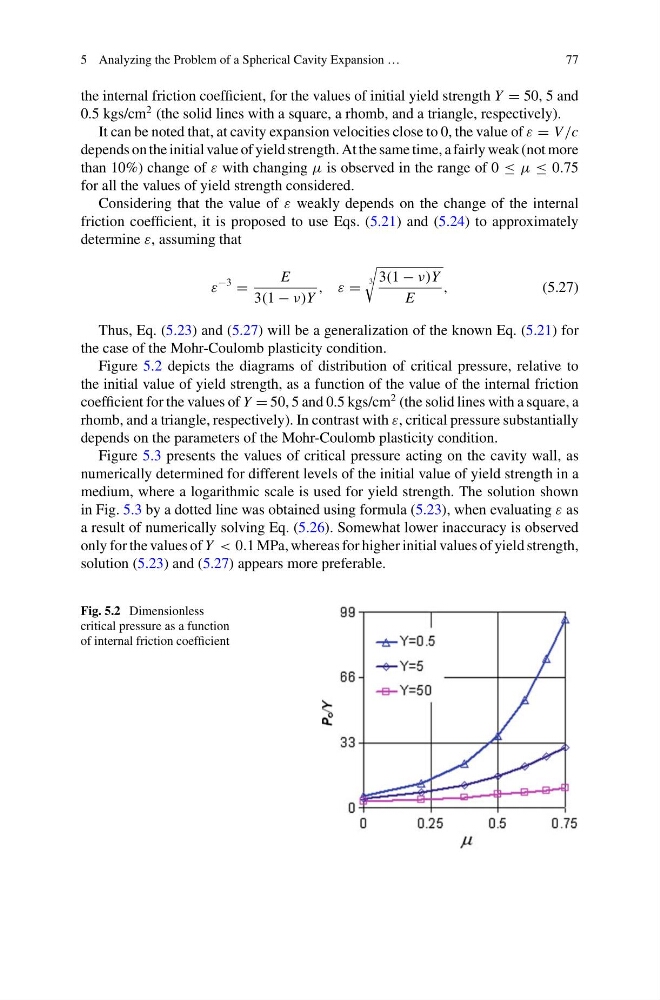
Figure 5.2 depicts the diagrams of distribution of critical pressure, relative to
the initial value of yield strength, as a function of the value of the internal friction
coefficient for the values of Y = 50, 5 and 0.5 kgs/cm
2 (the solid lines with a square, a
rhomb, and a triangle, respectively). In contrast with ε, critical pressure substantially
depends on the parameters of the Mohr-Coulomb plasticity condition.
Figure 5.3 presents the values of critical pressure acting on the cavity wall, as
numerically determined for different levels of the initial value of yield strength in a
medium, where a logarithmic scale is used for yield strength. The solution shown
in Fig. 5.3 by a dotted line was obtained using formula (5.23), when evaluating ε as
a result of numerically solving Eq. (5.26). Somewhat lower inaccuracy is observed
only for the values of Y < 0.1 MPa, whereas for higher initial values of yield strength,
solution (5.23) and (5.27) appears more preferable.
Fig. 5.2 Dimensionless
critical pressure as a function
of internal friction coefficient
77
the internal friction coefficient, for the values of initial yield strength Y = 50, 5 and
0.5 kgs/cm
2 (the solid lines with a square, a rhomb, and a triangle, respectively).
It can be noted that, at cavity expansion velocities close to 0, the value of ε = V /c
depends on the initial value of yield strength. At the same time, a fairly weak (not more
than 10%) change of ε with changing μ is observed in the range of 0 ≤ μ ≤ 0.75
for all the values of yield strength considered.
Considering that the value of ε weakly depends on the change of the internal
friction coefficient, it is proposed to use Eqs. (5.21) and (5.24) to approximately
determine ε, assuming that
ε
−3
=
E
3(1 − ν)Y
, ε =
3
3(1 − ν)Y
E
,
(5.27)
Thus, Eq. (5.23) and (5.27) will be a generalization of the known Eq. (5.21) for
the case of the Mohr-Coulomb plasticity condition.
Figure 5.2 depicts the diagrams of distribution of critical pressure, relative to
the initial value of yield strength, as a function of the value of the internal friction
coefficient for the values of Y = 50, 5 and 0.5 kgs/cm
2 (the solid lines with a square, a
rhomb, and a triangle, respectively). In contrast with ε, critical pressure substantially
depends on the parameters of the Mohr-Coulomb plasticity condition.
Figure 5.3 presents the values of critical pressure acting on the cavity wall, as
numerically determined for different levels of the initial value of yield strength in a
medium, where a logarithmic scale is used for yield strength. The solution shown
in Fig. 5.3 by a dotted line was obtained using formula (5.23), when evaluating ε as
a result of numerically solving Eq. (5.26). Somewhat lower inaccuracy is observed
only for the values of Y < 0.1 MPa, whereas for higher initial values of yield strength,
solution (5.23) and (5.27) appears more preferable.
Fig. 5.2 Dimensionless
critical pressure as a function
of internal friction coefficient