

76
V. L. Kotov et al.
To determine the value of ε, it is necessary to use the condition for ξ = ε in
equation set (5.8) U (ξ = ε) = ε:
Y
18
(12G + 9K + 8Gμ)
K G
−
2Y
9
(3 + 2μ)
K
ε
3−2μ
= ε
3
.
(5.26)
Nonlinear equation (5.26) is solved numerically by iterations.
In a special case of μ = 0:
Y
18
(12G + 9K )
K G
−
2Y
3K
ε
3
= ε
3
,
The solution of Eq. (5.26) can be written in the following closed form
ε
3
=
(4G + 3K )Y
6K G
1 +
2Y
3K
=
3(1 − ν)Y
E
1 +
2Y
3K
≈
3(1 − ν)Y
E
,
using the relations for the elastic constants:
Young’s modulus E =
9K G
3K +G
,
Poisson’s coefficient ν =
3K −2G
6K +2G
, 1 − ν =
3K +4G
6K +2G
.
This solution coincides with the earlier obtained solution (5.21) taking account
of Eq. (5.24).
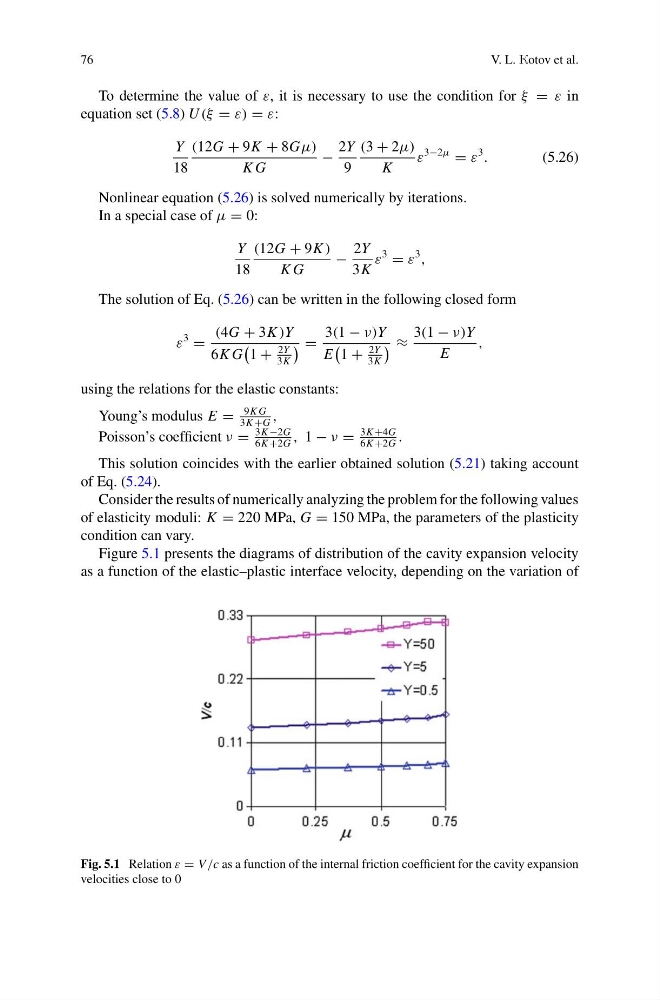
Consider the results of numerically analyzing the problem for the following values
of elasticity moduli: K = 220 MPa, G = 150 MPa, the parameters of the plasticity
condition can vary.
Figure 5.1 presents the diagrams of distribution of the cavity expansion velocity
as a function of the elastic–plastic interface velocity, depending on the variation of
Fig. 5.1 Relation ε = V /c as a function of the internal friction coefficient for the cavity expansion
velocities close to 0
V. L. Kotov et al.
To determine the value of ε, it is necessary to use the condition for ξ = ε in
equation set (5.8) U (ξ = ε) = ε:
Y
18
(12G + 9K + 8Gμ)
K G
−
2Y
9
(3 + 2μ)
K
ε
3−2μ
= ε
3
.
(5.26)
Nonlinear equation (5.26) is solved numerically by iterations.
In a special case of μ = 0:
Y
18
(12G + 9K )
K G
−
2Y
3K
ε
3
= ε
3
,
The solution of Eq. (5.26) can be written in the following closed form
ε
3
=
(4G + 3K )Y
6K G
1 +
2Y
3K
=
3(1 − ν)Y
E
1 +
2Y
3K
≈
3(1 − ν)Y
E
,
using the relations for the elastic constants:
Young’s modulus E =
9K G
3K +G
,
Poisson’s coefficient ν =
3K −2G
6K +2G
, 1 − ν =
3K +4G
6K +2G
.
This solution coincides with the earlier obtained solution (5.21) taking account
of Eq. (5.24).
Consider the results of numerically analyzing the problem for the following values
of elasticity moduli: K = 220 MPa, G = 150 MPa, the parameters of the plasticity
condition can vary.
Figure 5.1 presents the diagrams of distribution of the cavity expansion velocity
as a function of the elastic–plastic interface velocity, depending on the variation of
Fig. 5.1 Relation ε = V /c as a function of the internal friction coefficient for the cavity expansion
velocities close to 0