

4 Finite Element Method Study of the Protection …
61
4.3 Results of Computational Experiments
The axisymmetric problem of stability loss and supercritical behavior of a spherical
shell under compression loading between two non-deformable plates approaching
with a constant velocity of 1 m/s is considered. The shell is made of titanium alloy
(elastic modulus E = 120 GPa, Poisson’s ratio μ = 0.25, density ρ = 4.5 g/sm
3 ,
yield limit σ T = 0.64 GPa, strain hardening modulus g = 0.6 GPa).
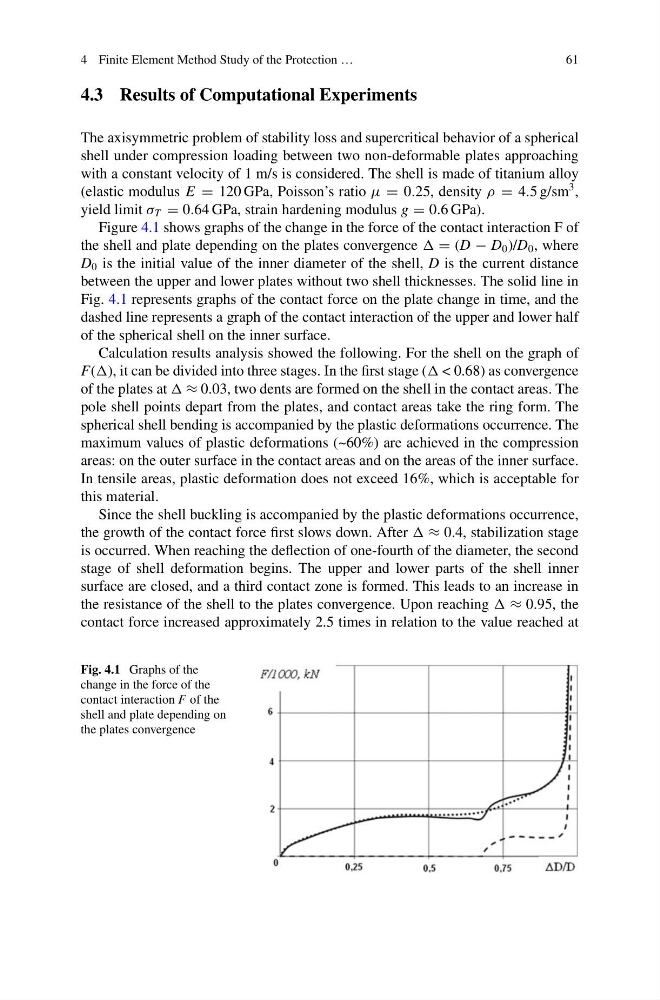
Figure 4.1 shows graphs of the change in the force of the contact interaction F of
the shell and plate depending on the plates convergence = (D − D 0 )/D 0 , where
D 0 is the initial value of the inner diameter of the shell, D is the current distance
between the upper and lower plates without two shell thicknesses. The solid line in
Fig. 4.1 represents graphs of the contact force on the plate change in time, and the
dashed line represents a graph of the contact interaction of the upper and lower half
of the spherical shell on the inner surface.
Calculation results analysis showed the following. For the shell on the graph of
F(), it can be divided into three stages. In the first stage ( < 0.68) as convergence
of the plates at ≈ 0.03, two dents are formed on the shell in the contact areas. The
pole shell points depart from the plates, and contact areas take the ring form. The
spherical shell bending is accompanied by the plastic deformations occurrence. The
maximum values of plastic deformations (~60%) are achieved in the compression
areas: on the outer surface in the contact areas and on the areas of the inner surface.
In tensile areas, plastic deformation does not exceed 16%, which is acceptable for
this material.
Since the shell buckling is accompanied by the plastic deformations occurrence,
the growth of the contact force first slows down. After ≈ 0.4, stabilization stage
is occurred. When reaching the deflection of one-fourth of the diameter, the second
stage of shell deformation begins. The upper and lower parts of the shell inner
surface are closed, and a third contact zone is formed. This leads to an increase in
the resistance of the shell to the plates convergence. Upon reaching ≈ 0.95, the
contact force increased approximately 2.5 times in relation to the value reached at
Fig. 4.1 Graphs of the
change in the force of the
contact interaction F of the
shell and plate depending on
the plates convergence
61
4.3 Results of Computational Experiments
The axisymmetric problem of stability loss and supercritical behavior of a spherical
shell under compression loading between two non-deformable plates approaching
with a constant velocity of 1 m/s is considered. The shell is made of titanium alloy
(elastic modulus E = 120 GPa, Poisson’s ratio μ = 0.25, density ρ = 4.5 g/sm
3 ,
yield limit σ T = 0.64 GPa, strain hardening modulus g = 0.6 GPa).
Figure 4.1 shows graphs of the change in the force of the contact interaction F of
the shell and plate depending on the plates convergence = (D − D 0 )/D 0 , where
D 0 is the initial value of the inner diameter of the shell, D is the current distance
between the upper and lower plates without two shell thicknesses. The solid line in
Fig. 4.1 represents graphs of the contact force on the plate change in time, and the
dashed line represents a graph of the contact interaction of the upper and lower half
of the spherical shell on the inner surface.
Calculation results analysis showed the following. For the shell on the graph of
F(), it can be divided into three stages. In the first stage ( < 0.68) as convergence
of the plates at ≈ 0.03, two dents are formed on the shell in the contact areas. The
pole shell points depart from the plates, and contact areas take the ring form. The
spherical shell bending is accompanied by the plastic deformations occurrence. The
maximum values of plastic deformations (~60%) are achieved in the compression
areas: on the outer surface in the contact areas and on the areas of the inner surface.
In tensile areas, plastic deformation does not exceed 16%, which is acceptable for
this material.
Since the shell buckling is accompanied by the plastic deformations occurrence,
the growth of the contact force first slows down. After ≈ 0.4, stabilization stage
is occurred. When reaching the deflection of one-fourth of the diameter, the second
stage of shell deformation begins. The upper and lower parts of the shell inner
surface are closed, and a third contact zone is formed. This leads to an increase in
the resistance of the shell to the plates convergence. Upon reaching ≈ 0.95, the
contact force increased approximately 2.5 times in relation to the value reached at
Fig. 4.1 Graphs of the
change in the force of the
contact interaction F of the
shell and plate depending on
the plates convergence