

48
D. Dudin and I. Keller
dc A
dt
+ c A ∇
· v = −∇
· j A ,
dc B
dt
+ c B ∇
· v = −∇
· j B ,
(3.24)
∇
· σ = 0.
(3.25)
The system of Eqs. (3.19)–(3.25) is a nonlinear formulation of the coupled
problem of diffusion and rheology, which takes into account the elastic properties.
3.3 Analysis of Relaxation of Spatial Perturbations
3.3.1 Model Problem
To carry out a qualitative analysis of the relaxation of perturbations described by the
equations given above, we consider a model problem (Stephenson 1988; Brassart
et al. 2018), in which the following hypotheses are accepted:
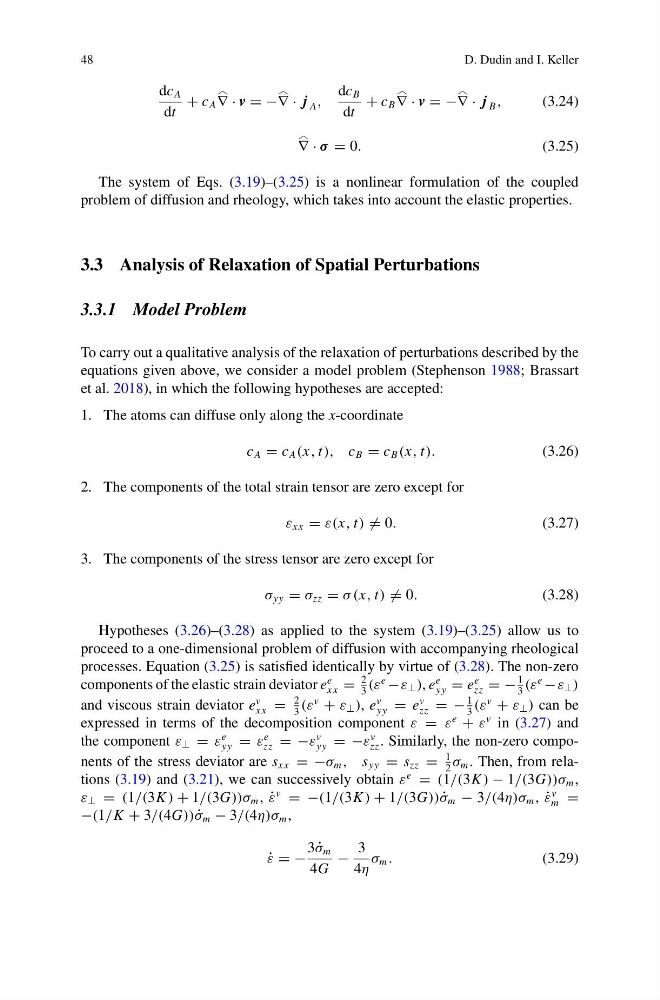
1. The atoms can diffuse only along the x-coordinate
c A = c A (x, t), c B = c B (x, t).
(3.26)
2. The components of the total strain tensor are zero except for
ε xx = ε(x, t) = 0.
(3.27)
3. The components of the stress tensor are zero except for
σ yy = σ zz = σ (x, t) = 0.
(3.28)
Hypotheses (3.26)–(3.28) as applied to the system (3.19)–(3.25) allow us to
proceed to a one-dimensional problem of diffusion with accompanying rheological
processes. Equation (3.25) is satisfied identically by virtue of (3.28). The non-zero
components of the elastic strain deviator e
e
xx =
2
3
(ε
e
−ε ⊥ ), e
e
yy = e
e
zz = −
1
3
(ε
e
−ε ⊥ )
and viscous strain deviator e
v
xx =
2
3
(ε
v
+ ε ⊥ ), e
v
yy = e
v
zz = −
1
3
(ε
v
+ ε ⊥ ) can be
expressed in terms of the decomposition component ε = ε
e
+ ε
v in (3.27) and
the component ε ⊥ = ε
e
yy = ε
e
zz = −ε
v
yy = −ε
v
zz . Similarly, the non-zero components of the stress deviator are s xx = −σ m , s yy = s zz =
1
2
σ m . Then, from relations (3.19) and (3.21), we can successively obtain ε
e
= (1/(3K ) − 1/(3G))σ m ,
ε ⊥ = (1/(3K ) + 1/(3G))σ m , ˙
ε
v
= −(1/(3K ) + 1/(3G)) ˙
σ m − 3/(4η)σ m , ˙
ε
v
m =
−(1/K + 3/(4G)) ˙
σ m − 3/(4η)σ m ,
˙
ε = −
3 ˙
σ m
4G
−
3
4η
σ m .
(3.29)
D. Dudin and I. Keller
dc A
dt
+ c A ∇
· v = −∇
· j A ,
dc B
dt
+ c B ∇
· v = −∇
· j B ,
(3.24)
∇
· σ = 0.
(3.25)
The system of Eqs. (3.19)–(3.25) is a nonlinear formulation of the coupled
problem of diffusion and rheology, which takes into account the elastic properties.
3.3 Analysis of Relaxation of Spatial Perturbations
3.3.1 Model Problem
To carry out a qualitative analysis of the relaxation of perturbations described by the
equations given above, we consider a model problem (Stephenson 1988; Brassart
et al. 2018), in which the following hypotheses are accepted:
1. The atoms can diffuse only along the x-coordinate
c A = c A (x, t), c B = c B (x, t).
(3.26)
2. The components of the total strain tensor are zero except for
ε xx = ε(x, t) = 0.
(3.27)
3. The components of the stress tensor are zero except for
σ yy = σ zz = σ (x, t) = 0.
(3.28)
Hypotheses (3.26)–(3.28) as applied to the system (3.19)–(3.25) allow us to
proceed to a one-dimensional problem of diffusion with accompanying rheological
processes. Equation (3.25) is satisfied identically by virtue of (3.28). The non-zero
components of the elastic strain deviator e
e
xx =
2
3
(ε
e
−ε ⊥ ), e
e
yy = e
e
zz = −
1
3
(ε
e
−ε ⊥ )
and viscous strain deviator e
v
xx =
2
3
(ε
v
+ ε ⊥ ), e
v
yy = e
v
zz = −
1
3
(ε
v
+ ε ⊥ ) can be
expressed in terms of the decomposition component ε = ε
e
+ ε
v in (3.27) and
the component ε ⊥ = ε
e
yy = ε
e
zz = −ε
v
yy = −ε
v
zz . Similarly, the non-zero components of the stress deviator are s xx = −σ m , s yy = s zz =
1
2
σ m . Then, from relations (3.19) and (3.21), we can successively obtain ε
e
= (1/(3K ) − 1/(3G))σ m ,
ε ⊥ = (1/(3K ) + 1/(3G))σ m , ˙
ε
v
= −(1/(3K ) + 1/(3G)) ˙
σ m − 3/(4η)σ m , ˙
ε
v
m =
−(1/K + 3/(4G)) ˙
σ m − 3/(4η)σ m ,
˙
ε = −
3 ˙
σ m
4G
−
3
4η
σ m .
(3.29)