

3 On the Spectrum of Relaxation Times in Coupled Diffusion …
47
The dependence of the elastic shear moduli G and bulk compression moduli K
on the component concentrations is neglected here.
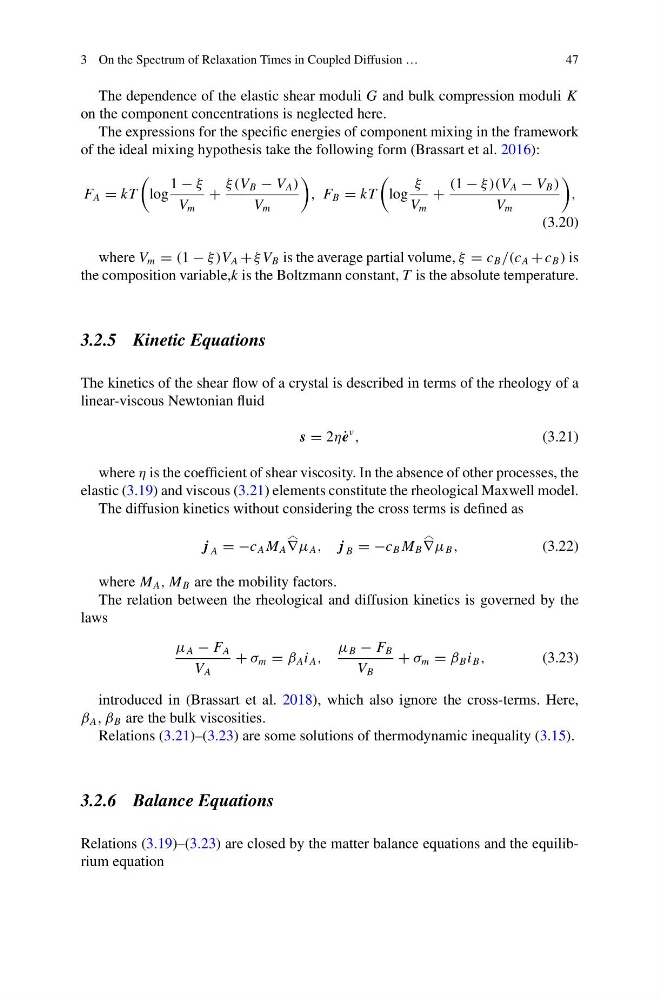
The expressions for the specific energies of component mixing in the framework
of the ideal mixing hypothesis take the following form (Brassart et al. 2016):
F A = kT
log
1 − ξ
V m
+
ξ (V B − V A )
V m
, F B = kT
log
ξ
V m
+
(1 − ξ)(V A − V B )
V m
,
(3.20)
where V m = (1 − ξ )V A + ξ V B is the average partial volume, ξ = c B /(c A + c B ) is
the composition variable,k is the Boltzmann constant, T is the absolute temperature.
3.2.5 Kinetic Equations
The kinetics of the shear flow of a crystal is described in terms of the rheology of a
linear-viscous Newtonian fluid
s = 2η˙ e
v
,
(3.21)
where η is the coefficient of shear viscosity. In the absence of other processes, the
elastic (3.19) and viscous (3.21) elements constitute the rheological Maxwell model.
The diffusion kinetics without considering the cross terms is defined as
j A = −c A M A ∇
μ A , j B = −c B M B ∇
μ B ,
(3.22)
where M A , M B are the mobility factors.
The relation between the rheological and diffusion kinetics is governed by the
laws
μ A − F A
V A
+ σ m = β A i A ,
μ B − F B
V B
+ σ m = β B i B ,
(3.23)
introduced in (Brassart et al. 2018), which also ignore the cross-terms. Here,
β A , β B are the bulk viscosities.
Relations (3.21)–(3.23) are some solutions of thermodynamic inequality (3.15).
3.2.6 Balance Equations
Relations (3.19)–(3.23) are closed by the matter balance equations and the equilibrium equation
47
The dependence of the elastic shear moduli G and bulk compression moduli K
on the component concentrations is neglected here.
The expressions for the specific energies of component mixing in the framework
of the ideal mixing hypothesis take the following form (Brassart et al. 2016):
F A = kT
log
1 − ξ
V m
+
ξ (V B − V A )
V m
, F B = kT
log
ξ
V m
+
(1 − ξ)(V A − V B )
V m
,
(3.20)
where V m = (1 − ξ )V A + ξ V B is the average partial volume, ξ = c B /(c A + c B ) is
the composition variable,k is the Boltzmann constant, T is the absolute temperature.
3.2.5 Kinetic Equations
The kinetics of the shear flow of a crystal is described in terms of the rheology of a
linear-viscous Newtonian fluid
s = 2η˙ e
v
,
(3.21)
where η is the coefficient of shear viscosity. In the absence of other processes, the
elastic (3.19) and viscous (3.21) elements constitute the rheological Maxwell model.
The diffusion kinetics without considering the cross terms is defined as
j A = −c A M A ∇
μ A , j B = −c B M B ∇
μ B ,
(3.22)
where M A , M B are the mobility factors.
The relation between the rheological and diffusion kinetics is governed by the
laws
μ A − F A
V A
+ σ m = β A i A ,
μ B − F B
V B
+ σ m = β B i B ,
(3.23)
introduced in (Brassart et al. 2018), which also ignore the cross-terms. Here,
β A , β B are the bulk viscosities.
Relations (3.21)–(3.23) are some solutions of thermodynamic inequality (3.15).
3.2.6 Balance Equations
Relations (3.19)–(3.23) are closed by the matter balance equations and the equilibrium equation