

19 Mud Shrinkage and Cracking Phenomenon Experimental …
383
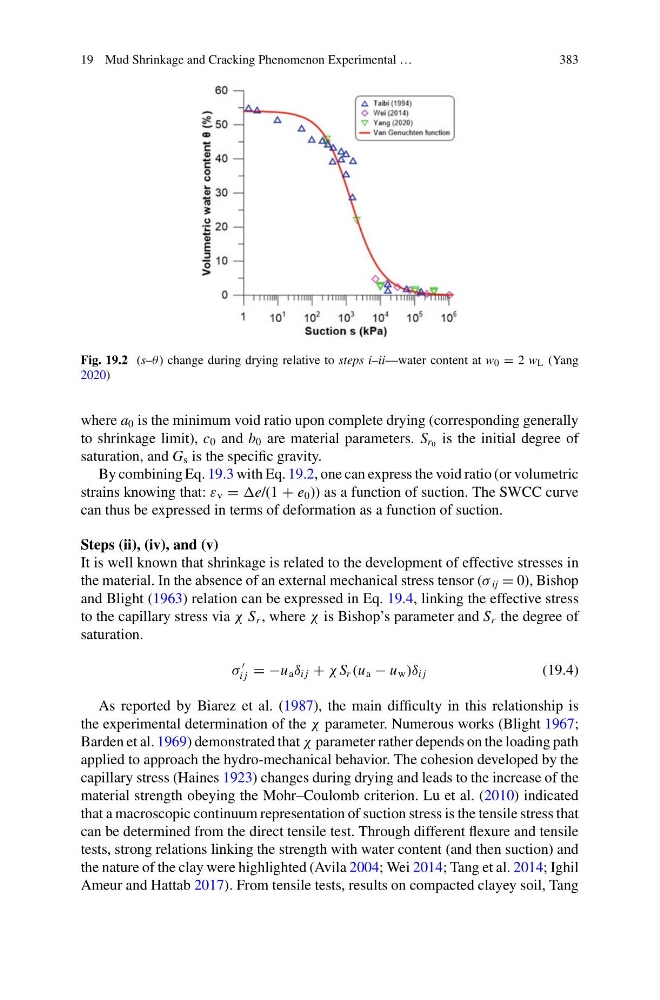
Fig. 19.2 (s–θ) change during drying relative to steps i–ii—water content at w 0 = 2 w L (Yang
2020)
where a 0 is the minimum void ratio upon complete drying (corresponding generally
to shrinkage limit), c 0 and b 0 are material parameters. S r 0 is the initial degree of
saturation, and G s is the specific gravity.
By combining Eq. 19.3 with Eq. 19.2, one can express the void ratio (or volumetric
strains knowing that: ε v = e/(1 + e 0 )) as a function of suction. The SWCC curve
can thus be expressed in terms of deformation as a function of suction.
Steps (ii), (iv), and (v)
It is well known that shrinkage is related to the development of effective stresses in
the material. In the absence of an external mechanical stress tensor (σ ij = 0), Bishop
and Blight (1963) relation can be expressed in Eq. 19.4, linking the effective stress
to the capillary stress via χ S r , where χ is Bishop’s parameter and S r the degree of
saturation.
σ
i j = −u a δ i j + χ S r (u a − u w )δ i j
(19.4)
As reported by Biarez et al. (1987), the main difficulty in this relationship is
the experimental determination of the χ parameter. Numerous works (Blight 1967;
Barden et al. 1969) demonstrated that χ parameter rather depends on the loading path
applied to approach the hydro-mechanical behavior. The cohesion developed by the
capillary stress (Haines 1923) changes during drying and leads to the increase of the
material strength obeying the Mohr–Coulomb criterion. Lu et al. (2010) indicated
that a macroscopic continuum representation of suction stress is the tensile stress that
can be determined from the direct tensile test. Through different flexure and tensile
tests, strong relations linking the strength with water content (and then suction) and
the nature of the clay were highlighted (Avila 2004; Wei 2014; Tang et al. 2014; Ighil
Ameur and Hattab 2017). From tensile tests, results on compacted clayey soil, Tang
383
Fig. 19.2 (s–θ) change during drying relative to steps i–ii—water content at w 0 = 2 w L (Yang
2020)
where a 0 is the minimum void ratio upon complete drying (corresponding generally
to shrinkage limit), c 0 and b 0 are material parameters. S r 0 is the initial degree of
saturation, and G s is the specific gravity.
By combining Eq. 19.3 with Eq. 19.2, one can express the void ratio (or volumetric
strains knowing that: ε v = e/(1 + e 0 )) as a function of suction. The SWCC curve
can thus be expressed in terms of deformation as a function of suction.
Steps (ii), (iv), and (v)
It is well known that shrinkage is related to the development of effective stresses in
the material. In the absence of an external mechanical stress tensor (σ ij = 0), Bishop
and Blight (1963) relation can be expressed in Eq. 19.4, linking the effective stress
to the capillary stress via χ S r , where χ is Bishop’s parameter and S r the degree of
saturation.
σ
i j = −u a δ i j + χ S r (u a − u w )δ i j
(19.4)
As reported by Biarez et al. (1987), the main difficulty in this relationship is
the experimental determination of the χ parameter. Numerous works (Blight 1967;
Barden et al. 1969) demonstrated that χ parameter rather depends on the loading path
applied to approach the hydro-mechanical behavior. The cohesion developed by the
capillary stress (Haines 1923) changes during drying and leads to the increase of the
material strength obeying the Mohr–Coulomb criterion. Lu et al. (2010) indicated
that a macroscopic continuum representation of suction stress is the tensile stress that
can be determined from the direct tensile test. Through different flexure and tensile
tests, strong relations linking the strength with water content (and then suction) and
the nature of the clay were highlighted (Avila 2004; Wei 2014; Tang et al. 2014; Ighil
Ameur and Hattab 2017). From tensile tests, results on compacted clayey soil, Tang