

26
A. M. Antonov et al.
μ x = 2B 2 L
2
μf
f
2
− η
2
2
η 2
η 1
e
−η 2 y
+ e
−η 1 y
sin(kx − ωt).
(2.24)
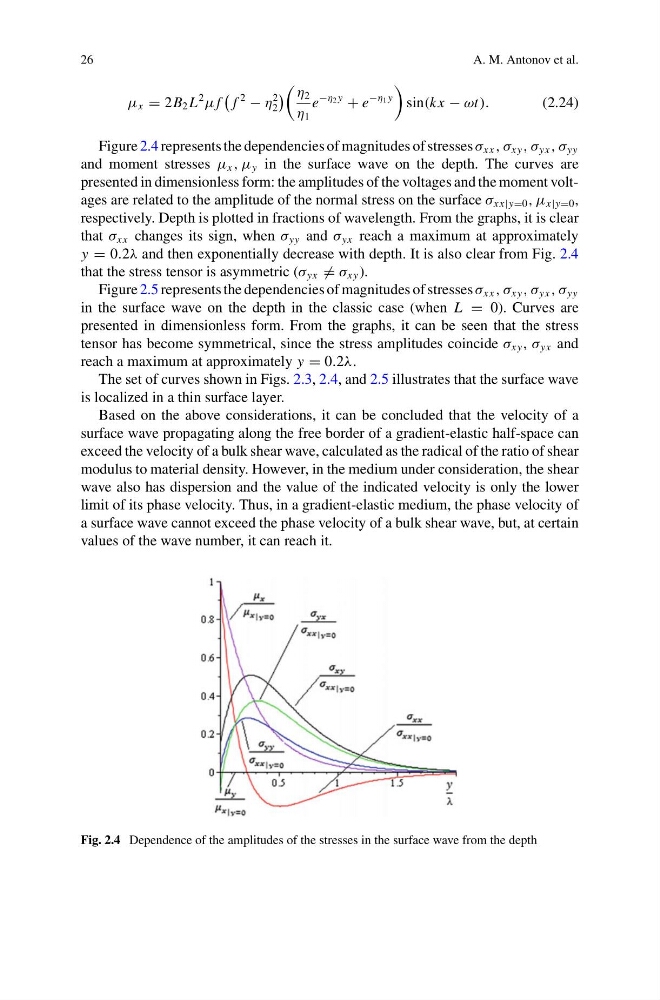
Figure 2.4 represents the dependencies of magnitudes of stresses σ xx , σ xy , σ yx , σ yy
and moment stresses μ x , μ y in the surface wave on the depth. The curves are
presented in dimensionless form: the amplitudes of the voltages and the moment voltages are related to the amplitude of the normal stress on the surface σ xx|y=0 , μ x|y=0 ,
respectively. Depth is plotted in fractions of wavelength. From the graphs, it is clear
that σ xx changes its sign, when σ yy and σ yx reach a maximum at approximately
y = 0.2λ and then exponentially decrease with depth. It is also clear from Fig. 2.4
that the stress tensor is asymmetric (σ yx = σ xy ).
Figure 2.5 represents the dependencies of magnitudes of stresses σ xx , σ xy , σ yx , σ yy
in the surface wave on the depth in the classic case (when L = 0). Curves are
presented in dimensionless form. From the graphs, it can be seen that the stress
tensor has become symmetrical, since the stress amplitudes coincide σ xy , σ yx and
reach a maximum at approximately y = 0.2λ.
The set of curves shown in Figs. 2.3, 2.4, and 2.5 illustrates that the surface wave
is localized in a thin surface layer.
Based on the above considerations, it can be concluded that the velocity of a
surface wave propagating along the free border of a gradient-elastic half-space can
exceed the velocity of a bulk shear wave, calculated as the radical of the ratio of shear
modulus to material density. However, in the medium under consideration, the shear
wave also has dispersion and the value of the indicated velocity is only the lower
limit of its phase velocity. Thus, in a gradient-elastic medium, the phase velocity of
a surface wave cannot exceed the phase velocity of a bulk shear wave, but, at certain
values of the wave number, it can reach it.
Fig. 2.4 Dependence of the amplitudes of the stresses in the surface wave from the depth
A. M. Antonov et al.
μ x = 2B 2 L
2
μf
f
2
− η
2
2
η 2
η 1
e
−η 2 y
+ e
−η 1 y
sin(kx − ωt).
(2.24)
Figure 2.4 represents the dependencies of magnitudes of stresses σ xx , σ xy , σ yx , σ yy
and moment stresses μ x , μ y in the surface wave on the depth. The curves are
presented in dimensionless form: the amplitudes of the voltages and the moment voltages are related to the amplitude of the normal stress on the surface σ xx|y=0 , μ x|y=0 ,
respectively. Depth is plotted in fractions of wavelength. From the graphs, it is clear
that σ xx changes its sign, when σ yy and σ yx reach a maximum at approximately
y = 0.2λ and then exponentially decrease with depth. It is also clear from Fig. 2.4
that the stress tensor is asymmetric (σ yx = σ xy ).
Figure 2.5 represents the dependencies of magnitudes of stresses σ xx , σ xy , σ yx , σ yy
in the surface wave on the depth in the classic case (when L = 0). Curves are
presented in dimensionless form. From the graphs, it can be seen that the stress
tensor has become symmetrical, since the stress amplitudes coincide σ xy , σ yx and
reach a maximum at approximately y = 0.2λ.
The set of curves shown in Figs. 2.3, 2.4, and 2.5 illustrates that the surface wave
is localized in a thin surface layer.
Based on the above considerations, it can be concluded that the velocity of a
surface wave propagating along the free border of a gradient-elastic half-space can
exceed the velocity of a bulk shear wave, calculated as the radical of the ratio of shear
modulus to material density. However, in the medium under consideration, the shear
wave also has dispersion and the value of the indicated velocity is only the lower
limit of its phase velocity. Thus, in a gradient-elastic medium, the phase velocity of
a surface wave cannot exceed the phase velocity of a bulk shear wave, but, at certain
values of the wave number, it can reach it.
Fig. 2.4 Dependence of the amplitudes of the stresses in the surface wave from the depth