

18 A Plausible Description of Continuum …
355
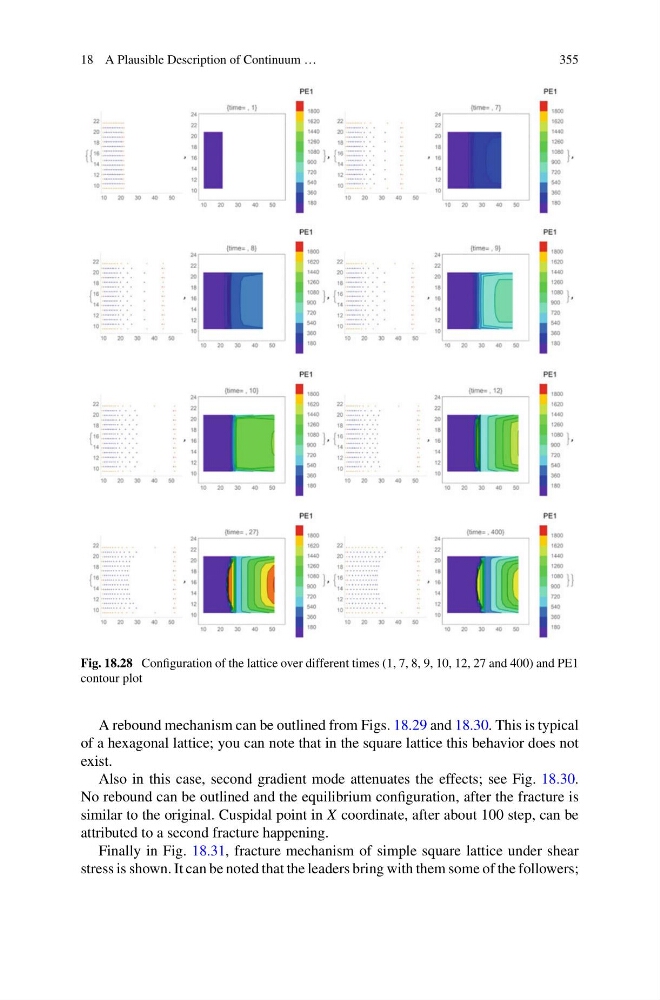
Fig. 18.28 Configuration of the lattice over different times (1, 7, 8, 9, 10, 12, 27 and 400) and PE1
contour plot
A rebound mechanism can be outlined from Figs. 18.29 and 18.30. This is typical
of a hexagonal lattice; you can note that in the square lattice this behavior does not
exist.
Also in this case, second gradient mode attenuates the effects; see Fig. 18.30.
No rebound can be outlined and the equilibrium configuration, after the fracture is
similar to the original. Cuspidal point in X coordinate, after about 100 step, can be
attributed to a second fracture happening.
Finally in Fig. 18.31, fracture mechanism of simple square lattice under shear
stress is shown. It can be noted that the leaders bring with them some of the followers;
355
Fig. 18.28 Configuration of the lattice over different times (1, 7, 8, 9, 10, 12, 27 and 400) and PE1
contour plot
A rebound mechanism can be outlined from Figs. 18.29 and 18.30. This is typical
of a hexagonal lattice; you can note that in the square lattice this behavior does not
exist.
Also in this case, second gradient mode attenuates the effects; see Fig. 18.30.
No rebound can be outlined and the equilibrium configuration, after the fracture is
similar to the original. Cuspidal point in X coordinate, after about 100 step, can be
attributed to a second fracture happening.
Finally in Fig. 18.31, fracture mechanism of simple square lattice under shear
stress is shown. It can be noted that the leaders bring with them some of the followers;