

22
A. M. Antonov et al.
σ yy = Ae ζ y+i(ωt−kx)
λζ 2 − λk 2 + 2μζ 2
+
+ 2B 1 μikη 1 e η 1 y+i(ωt−kx) + 2B 2 μikη 2 e η 2 y+i(ωt−kx) = 0,
σ yx = −2 Aμζ kie ζ y+i(ωt−kx) + B 1 μe η 1 y+i(ωt−kx)
k 2 + η 2
1 + 2η 2
1 k 2 L 2 − η 4
1 L 2 − k 4 L 2
+ B 2 μe η 2 y+i(ωt−kx)
k 2 + η 2
2 + 2η 2
2 k 2 L 2 − η 4
2 L 2 − k 4 L 2
= 0,
B 2 μe η 2 y+i(ωt−kx)
k 2 + η 2
2 + 2η 2
2 k 2 L 2 − η 4
2 L 2 − k 4 L 2
= 0,
μ y = 2B 1 L 2 η 1 μe η 1 y+i(ωt−kx)
k 2 − η 2
1
+ 2B 2 L 2 η 2 μe η 2 y+i(ωt−kx)
k 2 − η 2
2
= 0.
(2.16)
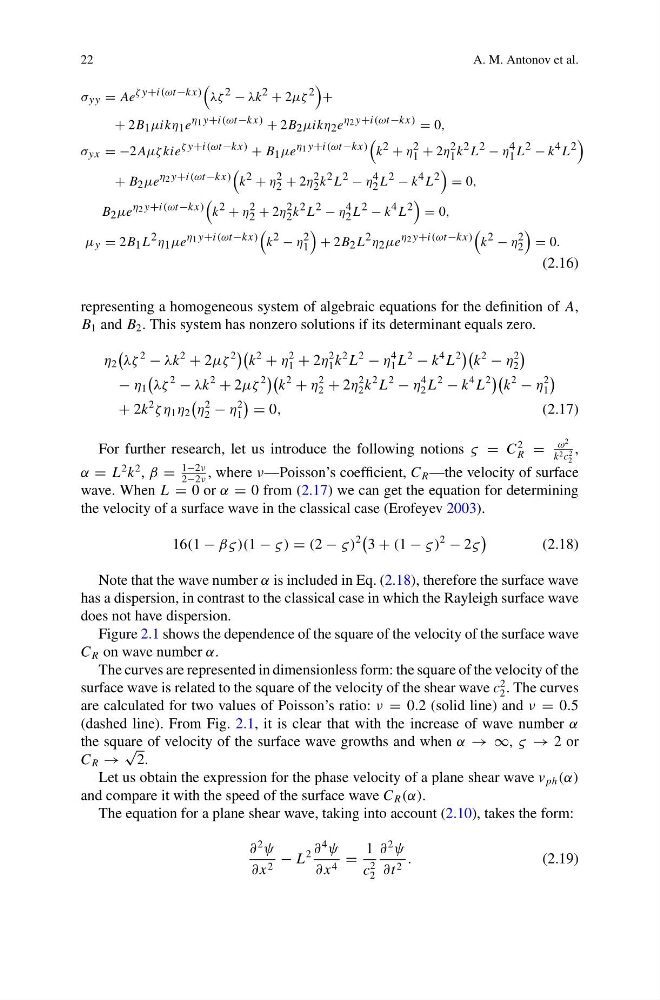
representing a homogeneous system of algebraic equations for the definition of A,
B 1 and B 2 . This system has nonzero solutions if its determinant equals zero.
η 2
λζ
2
− λk
2
+ 2μζ
2
k
2
+ η
2
1 + 2η
2
1 k
2 L
2
− η
4
1 L
2
− k
4 L
2
k
2
− η
2
2
− η 1
λζ
2
− λk
2
+ 2μζ
2
k
2
+ η
2
2 + 2η
2
2 k
2 L
2
− η
4
2 L
2
− k
4 L
2
k
2
− η
2
1
+ 2k
2
ζ η 1 η 2
η
2
2 − η
2
1
= 0,
(2.17)
For further research, let us introduce the following notions ς = C
2
R =
ω
2
k 2 c
2
2
,
α = L
2 k
2 , β =
1−2ν
2−2ν
, where ν—Poisson’s coefficient, C R —the velocity of surface
wave. When L = 0 or α = 0 from (2.17) we can get the equation for determining
the velocity of a surface wave in the classical case (Erofeyev 2003).
16(1 − βς)(1 − ς ) = (2 − ς )
2
3 + (1 − ς )
2
− 2ς
(2.18)
Note that the wave number α is included in Eq. (2.18), therefore the surface wave
has a dispersion, in contrast to the classical case in which the Rayleigh surface wave
does not have dispersion.
Figure 2.1 shows the dependence of the square of the velocity of the surface wave
C R on wave number α.
The curves are represented in dimensionless form: the square of the velocity of the
surface wave is related to the square of the velocity of the shear wave c
2
2 . The curves
are calculated for two values of Poisson’s ratio: ν = 0.2 (solid line) and ν = 0.5
(dashed line). From Fig. 2.1, it is clear that with the increase of wave number α
the square of velocity of the surface wave growths and when α → ∞, ς → 2 or
C R →
√
2.
Let us obtain the expression for the phase velocity of a plane shear wave v ph (α)
and compare it with the speed of the surface wave C R (α).
The equation for a plane shear wave, taking into account (2.10), takes the form:
∂
2
ψ
∂ x 2 − L
2 ∂
4
ψ
∂ x 4 =
1
c
2
2
∂
2
ψ
∂t 2 .
(2.19)
A. M. Antonov et al.
σ yy = Ae ζ y+i(ωt−kx)
λζ 2 − λk 2 + 2μζ 2
+
+ 2B 1 μikη 1 e η 1 y+i(ωt−kx) + 2B 2 μikη 2 e η 2 y+i(ωt−kx) = 0,
σ yx = −2 Aμζ kie ζ y+i(ωt−kx) + B 1 μe η 1 y+i(ωt−kx)
k 2 + η 2
1 + 2η 2
1 k 2 L 2 − η 4
1 L 2 − k 4 L 2
+ B 2 μe η 2 y+i(ωt−kx)
k 2 + η 2
2 + 2η 2
2 k 2 L 2 − η 4
2 L 2 − k 4 L 2
= 0,
B 2 μe η 2 y+i(ωt−kx)
k 2 + η 2
2 + 2η 2
2 k 2 L 2 − η 4
2 L 2 − k 4 L 2
= 0,
μ y = 2B 1 L 2 η 1 μe η 1 y+i(ωt−kx)
k 2 − η 2
1
+ 2B 2 L 2 η 2 μe η 2 y+i(ωt−kx)
k 2 − η 2
2
= 0.
(2.16)
representing a homogeneous system of algebraic equations for the definition of A,
B 1 and B 2 . This system has nonzero solutions if its determinant equals zero.
η 2
λζ
2
− λk
2
+ 2μζ
2
k
2
+ η
2
1 + 2η
2
1 k
2 L
2
− η
4
1 L
2
− k
4 L
2
k
2
− η
2
2
− η 1
λζ
2
− λk
2
+ 2μζ
2
k
2
+ η
2
2 + 2η
2
2 k
2 L
2
− η
4
2 L
2
− k
4 L
2
k
2
− η
2
1
+ 2k
2
ζ η 1 η 2
η
2
2 − η
2
1
= 0,
(2.17)
For further research, let us introduce the following notions ς = C
2
R =
ω
2
k 2 c
2
2
,
α = L
2 k
2 , β =
1−2ν
2−2ν
, where ν—Poisson’s coefficient, C R —the velocity of surface
wave. When L = 0 or α = 0 from (2.17) we can get the equation for determining
the velocity of a surface wave in the classical case (Erofeyev 2003).
16(1 − βς)(1 − ς ) = (2 − ς )
2
3 + (1 − ς )
2
− 2ς
(2.18)
Note that the wave number α is included in Eq. (2.18), therefore the surface wave
has a dispersion, in contrast to the classical case in which the Rayleigh surface wave
does not have dispersion.
Figure 2.1 shows the dependence of the square of the velocity of the surface wave
C R on wave number α.
The curves are represented in dimensionless form: the square of the velocity of the
surface wave is related to the square of the velocity of the shear wave c
2
2 . The curves
are calculated for two values of Poisson’s ratio: ν = 0.2 (solid line) and ν = 0.5
(dashed line). From Fig. 2.1, it is clear that with the increase of wave number α
the square of velocity of the surface wave growths and when α → ∞, ς → 2 or
C R →
√
2.
Let us obtain the expression for the phase velocity of a plane shear wave v ph (α)
and compare it with the speed of the surface wave C R (α).
The equation for a plane shear wave, taking into account (2.10), takes the form:
∂
2
ψ
∂ x 2 − L
2 ∂
4
ψ
∂ x 4 =
1
c
2
2
∂
2
ψ
∂t 2 .
(2.19)