

2 Excitation of the Waves with a Focused Source …
21
where c
2
1 =
(λ+2μ)
ρ
—the square of longitudinal wave velocity, c
2
2 =
μ
ρ
—the square
of shear wave velocity.
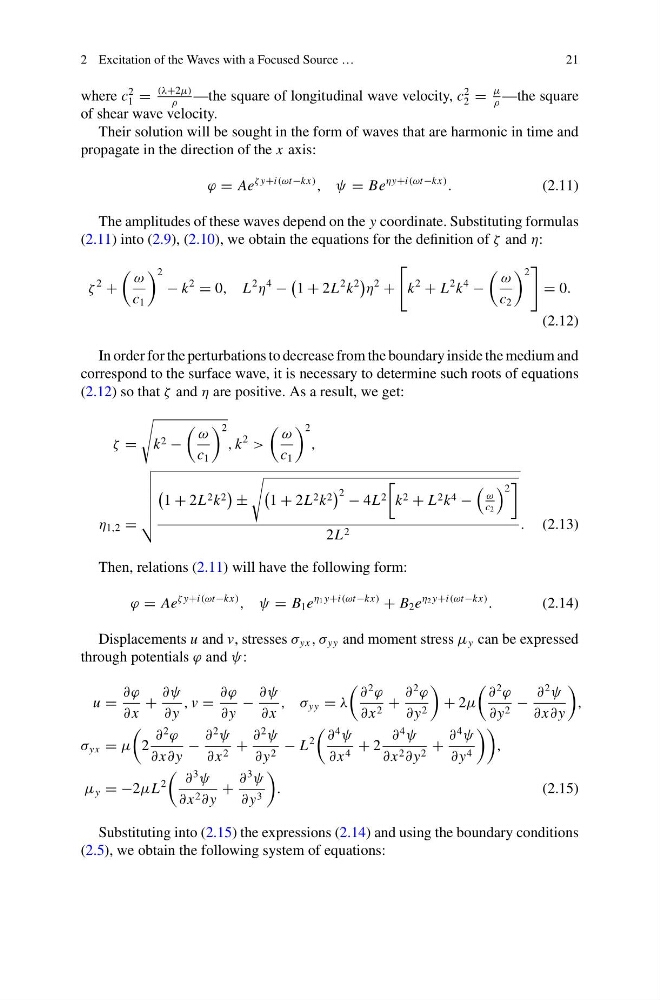
Their solution will be sought in the form of waves that are harmonic in time and
propagate in the direction of the x axis:
ϕ = Ae
ζ y+i(ωt−kx)
, ψ = Be
ηy+i(ωt−kx)
.
(2.11)
The amplitudes of these waves depend on the y coordinate. Substituting formulas
(2.11) into (2.9), (2.10), we obtain the equations for the definition of ζ and η:
ζ
2
+
ω
c 1
2
− k
2
= 0, L
2
η
4
−
1 + 2L
2 k
2
η
2
+
k
2
+ L
2 k
4
−
ω
c 2
2
= 0.
(2.12)
In order for the perturbations to decrease from the boundary inside the medium and
correspond to the surface wave, it is necessary to determine such roots of equations
(2.12) so that ζ and η are positive. As a result, we get:
ζ =
k 2 −
ω
c 1
2
, k
2
>
ω
c 1
2
,
η 1,2 =
1 + 2L 2 k 2
±
1 + 2L 2 k 2
2 − 4L 2
k 2 + L 2 k 4 −
ω
c 2
2
2L 2
. (2.13)
Then, relations (2.11) will have the following form:
ϕ = Ae
ζ y+i(ωt−kx)
, ψ = B 1 e
η 1 y+i(ωt−kx)
+ B 2 e
η 2 y+i(ωt−kx)
.
(2.14)
Displacements u and v, stresses σ yx , σ yy and moment stress μ y can be expressed
through potentials ϕ and ψ:
u =
∂ϕ
∂ x
+
∂ψ
∂ y
, v =
∂ϕ
∂ y
−
∂ψ
∂ x
, σ yy = λ
∂
2
ϕ
∂ x 2 +
∂
2
ϕ
∂ y 2
+ 2μ
∂
2
ϕ
∂ y 2 −
∂
2
ψ
∂ x∂ y
,
σ yx = μ
2
∂
2
ϕ
∂ x∂ y
−
∂
2
ψ
∂ x 2 +
∂
2
ψ
∂ y 2 − L
2
∂
4
ψ
∂ x 4 + 2
∂
4
ψ
∂ x 2 ∂ y 2 +
∂
4
ψ
∂ y 4
,
μ y = −2μL
2
∂
3
ψ
∂ x 2 ∂ y
+
∂
3
ψ
∂ y 3
.
(2.15)
Substituting into (2.15) the expressions (2.14) and using the boundary conditions
(2.5), we obtain the following system of equations:
21
where c
2
1 =
(λ+2μ)
ρ
—the square of longitudinal wave velocity, c
2
2 =
μ
ρ
—the square
of shear wave velocity.
Their solution will be sought in the form of waves that are harmonic in time and
propagate in the direction of the x axis:
ϕ = Ae
ζ y+i(ωt−kx)
, ψ = Be
ηy+i(ωt−kx)
.
(2.11)
The amplitudes of these waves depend on the y coordinate. Substituting formulas
(2.11) into (2.9), (2.10), we obtain the equations for the definition of ζ and η:
ζ
2
+
ω
c 1
2
− k
2
= 0, L
2
η
4
−
1 + 2L
2 k
2
η
2
+
k
2
+ L
2 k
4
−
ω
c 2
2
= 0.
(2.12)
In order for the perturbations to decrease from the boundary inside the medium and
correspond to the surface wave, it is necessary to determine such roots of equations
(2.12) so that ζ and η are positive. As a result, we get:
ζ =
k 2 −
ω
c 1
2
, k
2
>
ω
c 1
2
,
η 1,2 =
1 + 2L 2 k 2
±
1 + 2L 2 k 2
2 − 4L 2
k 2 + L 2 k 4 −
ω
c 2
2
2L 2
. (2.13)
Then, relations (2.11) will have the following form:
ϕ = Ae
ζ y+i(ωt−kx)
, ψ = B 1 e
η 1 y+i(ωt−kx)
+ B 2 e
η 2 y+i(ωt−kx)
.
(2.14)
Displacements u and v, stresses σ yx , σ yy and moment stress μ y can be expressed
through potentials ϕ and ψ:
u =
∂ϕ
∂ x
+
∂ψ
∂ y
, v =
∂ϕ
∂ y
−
∂ψ
∂ x
, σ yy = λ
∂
2
ϕ
∂ x 2 +
∂
2
ϕ
∂ y 2
+ 2μ
∂
2
ϕ
∂ y 2 −
∂
2
ψ
∂ x∂ y
,
σ yx = μ
2
∂
2
ϕ
∂ x∂ y
−
∂
2
ψ
∂ x 2 +
∂
2
ψ
∂ y 2 − L
2
∂
4
ψ
∂ x 4 + 2
∂
4
ψ
∂ x 2 ∂ y 2 +
∂
4
ψ
∂ y 4
,
μ y = −2μL
2
∂
3
ψ
∂ x 2 ∂ y
+
∂
3
ψ
∂ y 3
.
(2.15)
Substituting into (2.15) the expressions (2.14) and using the boundary conditions
(2.5), we obtain the following system of equations: