

17 Microplane Modeling for Inelastic Responses …
315
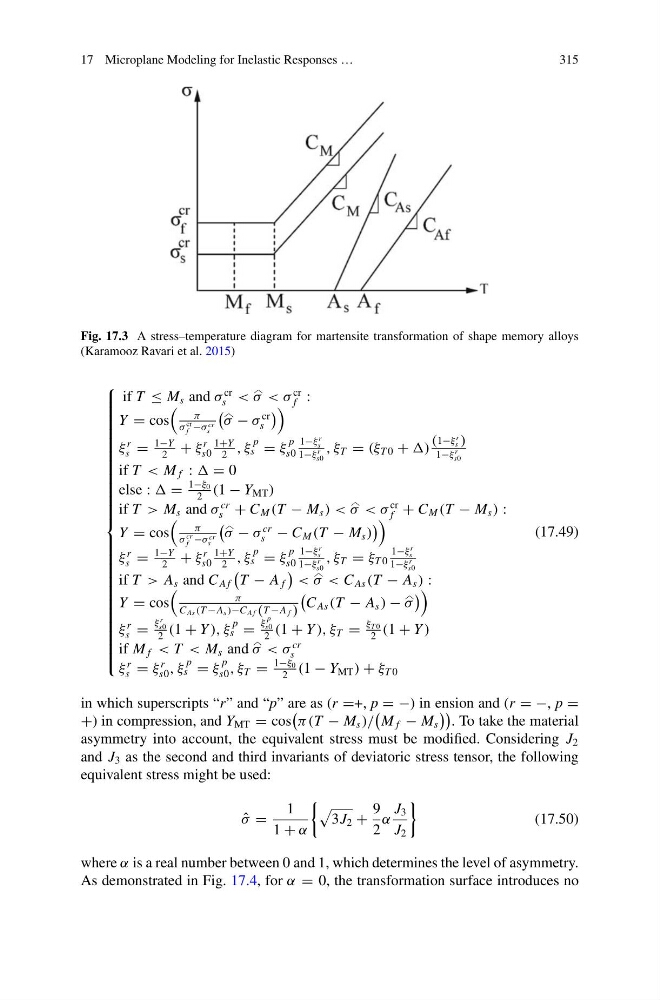
Fig. 17.3 A stress–temperature diagram for martensite transformation of shape memory alloys
(Karamooz Ravari et al. 2015)
⎧
⎪ ⎪ ⎪ ⎪ ⎪ ⎪ ⎪ ⎪ ⎪ ⎪ ⎪ ⎪ ⎪ ⎪ ⎪ ⎪ ⎪ ⎪ ⎪ ⎪ ⎪ ⎪ ⎪ ⎪ ⎪ ⎪ ⎨
⎪ ⎪ ⎪ ⎪ ⎪ ⎪ ⎪ ⎪ ⎪ ⎪ ⎪ ⎪ ⎪ ⎪ ⎪ ⎪ ⎪ ⎪ ⎪ ⎪ ⎪ ⎪ ⎪ ⎪ ⎪ ⎪ ⎩
if T ≤ M s and σ
cr
s < σ
< σ
cr
f :
Y = cos
π
σ
cr
f −σ cr
s
σ
− σ
cr
s
ξ
r
s =
1−Y
2
+ ξ
r
s0
1+Y
2
, ξ
p
s = ξ
p
s0
1−ξ
r
s
1−ξ
r
s0
, ξ T = (ξ T 0 + ) (1−ξ
r
s )
1−ξ
r
s0
if T < M f : = 0
else : =
1−ξ 0
2 (1 − Y MT )
if T > M s and σ
cr
s + C M (T − M s ) < σ
< σ
cr
f + C M (T − M s ) :
Y = cos
π
σ
cr
f −σ cr
s
σ
− σ
cr
s − C M (T − M s )
ξ
r
s =
1−Y
2
+ ξ
r
s0
1+Y
2
, ξ
p
s = ξ
p
s0
1−ξ
r
s
1−ξ
r
s0
, ξ T = ξ T 0
1−ξ
r
s
1−ξ
r
s0
if T > A s and C A f
T − A f
< σ
< C As (T − A s ) :
Y = cos
π
C As (T −A s )−CAf (T −A f )
C As (T − A s ) − σ
ξ
r
s =
ξ
r
s0
2 (1 + Y ), ξ
p
s =
ξ
p
s0
2 (1 + Y ), ξ T =
ξ T 0
2 (1 + Y )
if M f < T < M s and σ
< σ
cr
s
ξ
r
s = ξ
r
s0 , ξ
p
s = ξ
p
s0 , ξ T =
1−ξ 0
2 (1 − Y MT ) + ξ T 0
(17.49)
in which superscripts “r” and “p” are as (r =+, p = −) in ension and (r = −, p =
+) in compression, and Y MT = cos
π (T − M s )/
M f − M s
. To take the material
asymmetry into account, the equivalent stress must be modified. Considering J 2
and J 3 as the second and third invariants of deviatoric stress tensor, the following
equivalent stress might be used:
ˆ
σ =
1
1 + α
3J 2 +
9
2
α
J 3
J 2
(17.50)
where α is a real number between 0 and 1, which determines the level of asymmetry.
As demonstrated in Fig. 17.4, for α = 0, the transformation surface introduces no
315
Fig. 17.3 A stress–temperature diagram for martensite transformation of shape memory alloys
(Karamooz Ravari et al. 2015)
⎧
⎪ ⎪ ⎪ ⎪ ⎪ ⎪ ⎪ ⎪ ⎪ ⎪ ⎪ ⎪ ⎪ ⎪ ⎪ ⎪ ⎪ ⎪ ⎪ ⎪ ⎪ ⎪ ⎪ ⎪ ⎪ ⎪ ⎨
⎪ ⎪ ⎪ ⎪ ⎪ ⎪ ⎪ ⎪ ⎪ ⎪ ⎪ ⎪ ⎪ ⎪ ⎪ ⎪ ⎪ ⎪ ⎪ ⎪ ⎪ ⎪ ⎪ ⎪ ⎪ ⎪ ⎩
if T ≤ M s and σ
cr
s < σ
< σ
cr
f :
Y = cos
π
σ
cr
f −σ cr
s
σ
− σ
cr
s
ξ
r
s =
1−Y
2
+ ξ
r
s0
1+Y
2
, ξ
p
s = ξ
p
s0
1−ξ
r
s
1−ξ
r
s0
, ξ T = (ξ T 0 + ) (1−ξ
r
s )
1−ξ
r
s0
if T < M f : = 0
else : =
1−ξ 0
2 (1 − Y MT )
if T > M s and σ
cr
s + C M (T − M s ) < σ
< σ
cr
f + C M (T − M s ) :
Y = cos
π
σ
cr
f −σ cr
s
σ
− σ
cr
s − C M (T − M s )
ξ
r
s =
1−Y
2
+ ξ
r
s0
1+Y
2
, ξ
p
s = ξ
p
s0
1−ξ
r
s
1−ξ
r
s0
, ξ T = ξ T 0
1−ξ
r
s
1−ξ
r
s0
if T > A s and C A f
T − A f
< σ
< C As (T − A s ) :
Y = cos
π
C As (T −A s )−CAf (T −A f )
C As (T − A s ) − σ
ξ
r
s =
ξ
r
s0
2 (1 + Y ), ξ
p
s =
ξ
p
s0
2 (1 + Y ), ξ T =
ξ T 0
2 (1 + Y )
if M f < T < M s and σ
< σ
cr
s
ξ
r
s = ξ
r
s0 , ξ
p
s = ξ
p
s0 , ξ T =
1−ξ 0
2 (1 − Y MT ) + ξ T 0
(17.49)
in which superscripts “r” and “p” are as (r =+, p = −) in ension and (r = −, p =
+) in compression, and Y MT = cos
π (T − M s )/
M f − M s
. To take the material
asymmetry into account, the equivalent stress must be modified. Considering J 2
and J 3 as the second and third invariants of deviatoric stress tensor, the following
equivalent stress might be used:
ˆ
σ =
1
1 + α
3J 2 +
9
2
α
J 3
J 2
(17.50)
where α is a real number between 0 and 1, which determines the level of asymmetry.
As demonstrated in Fig. 17.4, for α = 0, the transformation surface introduces no