

306
M. R. Karamooz-Ravari et al.
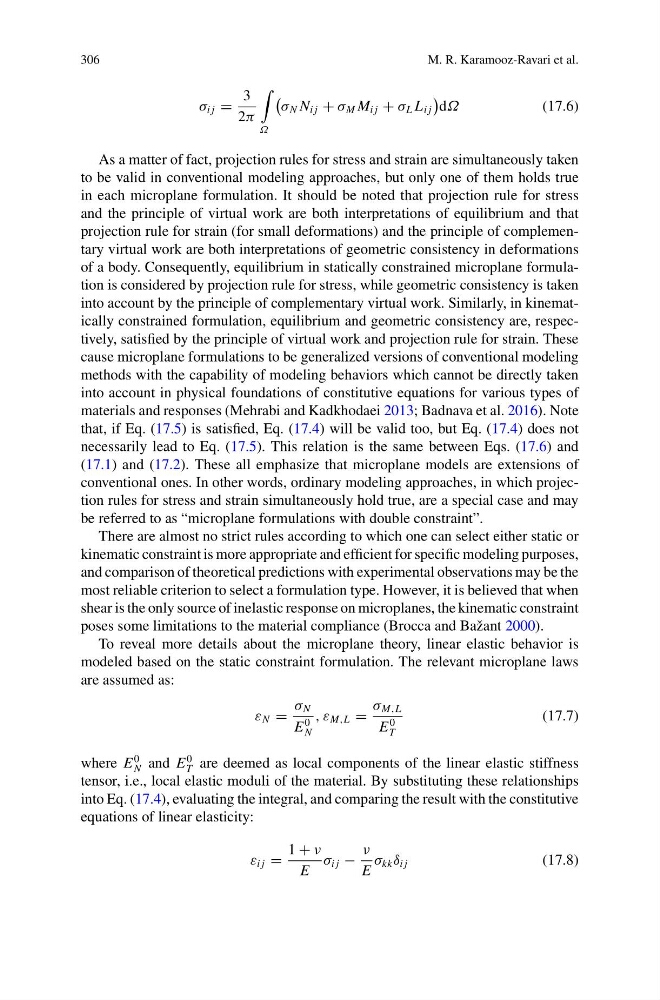
σ i j =
3
2π
Ω
σ N N i j + σ M M i j + σ L L i j
dΩ
(17.6)
As a matter of fact, projection rules for stress and strain are simultaneously taken
to be valid in conventional modeling approaches, but only one of them holds true
in each microplane formulation. It should be noted that projection rule for stress
and the principle of virtual work are both interpretations of equilibrium and that
projection rule for strain (for small deformations) and the principle of complementary virtual work are both interpretations of geometric consistency in deformations
of a body. Consequently, equilibrium in statically constrained microplane formulation is considered by projection rule for stress, while geometric consistency is taken
into account by the principle of complementary virtual work. Similarly, in kinematically constrained formulation, equilibrium and geometric consistency are, respectively, satisfied by the principle of virtual work and projection rule for strain. These
cause microplane formulations to be generalized versions of conventional modeling
methods with the capability of modeling behaviors which cannot be directly taken
into account in physical foundations of constitutive equations for various types of
materials and responses (Mehrabi and Kadkhodaei 2013; Badnava et al. 2016). Note
that, if Eq. (17.5) is satisfied, Eq. (17.4) will be valid too, but Eq. (17.4) does not
necessarily lead to Eq. (17.5). This relation is the same between Eqs. (17.6) and
(17.1) and (17.2). These all emphasize that microplane models are extensions of
conventional ones. In other words, ordinary modeling approaches, in which projection rules for stress and strain simultaneously hold true, are a special case and may
be referred to as “microplane formulations with double constraint”.
There are almost no strict rules according to which one can select either static or
kinematic constraint is more appropriate and efficient for specific modeling purposes,
and comparison of theoretical predictions with experimental observations may be the
most reliable criterion to select a formulation type. However, it is believed that when
shear is the only source of inelastic response on microplanes, the kinematic constraint
poses some limitations to the material compliance (Brocca and Bažant 2000).
To reveal more details about the microplane theory, linear elastic behavior is
modeled based on the static constraint formulation. The relevant microplane laws
are assumed as:
ε N =
σ N
E
0
N
, ε M,L =
σ M,L
E
0
T
(17.7)
where E
0
N and E
0
T are deemed as local components of the linear elastic stiffness
tensor, i.e., local elastic moduli of the material. By substituting these relationships
into Eq. (17.4), evaluating the integral, and comparing the result with the constitutive
equations of linear elasticity:
ε i j =
1 + ν
E
σ i j −
ν
E
σ kk δ i j
(17.8)
M. R. Karamooz-Ravari et al.
σ i j =
3
2π
Ω
σ N N i j + σ M M i j + σ L L i j
dΩ
(17.6)
As a matter of fact, projection rules for stress and strain are simultaneously taken
to be valid in conventional modeling approaches, but only one of them holds true
in each microplane formulation. It should be noted that projection rule for stress
and the principle of virtual work are both interpretations of equilibrium and that
projection rule for strain (for small deformations) and the principle of complementary virtual work are both interpretations of geometric consistency in deformations
of a body. Consequently, equilibrium in statically constrained microplane formulation is considered by projection rule for stress, while geometric consistency is taken
into account by the principle of complementary virtual work. Similarly, in kinematically constrained formulation, equilibrium and geometric consistency are, respectively, satisfied by the principle of virtual work and projection rule for strain. These
cause microplane formulations to be generalized versions of conventional modeling
methods with the capability of modeling behaviors which cannot be directly taken
into account in physical foundations of constitutive equations for various types of
materials and responses (Mehrabi and Kadkhodaei 2013; Badnava et al. 2016). Note
that, if Eq. (17.5) is satisfied, Eq. (17.4) will be valid too, but Eq. (17.4) does not
necessarily lead to Eq. (17.5). This relation is the same between Eqs. (17.6) and
(17.1) and (17.2). These all emphasize that microplane models are extensions of
conventional ones. In other words, ordinary modeling approaches, in which projection rules for stress and strain simultaneously hold true, are a special case and may
be referred to as “microplane formulations with double constraint”.
There are almost no strict rules according to which one can select either static or
kinematic constraint is more appropriate and efficient for specific modeling purposes,
and comparison of theoretical predictions with experimental observations may be the
most reliable criterion to select a formulation type. However, it is believed that when
shear is the only source of inelastic response on microplanes, the kinematic constraint
poses some limitations to the material compliance (Brocca and Bažant 2000).
To reveal more details about the microplane theory, linear elastic behavior is
modeled based on the static constraint formulation. The relevant microplane laws
are assumed as:
ε N =
σ N
E
0
N
, ε M,L =
σ M,L
E
0
T
(17.7)
where E
0
N and E
0
T are deemed as local components of the linear elastic stiffness
tensor, i.e., local elastic moduli of the material. By substituting these relationships
into Eq. (17.4), evaluating the integral, and comparing the result with the constitutive
equations of linear elasticity:
ε i j =
1 + ν
E
σ i j −
ν
E
σ kk δ i j
(17.8)