

16 Strain Gradient Models for Growing Solid Bodies
299
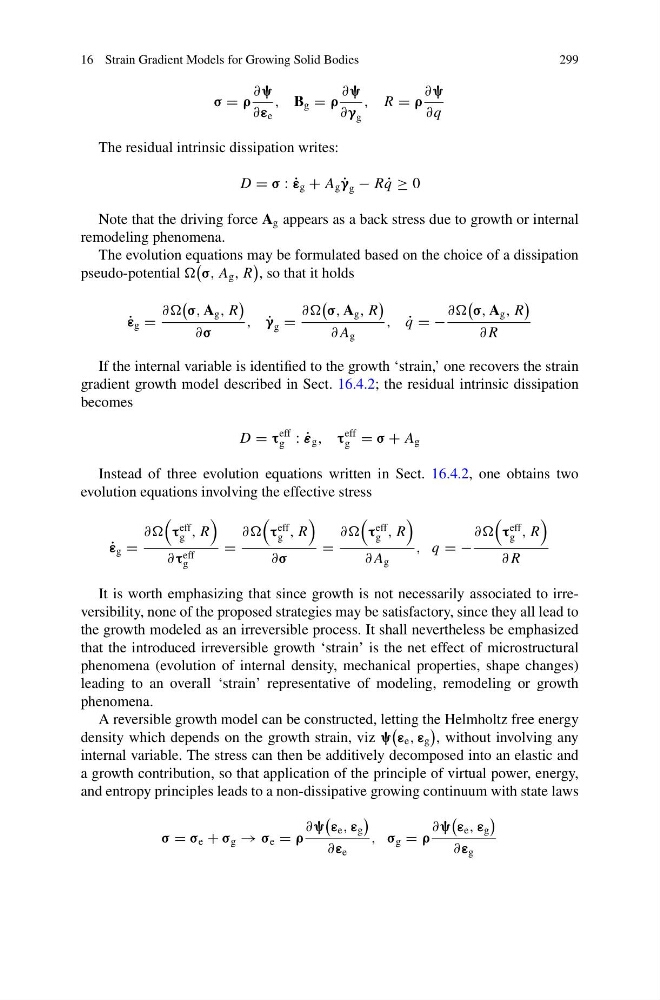
σ = ρ
∂ψ
∂ε e
, B g = ρ
∂ψ
∂γ g
, R = ρ
∂ψ
∂q
The residual intrinsic dissipation writes:
D = σ : ˙
ε g + A g ˙
γ g − R ˙
q ≥ 0
Note that the driving force A g appears as a back stress due to growth or internal
remodeling phenomena.
The evolution equations may be formulated based on the choice of a dissipation
pseudo-potential
σ, A g , R
, so that it holds
˙
ε g =
∂∂
σ, A g , R
∂σ
, ˙
γ g =
∂∂
σ, A g , R
∂ A g
, ˙
q = −
∂∂
σ, A g , R
∂ R
If the internal variable is identified to the growth ‘strain,’ one recovers the strain
gradient growth model described in Sect. 16.4.2; the residual intrinsic dissipation
becomes
D = τ
eff
g : ˙
ε g , τ
eff
g = σ + A g
Instead of three evolution equations written in Sect. 16.4.2, one obtains two
evolution equations involving the effective stress
˙
ε g =
∂∂
τ
eff
g , R
∂τ eff
g
=
∂∂
τ
eff
g , R
∂σ
=
∂∂
τ
eff
g , R
∂ A g
, q = −
∂∂
τ
eff
g , R
∂ R
It is worth emphasizing that since growth is not necessarily associated to irreversibility, none of the proposed strategies may be satisfactory, since they all lead to
the growth modeled as an irreversible process. It shall nevertheless be emphasized
that the introduced irreversible growth ‘strain’ is the net effect of microstructural
phenomena (evolution of internal density, mechanical properties, shape changes)
leading to an overall ‘strain’ representative of modeling, remodeling or growth
phenomena.
A reversible growth model can be constructed, letting the Helmholtz free energy
density which depends on the growth strain, viz ψ
ε e , ε g
, without involving any
internal variable. The stress can then be additively decomposed into an elastic and
a growth contribution, so that application of the principle of virtual power, energy,
and entropy principles leads to a non-dissipative growing continuum with state laws
σ = σ e + σ g → σ e = ρ
∂ψ
ε e , ε g
∂ε e
, σ g = ρ
∂ψ
ε e , ε g
∂ε g
299
σ = ρ
∂ψ
∂ε e
, B g = ρ
∂ψ
∂γ g
, R = ρ
∂ψ
∂q
The residual intrinsic dissipation writes:
D = σ : ˙
ε g + A g ˙
γ g − R ˙
q ≥ 0
Note that the driving force A g appears as a back stress due to growth or internal
remodeling phenomena.
The evolution equations may be formulated based on the choice of a dissipation
pseudo-potential
σ, A g , R
, so that it holds
˙
ε g =
∂∂
σ, A g , R
∂σ
, ˙
γ g =
∂∂
σ, A g , R
∂ A g
, ˙
q = −
∂∂
σ, A g , R
∂ R
If the internal variable is identified to the growth ‘strain,’ one recovers the strain
gradient growth model described in Sect. 16.4.2; the residual intrinsic dissipation
becomes
D = τ
eff
g : ˙
ε g , τ
eff
g = σ + A g
Instead of three evolution equations written in Sect. 16.4.2, one obtains two
evolution equations involving the effective stress
˙
ε g =
∂∂
τ
eff
g , R
∂τ eff
g
=
∂∂
τ
eff
g , R
∂σ
=
∂∂
τ
eff
g , R
∂ A g
, q = −
∂∂
τ
eff
g , R
∂ R
It is worth emphasizing that since growth is not necessarily associated to irreversibility, none of the proposed strategies may be satisfactory, since they all lead to
the growth modeled as an irreversible process. It shall nevertheless be emphasized
that the introduced irreversible growth ‘strain’ is the net effect of microstructural
phenomena (evolution of internal density, mechanical properties, shape changes)
leading to an overall ‘strain’ representative of modeling, remodeling or growth
phenomena.
A reversible growth model can be constructed, letting the Helmholtz free energy
density which depends on the growth strain, viz ψ
ε e , ε g
, without involving any
internal variable. The stress can then be additively decomposed into an elastic and
a growth contribution, so that application of the principle of virtual power, energy,
and entropy principles leads to a non-dissipative growing continuum with state laws
σ = σ e + σ g → σ e = ρ
∂ψ
ε e , ε g
∂ε e
, σ g = ρ
∂ψ
ε e , ε g
∂ε g