

15 Homogenization-Based Mechanical Behavior Modeling of Composites …
265
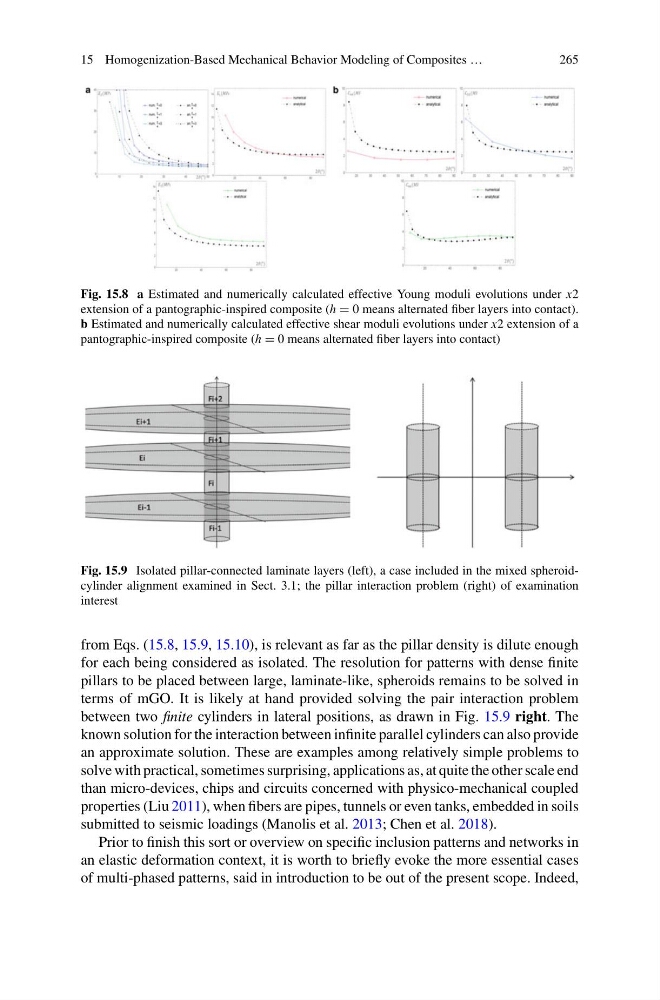
Fig. 15.8 a Estimated and numerically calculated effective Young moduli evolutions under x2
extension of a pantographic-inspired composite (h = 0 means alternated fiber layers into contact).
b Estimated and numerically calculated effective shear moduli evolutions under x2 extension of a
pantographic-inspired composite (h = 0 means alternated fiber layers into contact)
Fig. 15.9 Isolated pillar-connected laminate layers (left), a case included in the mixed spheroidcylinder alignment examined in Sect. 3.1; the pillar interaction problem (right) of examination
interest
from Eqs. (15.8, 15.9, 15.10), is relevant as far as the pillar density is dilute enough
for each being considered as isolated. The resolution for patterns with dense finite
pillars to be placed between large, laminate-like, spheroids remains to be solved in
terms of mGO. It is likely at hand provided solving the pair interaction problem
between two finite cylinders in lateral positions, as drawn in Fig. 15.9 right. The
known solution for the interaction between infinite parallel cylinders can also provide
an approximate solution. These are examples among relatively simple problems to
solve with practical, sometimes surprising, applications as, at quite the other scale end
than micro-devices, chips and circuits concerned with physico-mechanical coupled
properties (Liu 2011), when fibers are pipes, tunnels or even tanks, embedded in soils
submitted to seismic loadings (Manolis et al. 2013; Chen et al. 2018).
Prior to finish this sort or overview on specific inclusion patterns and networks in
an elastic deformation context, it is worth to briefly evoke the more essential cases
of multi-phased patterns, said in introduction to be out of the present scope. Indeed,
265
Fig. 15.8 a Estimated and numerically calculated effective Young moduli evolutions under x2
extension of a pantographic-inspired composite (h = 0 means alternated fiber layers into contact).
b Estimated and numerically calculated effective shear moduli evolutions under x2 extension of a
pantographic-inspired composite (h = 0 means alternated fiber layers into contact)
Fig. 15.9 Isolated pillar-connected laminate layers (left), a case included in the mixed spheroidcylinder alignment examined in Sect. 3.1; the pillar interaction problem (right) of examination
interest
from Eqs. (15.8, 15.9, 15.10), is relevant as far as the pillar density is dilute enough
for each being considered as isolated. The resolution for patterns with dense finite
pillars to be placed between large, laminate-like, spheroids remains to be solved in
terms of mGO. It is likely at hand provided solving the pair interaction problem
between two finite cylinders in lateral positions, as drawn in Fig. 15.9 right. The
known solution for the interaction between infinite parallel cylinders can also provide
an approximate solution. These are examples among relatively simple problems to
solve with practical, sometimes surprising, applications as, at quite the other scale end
than micro-devices, chips and circuits concerned with physico-mechanical coupled
properties (Liu 2011), when fibers are pipes, tunnels or even tanks, embedded in soils
submitted to seismic loadings (Manolis et al. 2013; Chen et al. 2018).
Prior to finish this sort or overview on specific inclusion patterns and networks in
an elastic deformation context, it is worth to briefly evoke the more essential cases
of multi-phased patterns, said in introduction to be out of the present scope. Indeed,