

15 Homogenization-Based Mechanical Behavior Modeling of Composites …
253
ψ V (ω) =
1
8 π 2 v
D
+
V (ω)
D
−
V (ω)
n
i=1
˜
s
V i
(z,ω)
⎛
⎝
n
j=1
˜
s
V j (z,ω)
⎞
⎠ dz, with v =
n
i=1
v i ,
(15.4a)
ψ V (ω) =
n
i=1
v i
v
ψ V i (ω) +
n
i=1
n
j=i+1
v i + v j
v
ψ V i ,V j (ω).
(15.4b)
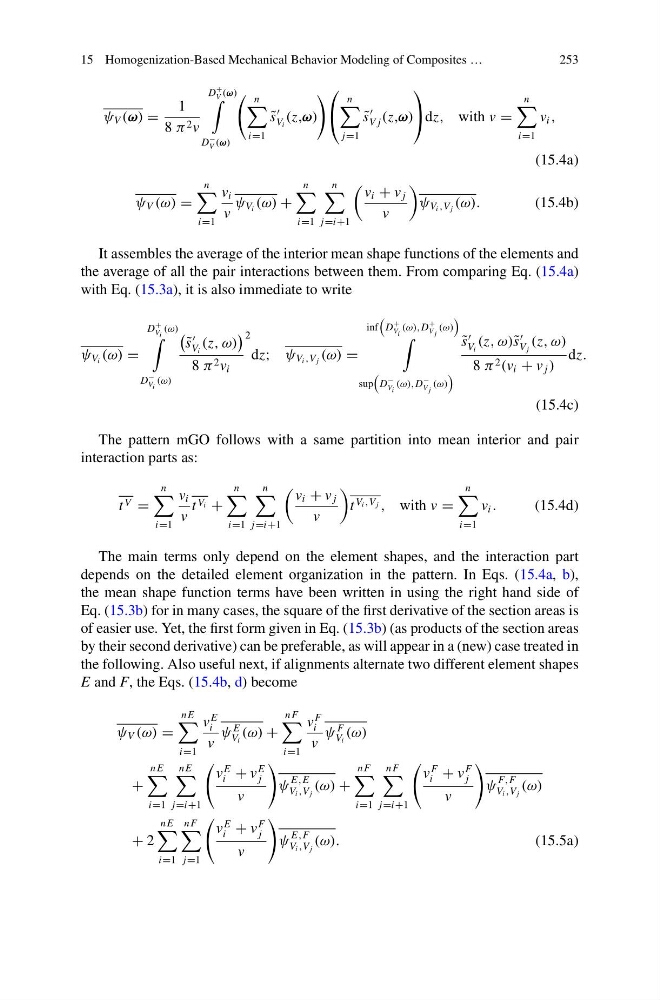
It assembles the average of the interior mean shape functions of the elements and
the average of all the pair interactions between them. From comparing Eq. (15.4a)
with Eq. (15.3a), it is also immediate to write
ψ V i (ω) =
D
+
V i
(ω)
D
−
V i
(ω)
˜
s
V i
(z, ω)
8 π 2 v i
2
dz; ψ V i ,V j (ω) =
inf
D
+
V i
(ω),D
+
V j
(ω)
sup
D
−
V i
(ω),D
−
V j
(ω)
˜
s
V i
(z, ω)˜ s
V j
(z, ω)
8 π 2 (v i + v j )
dz.
(15.4c)
The pattern mGO follows with a same partition into mean interior and pair
interaction parts as:
t V =
n
i=1
v i
v
t V i +
n
i=1
n
j=i+1
v i + v j
v
t V i ,V j , with v =
n
i=1
v i .
(15.4d)
The main terms only depend on the element shapes, and the interaction part
depends on the detailed element organization in the pattern. In Eqs. (15.4a, b),
the mean shape function terms have been written in using the right hand side of
Eq. (15.3b) for in many cases, the square of the first derivative of the section areas is
of easier use. Yet, the first form given in Eq. (15.3b) (as products of the section areas
by their second derivative) can be preferable, as will appear in a (new) case treated in
the following. Also useful next, if alignments alternate two different element shapes
E and F, the Eqs. (15.4b, d) become
ψ V (ω) =
nE
i=1
v
E
i
v
ψ
E
V i
(ω) +
nF
i=1
v
F
i
v
ψ
F
V i
(ω)
+
nE
i=1
nE
j=i+1
v
E
i + v
E
j
v
ψ
E,E
V i ,V j
(ω) +
nF
i=1
nF
j=i+1
v
F
i + v
F
j
v
ψ
F,F
V i ,V j
(ω)
+ 2
nE
i=1
nF
j=1
v
E
i + v
F
j
v
ψ
E,F
V i ,V j
(ω).
(15.5a)
253
ψ V (ω) =
1
8 π 2 v
D
+
V (ω)
D
−
V (ω)
n
i=1
˜
s
V i
(z,ω)
⎛
⎝
n
j=1
˜
s
V j (z,ω)
⎞
⎠ dz, with v =
n
i=1
v i ,
(15.4a)
ψ V (ω) =
n
i=1
v i
v
ψ V i (ω) +
n
i=1
n
j=i+1
v i + v j
v
ψ V i ,V j (ω).
(15.4b)
It assembles the average of the interior mean shape functions of the elements and
the average of all the pair interactions between them. From comparing Eq. (15.4a)
with Eq. (15.3a), it is also immediate to write
ψ V i (ω) =
D
+
V i
(ω)
D
−
V i
(ω)
˜
s
V i
(z, ω)
8 π 2 v i
2
dz; ψ V i ,V j (ω) =
inf
D
+
V i
(ω),D
+
V j
(ω)
sup
D
−
V i
(ω),D
−
V j
(ω)
˜
s
V i
(z, ω)˜ s
V j
(z, ω)
8 π 2 (v i + v j )
dz.
(15.4c)
The pattern mGO follows with a same partition into mean interior and pair
interaction parts as:
t V =
n
i=1
v i
v
t V i +
n
i=1
n
j=i+1
v i + v j
v
t V i ,V j , with v =
n
i=1
v i .
(15.4d)
The main terms only depend on the element shapes, and the interaction part
depends on the detailed element organization in the pattern. In Eqs. (15.4a, b),
the mean shape function terms have been written in using the right hand side of
Eq. (15.3b) for in many cases, the square of the first derivative of the section areas is
of easier use. Yet, the first form given in Eq. (15.3b) (as products of the section areas
by their second derivative) can be preferable, as will appear in a (new) case treated in
the following. Also useful next, if alignments alternate two different element shapes
E and F, the Eqs. (15.4b, d) become
ψ V (ω) =
nE
i=1
v
E
i
v
ψ
E
V i
(ω) +
nF
i=1
v
F
i
v
ψ
F
V i
(ω)
+
nE
i=1
nE
j=i+1
v
E
i + v
E
j
v
ψ
E,E
V i ,V j
(ω) +
nF
i=1
nF
j=i+1
v
F
i + v
F
j
v
ψ
F,F
V i ,V j
(ω)
+ 2
nE
i=1
nF
j=1
v
E
i + v
F
j
v
ψ
E,F
V i ,V j
(ω).
(15.5a)