

252
P. Franciosi and M. Spagnuolo
properties, of the coupled magneto-electro-elastic type. These GO sets remain valid
for any shape function to be considered according to Eq. (15.2a).
Conversely, the shape function in Eq. (15.2a) is only determined from the geometrical characteristics of the V “ domain” (single inclusion or pattern) under concern.
Once it is determined for some V, it can be used with any set of elementary GOs. Of
course, the difficulty remains in analytically solving the integrals in Eq. (15.2a) for
each independent term of the GO or mGO to be obtained.
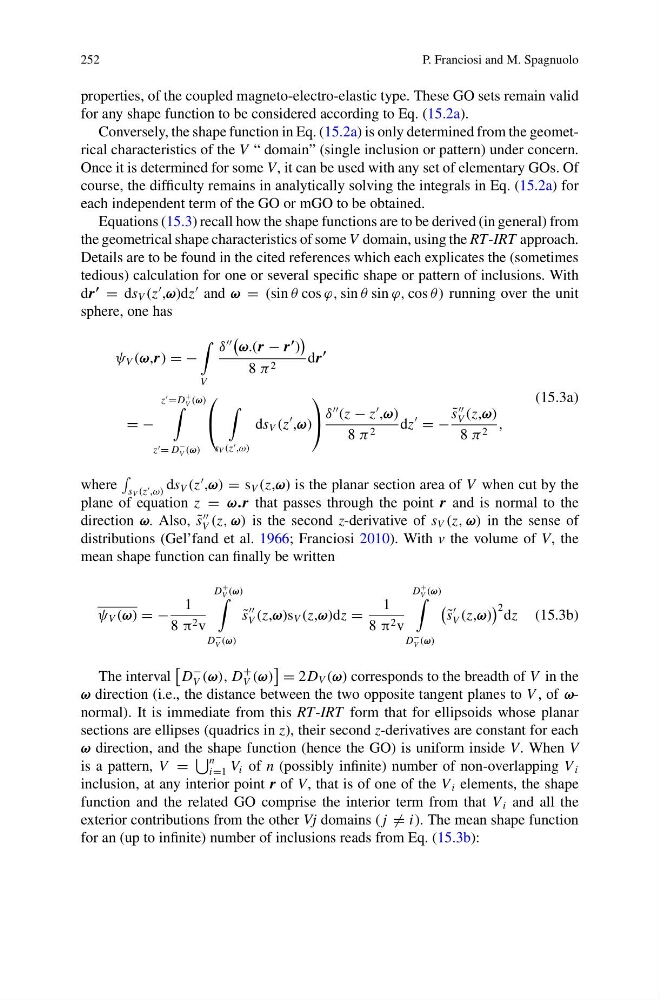
Equations (15.3) recall how the shape functions are to be derived (in general) from
the geometrical shape characteristics of some V domain, using the RT-IRT approach.
Details are to be found in the cited references which each explicates the (sometimes
tedious) calculation for one or several specific shape or pattern of inclusions. With
dr
= ds V (z
,ω)dz
and ω = (sin θ cos ϕ, sin θ sin ϕ, cos θ ) running over the unit
sphere, one has
ψ V (ω,r) = −
V
δ
ω.(r − r
)
8 π 2
dr
= −
z
=D
+
V (ω)
z = D
−
V (ω)
⎛
⎝
s V (z ,ω)
ds V (z
,ω)
⎞
⎠ δ
(z − z
,ω)
8 π 2
dz
= −
˜
s
V (z,ω)
8 π 2 ,
(15.3a)
where
s V (z ,ω) ds V (z
,ω) = s V (z,ω) is the planar section area of V when cut by the
plane of equation z = ω.r that passes through the point r and is normal to the
direction ω. Also, ˜
s
V (z, ω) is the second z-derivative of s V (z, ω) in the sense of
distributions (Gel’fand et al. 1966; Franciosi 2010). With v the volume of V, the
mean shape function can finally be written
ψ V (ω) = −
1
8 π 2 v
D
+
V (ω)
D
−
V (ω)
˜
s
V (z,ω)s V (z,ω)dz =
1
8 π 2 v
D
+
V (ω)
D
−
V (ω)
˜
s
V (z,ω)
2 dz (15.3b)
The interval
D
−
V (ω), D
+
V (ω)
= 2D V (ω) corresponds to the breadth of V in the
ω direction (i.e., the distance between the two opposite tangent planes to V , of ωnormal). It is immediate from this RT-IRT form that for ellipsoids whose planar
sections are ellipses (quadrics in z), their second z-derivatives are constant for each
ω direction, and the shape function (hence the GO) is uniform inside V. When V
is a pattern, V =
n
i=1 V i of n (possibly infinite) number of non-overlapping V i
inclusion, at any interior point r of V, that is of one of the V i elements, the shape
function and the related GO comprise the interior term from that V i and all the
exterior contributions from the other Vj domains ( j = i). The mean shape function
for an (up to infinite) number of inclusions reads from Eq. (15.3b):
P. Franciosi and M. Spagnuolo
properties, of the coupled magneto-electro-elastic type. These GO sets remain valid
for any shape function to be considered according to Eq. (15.2a).
Conversely, the shape function in Eq. (15.2a) is only determined from the geometrical characteristics of the V “ domain” (single inclusion or pattern) under concern.
Once it is determined for some V, it can be used with any set of elementary GOs. Of
course, the difficulty remains in analytically solving the integrals in Eq. (15.2a) for
each independent term of the GO or mGO to be obtained.
Equations (15.3) recall how the shape functions are to be derived (in general) from
the geometrical shape characteristics of some V domain, using the RT-IRT approach.
Details are to be found in the cited references which each explicates the (sometimes
tedious) calculation for one or several specific shape or pattern of inclusions. With
dr
= ds V (z
,ω)dz
and ω = (sin θ cos ϕ, sin θ sin ϕ, cos θ ) running over the unit
sphere, one has
ψ V (ω,r) = −
V
δ
ω.(r − r
)
8 π 2
dr
= −
z
=D
+
V (ω)
z = D
−
V (ω)
⎛
⎝
s V (z ,ω)
ds V (z
,ω)
⎞
⎠ δ
(z − z
,ω)
8 π 2
dz
= −
˜
s
V (z,ω)
8 π 2 ,
(15.3a)
where
s V (z ,ω) ds V (z
,ω) = s V (z,ω) is the planar section area of V when cut by the
plane of equation z = ω.r that passes through the point r and is normal to the
direction ω. Also, ˜
s
V (z, ω) is the second z-derivative of s V (z, ω) in the sense of
distributions (Gel’fand et al. 1966; Franciosi 2010). With v the volume of V, the
mean shape function can finally be written
ψ V (ω) = −
1
8 π 2 v
D
+
V (ω)
D
−
V (ω)
˜
s
V (z,ω)s V (z,ω)dz =
1
8 π 2 v
D
+
V (ω)
D
−
V (ω)
˜
s
V (z,ω)
2 dz (15.3b)
The interval
D
−
V (ω), D
+
V (ω)
= 2D V (ω) corresponds to the breadth of V in the
ω direction (i.e., the distance between the two opposite tangent planes to V , of ωnormal). It is immediate from this RT-IRT form that for ellipsoids whose planar
sections are ellipses (quadrics in z), their second z-derivatives are constant for each
ω direction, and the shape function (hence the GO) is uniform inside V. When V
is a pattern, V =
n
i=1 V i of n (possibly infinite) number of non-overlapping V i
inclusion, at any interior point r of V, that is of one of the V i elements, the shape
function and the related GO comprise the interior term from that V i and all the
exterior contributions from the other Vj domains ( j = i). The mean shape function
for an (up to infinite) number of inclusions reads from Eq. (15.3b):