

250
P. Franciosi and M. Spagnuolo
properties when trespassing concentrations limits. Hence, the PCW estimate form
which is recalled in Eq. (15.1a) involves one more GO than the HS estimate, independently on the mGOs for the inclusion shapes but with a request of consistency
with these shapes and their relative concentrations. In contrast with the inclusion
mGOs, owing to the request on the spatial distribution symmetry to be ellipsoidal,
this GO is uniform for it is the one of an ellipsoidal shape. If all the inclusions have
a same shape, they all have a same mGO (or GO if ellipsoids), and if this shape is
ellipsoidal and is represented by the same ellipsoidal GO as the one characterizing
the spatial distribution, total space filling by the inclusions is permitted and only
then. The same reasoning can be transposed from isolated inclusions to patterns of
them, with a spatial distribution GO applying to the patterns, with the smaller the
“lost” matrix volume fraction at the pattern boundary, when the larger the pattern
is. Infinite inclusion patterns become then a limit case for which the spatial distribution GO calls for a different interpretation. The cases of multi-phased pattern are
a more complex issue for which Eq. (15.1a) needs be modified (Fassi-Fehri et al.
1989; Franciosi and Charles 2016b) not to be considered here, yet evoked in the last
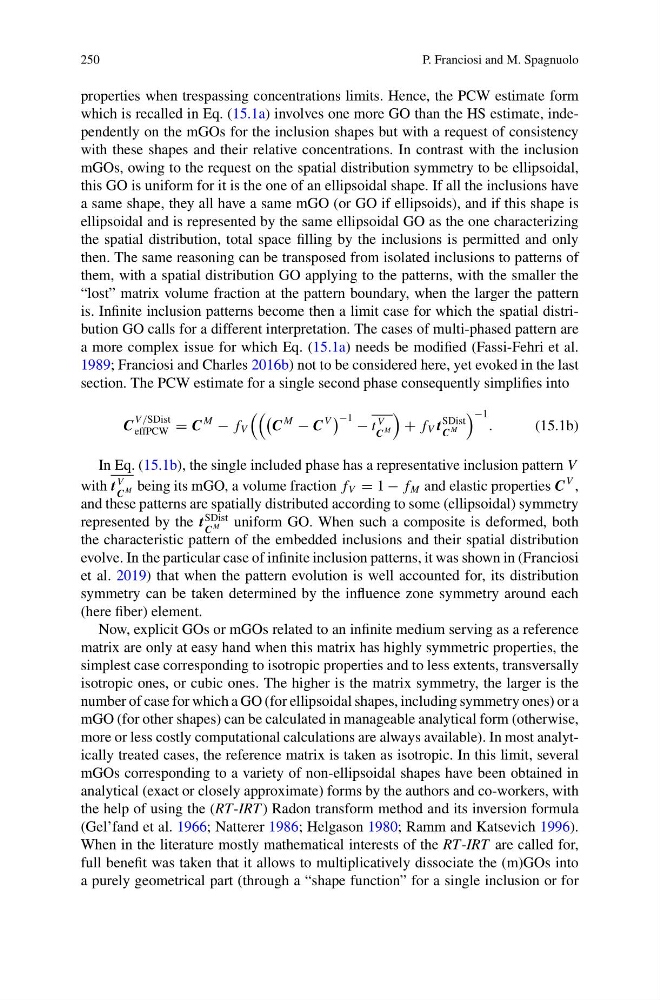
section. The PCW estimate for a single second phase consequently simplifies into
C
V /SDist
effPCW = C
M
− f V
C
M
− C
V
−1 − t
V
C
M
+ f V t
SDist
C
M
−1 .
(15.1b)
In Eq. (15.1b), the single included phase has a representative inclusion pattern V
with t
V
C
M being its mGO, a volume fraction f V = 1 − f M and elastic properties C
V ,
and these patterns are spatially distributed according to some (ellipsoidal) symmetry
represented by the t
SDist
C
M
uniform GO. When such a composite is deformed, both
the characteristic pattern of the embedded inclusions and their spatial distribution
evolve. In the particular case of infinite inclusion patterns, it was shown in (Franciosi
et al. 2019) that when the pattern evolution is well accounted for, its distribution
symmetry can be taken determined by the influence zone symmetry around each
(here fiber) element.
Now, explicit GOs or mGOs related to an infinite medium serving as a reference
matrix are only at easy hand when this matrix has highly symmetric properties, the
simplest case corresponding to isotropic properties and to less extents, transversally
isotropic ones, or cubic ones. The higher is the matrix symmetry, the larger is the
number of case for which a GO (for ellipsoidal shapes, including symmetry ones) or a
mGO (for other shapes) can be calculated in manageable analytical form (otherwise,
more or less costly computational calculations are always available). In most analytically treated cases, the reference matrix is taken as isotropic. In this limit, several
mGOs corresponding to a variety of non-ellipsoidal shapes have been obtained in
analytical (exact or closely approximate) forms by the authors and co-workers, with
the help of using the (RT-IRT ) Radon transform method and its inversion formula
(Gel’fand et al. 1966; Natterer 1986; Helgason 1980; Ramm and Katsevich 1996).
When in the literature mostly mathematical interests of the RT-IRT are called for,
full benefit was taken that it allows to multiplicatively dissociate the (m)GOs into
a purely geometrical part (through a “shape function” for a single inclusion or for
P. Franciosi and M. Spagnuolo
properties when trespassing concentrations limits. Hence, the PCW estimate form
which is recalled in Eq. (15.1a) involves one more GO than the HS estimate, independently on the mGOs for the inclusion shapes but with a request of consistency
with these shapes and their relative concentrations. In contrast with the inclusion
mGOs, owing to the request on the spatial distribution symmetry to be ellipsoidal,
this GO is uniform for it is the one of an ellipsoidal shape. If all the inclusions have
a same shape, they all have a same mGO (or GO if ellipsoids), and if this shape is
ellipsoidal and is represented by the same ellipsoidal GO as the one characterizing
the spatial distribution, total space filling by the inclusions is permitted and only
then. The same reasoning can be transposed from isolated inclusions to patterns of
them, with a spatial distribution GO applying to the patterns, with the smaller the
“lost” matrix volume fraction at the pattern boundary, when the larger the pattern
is. Infinite inclusion patterns become then a limit case for which the spatial distribution GO calls for a different interpretation. The cases of multi-phased pattern are
a more complex issue for which Eq. (15.1a) needs be modified (Fassi-Fehri et al.
1989; Franciosi and Charles 2016b) not to be considered here, yet evoked in the last
section. The PCW estimate for a single second phase consequently simplifies into
C
V /SDist
effPCW = C
M
− f V
C
M
− C
V
−1 − t
V
C
M
+ f V t
SDist
C
M
−1 .
(15.1b)
In Eq. (15.1b), the single included phase has a representative inclusion pattern V
with t
V
C
M being its mGO, a volume fraction f V = 1 − f M and elastic properties C
V ,
and these patterns are spatially distributed according to some (ellipsoidal) symmetry
represented by the t
SDist
C
M
uniform GO. When such a composite is deformed, both
the characteristic pattern of the embedded inclusions and their spatial distribution
evolve. In the particular case of infinite inclusion patterns, it was shown in (Franciosi
et al. 2019) that when the pattern evolution is well accounted for, its distribution
symmetry can be taken determined by the influence zone symmetry around each
(here fiber) element.
Now, explicit GOs or mGOs related to an infinite medium serving as a reference
matrix are only at easy hand when this matrix has highly symmetric properties, the
simplest case corresponding to isotropic properties and to less extents, transversally
isotropic ones, or cubic ones. The higher is the matrix symmetry, the larger is the
number of case for which a GO (for ellipsoidal shapes, including symmetry ones) or a
mGO (for other shapes) can be calculated in manageable analytical form (otherwise,
more or less costly computational calculations are always available). In most analytically treated cases, the reference matrix is taken as isotropic. In this limit, several
mGOs corresponding to a variety of non-ellipsoidal shapes have been obtained in
analytical (exact or closely approximate) forms by the authors and co-workers, with
the help of using the (RT-IRT ) Radon transform method and its inversion formula
(Gel’fand et al. 1966; Natterer 1986; Helgason 1980; Ramm and Katsevich 1996).
When in the literature mostly mathematical interests of the RT-IRT are called for,
full benefit was taken that it allows to multiplicatively dissociate the (m)GOs into
a purely geometrical part (through a “shape function” for a single inclusion or for