

15 Homogenization-Based Mechanical Behavior Modeling of Composites …
249
C
V j/SDist
effPCW = C
M
−
⎛
⎝
⎛
⎝
n
j=1
f V j
C
M
− C
V j
−1 − t
V j
C
M
−1
⎞
⎠
−1
+ t
SDist
C
M
⎞
⎠
−1
(15.1a)
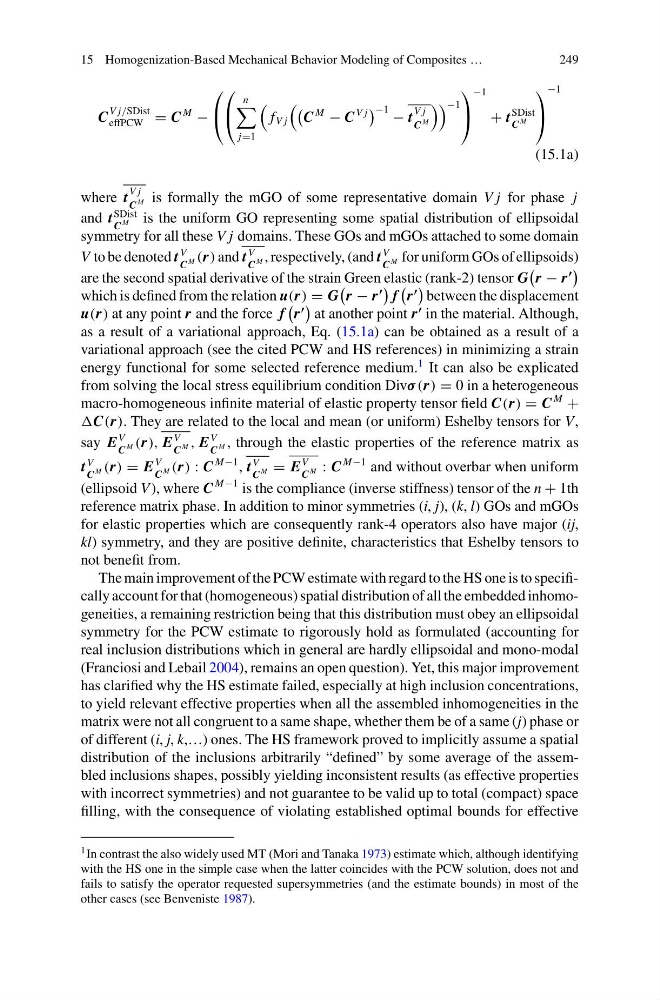
where t
V j
C
M is formally the mGO of some representative domain V j for phase j
and t
SDist
C
M
is the uniform GO representing some spatial distribution of ellipsoidal
symmetry for all these V j domains. These GOs and mGOs attached to some domain
V to be denoted t
V
C
M (r) and t
V
C
M , respectively, (and t
V
C
M for uniform GOs of ellipsoids)
are the second spatial derivative of the strain Green elastic (rank-2) tensor G
r − r
which is defined from the relation u(r) = G
r − r
f
r
between the displacement
u(r) at any point r and the force f
r
at another point r
in the material. Although,
as a result of a variational approach, Eq. (15.1a) can be obtained as a result of a
variational approach (see the cited PCW and HS references) in minimizing a strain
energy functional for some selected reference medium.
1 It can also be explicated
from solving the local stress equilibrium condition Divσ (r) = 0 in a heterogeneous
macro-homogeneous infinite material of elastic property tensor field C(r) = C
M
+
C(r). They are related to the local and mean (or uniform) Eshelby tensors for V,
say E
V
C
M (r), E
V
C
M , E
V
C
M , through the elastic properties of the reference matrix as
t
V
C
M (r) = E
V
C
M (r) : C
M−1 , t
V
C
M = E
V
C
M : C
M−1 and without overbar when uniform
(ellipsoid V ), where C
M−1 is the compliance (inverse stiffness) tensor of the n + 1th
reference matrix phase. In addition to minor symmetries (i, j), (k, l) GOs and mGOs
for elastic properties which are consequently rank-4 operators also have major (ij,
kl) symmetry, and they are positive definite, characteristics that Eshelby tensors to
not benefit from.
The main improvement of the PCW estimate with regard to the HS one is to specifically account for that (homogeneous) spatial distribution of all the embedded inhomogeneities, a remaining restriction being that this distribution must obey an ellipsoidal
symmetry for the PCW estimate to rigorously hold as formulated (accounting for
real inclusion distributions which in general are hardly ellipsoidal and mono-modal
(Franciosi and Lebail 2004), remains an open question). Yet, this major improvement
has clarified why the HS estimate failed, especially at high inclusion concentrations,
to yield relevant effective properties when all the assembled inhomogeneities in the
matrix were not all congruent to a same shape, whether them be of a same (j) phase or
of different (i, j, k,…) ones. The HS framework proved to implicitly assume a spatial
distribution of the inclusions arbitrarily “defined” by some average of the assembled inclusions shapes, possibly yielding inconsistent results (as effective properties
with incorrect symmetries) and not guarantee to be valid up to total (compact) space
filling, with the consequence of violating established optimal bounds for effective
1 In contrast the also widely used MT (Mori and Tanaka 1973) estimate which, although identifying
with the HS one in the simple case when the latter coincides with the PCW solution, does not and
fails to satisfy the operator requested supersymmetries (and the estimate bounds) in most of the
other cases (see Benveniste 1987).
249
C
V j/SDist
effPCW = C
M
−
⎛
⎝
⎛
⎝
n
j=1
f V j
C
M
− C
V j
−1 − t
V j
C
M
−1
⎞
⎠
−1
+ t
SDist
C
M
⎞
⎠
−1
(15.1a)
where t
V j
C
M is formally the mGO of some representative domain V j for phase j
and t
SDist
C
M
is the uniform GO representing some spatial distribution of ellipsoidal
symmetry for all these V j domains. These GOs and mGOs attached to some domain
V to be denoted t
V
C
M (r) and t
V
C
M , respectively, (and t
V
C
M for uniform GOs of ellipsoids)
are the second spatial derivative of the strain Green elastic (rank-2) tensor G
r − r
which is defined from the relation u(r) = G
r − r
f
r
between the displacement
u(r) at any point r and the force f
r
at another point r
in the material. Although,
as a result of a variational approach, Eq. (15.1a) can be obtained as a result of a
variational approach (see the cited PCW and HS references) in minimizing a strain
energy functional for some selected reference medium.
1 It can also be explicated
from solving the local stress equilibrium condition Divσ (r) = 0 in a heterogeneous
macro-homogeneous infinite material of elastic property tensor field C(r) = C
M
+
C(r). They are related to the local and mean (or uniform) Eshelby tensors for V,
say E
V
C
M (r), E
V
C
M , E
V
C
M , through the elastic properties of the reference matrix as
t
V
C
M (r) = E
V
C
M (r) : C
M−1 , t
V
C
M = E
V
C
M : C
M−1 and without overbar when uniform
(ellipsoid V ), where C
M−1 is the compliance (inverse stiffness) tensor of the n + 1th
reference matrix phase. In addition to minor symmetries (i, j), (k, l) GOs and mGOs
for elastic properties which are consequently rank-4 operators also have major (ij,
kl) symmetry, and they are positive definite, characteristics that Eshelby tensors to
not benefit from.
The main improvement of the PCW estimate with regard to the HS one is to specifically account for that (homogeneous) spatial distribution of all the embedded inhomogeneities, a remaining restriction being that this distribution must obey an ellipsoidal
symmetry for the PCW estimate to rigorously hold as formulated (accounting for
real inclusion distributions which in general are hardly ellipsoidal and mono-modal
(Franciosi and Lebail 2004), remains an open question). Yet, this major improvement
has clarified why the HS estimate failed, especially at high inclusion concentrations,
to yield relevant effective properties when all the assembled inhomogeneities in the
matrix were not all congruent to a same shape, whether them be of a same (j) phase or
of different (i, j, k,…) ones. The HS framework proved to implicitly assume a spatial
distribution of the inclusions arbitrarily “defined” by some average of the assembled inclusions shapes, possibly yielding inconsistent results (as effective properties
with incorrect symmetries) and not guarantee to be valid up to total (compact) space
filling, with the consequence of violating established optimal bounds for effective
1 In contrast the also widely used MT (Mori and Tanaka 1973) estimate which, although identifying
with the HS one in the simple case when the latter coincides with the PCW solution, does not and
fails to satisfy the operator requested supersymmetries (and the estimate bounds) in most of the
other cases (see Benveniste 1987).