

98
L. Igumnov et al.
and rolling of viscoelastic cylinder along the foundation of the same material are
represented. In the work (Grigoryan 1993), solution of the problem concerning body
penetration in soil ground is represented, but mathematical model of this medium
does not describe its hereditary properties, stresses in contact area, and contact forces
which are found using the relations obtained experimentally. Besides, non-stationary
regime of motion is not considered.
In accessible literature on the whole, solutions of non-stationary viscoelastic
dynamic contact problems are not represented. In this work for the first time, solution of non-stationary dynamic plane problem concerning interaction of absolutely
rigid striker with viscoelastic half plane, hereditary properties of which material are
described by Koltunov kernel, is obtained.
7.2 Problem Statement
In a rectangular Cartesian coordinate system, we consider viscoelastic half-plane
x 3 ≥ 0. At the initial time t = 0 an absolutely rigid striker of mass m starts indenting
into the half plane.
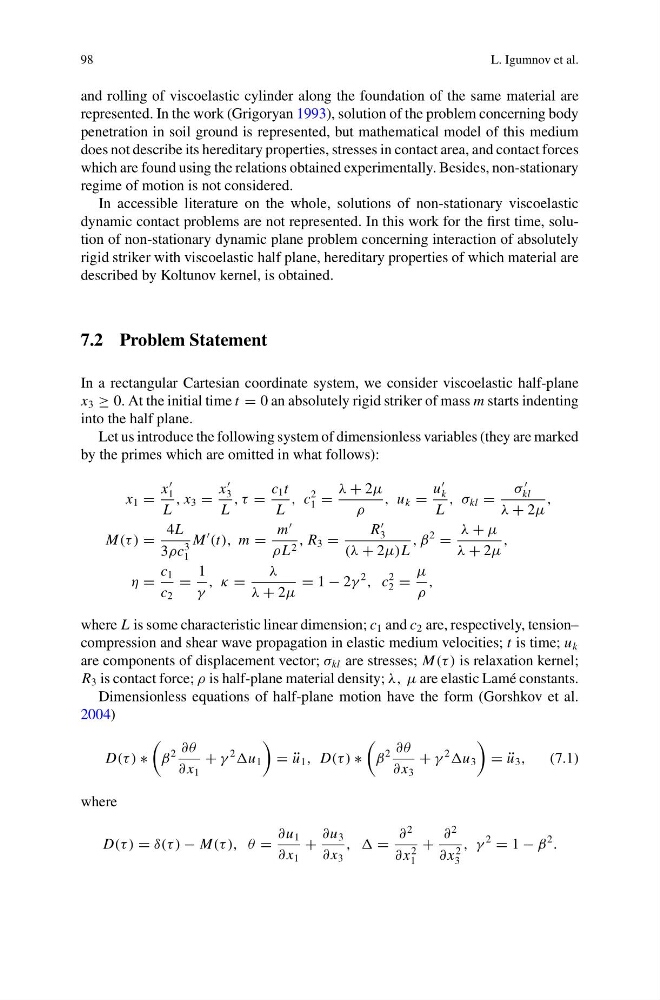
Let us introduce the following system of dimensionless variables (they are marked
by the primes which are omitted in what follows):
x 1 =
x
1
L
, x 3 =
x
3
L
, τ =
c 1 t
L
, c
2
1 =
λ + 2μ
ρ
, u k =
u
k
L
, σ kl =
σ
kl
λ + 2μ
,
M(τ ) =
4L
3ρc
3
1
M
(t), m =
m
ρ L 2 , R 3 =
R
3
(λ + 2μ)L
, β
2
=
λ + μ
λ + 2μ
,
η =
c 1
c 2
=
1
γ
, κ =
λ
λ + 2μ
= 1 − 2γ
2
, c
2
2 =
μ
ρ
,
where L is some characteristic linear dimension; c 1 and c 2 are, respectively, tension–
compression and shear wave propagation in elastic medium velocities; t is time; u k
are components of displacement vector; σ kl are stresses; M(τ ) is relaxation kernel;
R 3 is contact force; ρ is half-plane material density; λ, μ are elastic Lamé constants.
Dimensionless equations of half-plane motion have the form (Gorshkov et al.
2004)
D(τ ) ∗
β
2 ∂θ
∂ x 1
+ γ
2
u 1
= ¨
u 1 , D(τ ) ∗
β
2 ∂θ
∂ x 3
+ γ
2
u 3
= ¨
u 3 ,
(7.1)
where
D(τ ) = δ(τ ) − M(τ ), θ =
∂u 1
∂ x 1
+
∂u 3
∂ x 3
, , =
∂
2
∂ x
2
1
+
∂
2
∂ x
2
3
, γ
2
= 1 − β
2
.
L. Igumnov et al.
and rolling of viscoelastic cylinder along the foundation of the same material are
represented. In the work (Grigoryan 1993), solution of the problem concerning body
penetration in soil ground is represented, but mathematical model of this medium
does not describe its hereditary properties, stresses in contact area, and contact forces
which are found using the relations obtained experimentally. Besides, non-stationary
regime of motion is not considered.
In accessible literature on the whole, solutions of non-stationary viscoelastic
dynamic contact problems are not represented. In this work for the first time, solution of non-stationary dynamic plane problem concerning interaction of absolutely
rigid striker with viscoelastic half plane, hereditary properties of which material are
described by Koltunov kernel, is obtained.
7.2 Problem Statement
In a rectangular Cartesian coordinate system, we consider viscoelastic half-plane
x 3 ≥ 0. At the initial time t = 0 an absolutely rigid striker of mass m starts indenting
into the half plane.
Let us introduce the following system of dimensionless variables (they are marked
by the primes which are omitted in what follows):
x 1 =
x
1
L
, x 3 =
x
3
L
, τ =
c 1 t
L
, c
2
1 =
λ + 2μ
ρ
, u k =
u
k
L
, σ kl =
σ
kl
λ + 2μ
,
M(τ ) =
4L
3ρc
3
1
M
(t), m =
m
ρ L 2 , R 3 =
R
3
(λ + 2μ)L
, β
2
=
λ + μ
λ + 2μ
,
η =
c 1
c 2
=
1
γ
, κ =
λ
λ + 2μ
= 1 − 2γ
2
, c
2
2 =
μ
ρ
,
where L is some characteristic linear dimension; c 1 and c 2 are, respectively, tension–
compression and shear wave propagation in elastic medium velocities; t is time; u k
are components of displacement vector; σ kl are stresses; M(τ ) is relaxation kernel;
R 3 is contact force; ρ is half-plane material density; λ, μ are elastic Lamé constants.
Dimensionless equations of half-plane motion have the form (Gorshkov et al.
2004)
D(τ ) ∗
β
2 ∂θ
∂ x 1
+ γ
2
u 1
= ¨
u 1 , D(τ ) ∗
β
2 ∂θ
∂ x 3
+ γ
2
u 3
= ¨
u 3 ,
(7.1)
where
D(τ ) = δ(τ ) − M(τ ), θ =
∂u 1
∂ x 1
+
∂u 3
∂ x 3
, , =
∂
2
∂ x
2
1
+
∂
2
∂ x
2
3
, γ
2
= 1 − β
2
.