

90
L. Igumnov et al.
analytical method of modal expansion developed by Zheltkov (Jeltkov et al. 1993).
A method being developed by Lychev is based on representing the solutions of the
problems under consideration in the form of a spectral expansion with biorthogonal
systems of the eigenfunctions of mutually conjugated pencils of differential operators (Lycheva and Lychev 2016). Laplace time transformation followed by inversion
is the most common procedure of constructing the solutions of the considered problems (Christensen 1982; Filippov and Cheban 1988; Egorychev and Poddayeva 2006;
Colombaro et al. 2017).
In addition to the works mentioned above, one can refer to a lot of others (for
instance, Lokshin 1982; Amendola et al. 2012; Kurbanov and Nasibzada 2015),
however, let us remark here that the mathematical complexity significantly limits
the class of the studied problems. So, even for one-dimensional non-stationary wave
processes the most results were received either in a limited time range or with low
viscosity or they were represented in a hardly analyzable form.
The purpose of this work is to consider the issues related to constructing the solutions of problems of the above-noted types with a time-independent Poisson’s ratio.
We note that the process of constructing of the solution of non-stationary dynamic
problems for linear viscoelastic bodies with a time-independent Poisson’s ratio using
the Laplace transform in time was considered earlier in the work (Christensen 1982)
and some others. In this paper, the attention is paid to the conditions under which
the poles of the solution in transforms are simple, and there are no branch points.
6.2 Mathematical Statement of Problem
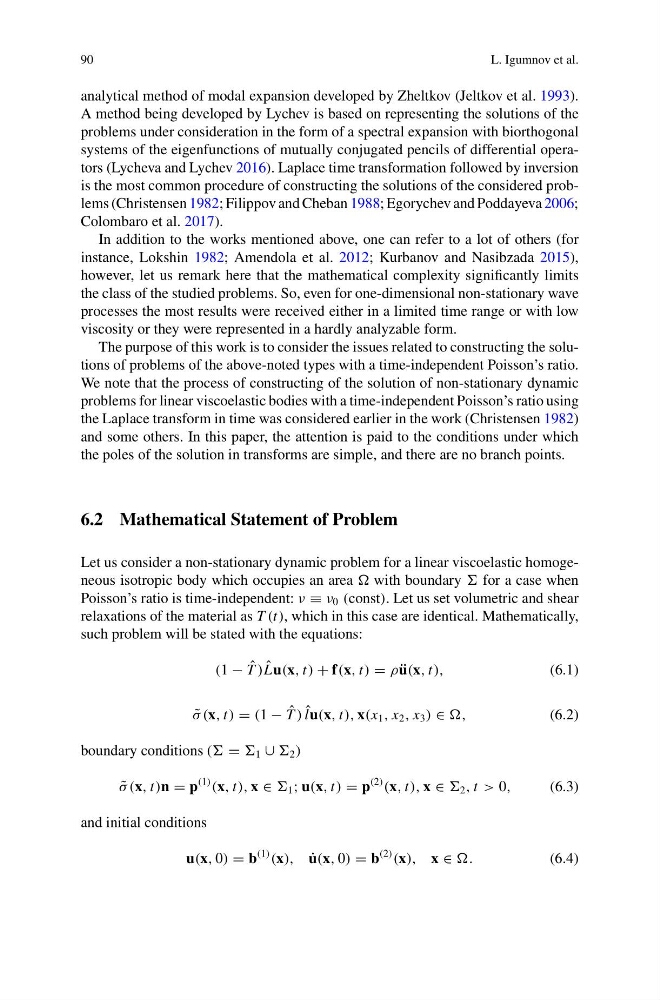
Let us consider a non-stationary dynamic problem for a linear viscoelastic homogeneous isotropic body which occupies an area with boundary for a case when
Poisson’s ratio is time-independent: ν ≡ ν 0 (const). Let us set volumetric and shear
relaxations of the material as T (t), which in this case are identical. Mathematically,
such problem will be stated with the equations:
(1 − ˆ
T ) ˆ
Lu(x, t) + f(x, t) = ρ ¨
u(x, t),
(6.1)
˜
σ (x, t) = (1 − ˆ
T ) ˆ
lu(x, t), x(x 1 , x 2 , x 3 ) ∈ ,
(6.2)
boundary conditions ( = 1 ∪ 2 )
˜
σ (x, t)n = p
(1)
(x, t), x ∈ 1 ; u(x, t) = p
(2)
(x, t), x ∈ 2 , t > 0,
(6.3)
and initial conditions
u(x, 0) = b
(1)
(x), ˙
u(x, 0) = b
(2)
(x), x ∈ .
(6.4)
L. Igumnov et al.
analytical method of modal expansion developed by Zheltkov (Jeltkov et al. 1993).
A method being developed by Lychev is based on representing the solutions of the
problems under consideration in the form of a spectral expansion with biorthogonal
systems of the eigenfunctions of mutually conjugated pencils of differential operators (Lycheva and Lychev 2016). Laplace time transformation followed by inversion
is the most common procedure of constructing the solutions of the considered problems (Christensen 1982; Filippov and Cheban 1988; Egorychev and Poddayeva 2006;
Colombaro et al. 2017).
In addition to the works mentioned above, one can refer to a lot of others (for
instance, Lokshin 1982; Amendola et al. 2012; Kurbanov and Nasibzada 2015),
however, let us remark here that the mathematical complexity significantly limits
the class of the studied problems. So, even for one-dimensional non-stationary wave
processes the most results were received either in a limited time range or with low
viscosity or they were represented in a hardly analyzable form.
The purpose of this work is to consider the issues related to constructing the solutions of problems of the above-noted types with a time-independent Poisson’s ratio.
We note that the process of constructing of the solution of non-stationary dynamic
problems for linear viscoelastic bodies with a time-independent Poisson’s ratio using
the Laplace transform in time was considered earlier in the work (Christensen 1982)
and some others. In this paper, the attention is paid to the conditions under which
the poles of the solution in transforms are simple, and there are no branch points.
6.2 Mathematical Statement of Problem
Let us consider a non-stationary dynamic problem for a linear viscoelastic homogeneous isotropic body which occupies an area with boundary for a case when
Poisson’s ratio is time-independent: ν ≡ ν 0 (const). Let us set volumetric and shear
relaxations of the material as T (t), which in this case are identical. Mathematically,
such problem will be stated with the equations:
(1 − ˆ
T ) ˆ
Lu(x, t) + f(x, t) = ρ ¨
u(x, t),
(6.1)
˜
σ (x, t) = (1 − ˆ
T ) ˆ
lu(x, t), x(x 1 , x 2 , x 3 ) ∈ ,
(6.2)
boundary conditions ( = 1 ∪ 2 )
˜
σ (x, t)n = p
(1)
(x, t), x ∈ 1 ; u(x, t) = p
(2)
(x, t), x ∈ 2 , t > 0,
(6.3)
and initial conditions
u(x, 0) = b
(1)
(x), ˙
u(x, 0) = b
(2)
(x), x ∈ .
(6.4)