

463
the membrane design. Nano-emulsions have been developed as
well that are sprayed directly onto skins and can have better efficacy
than conventional emulsions. Various kinds of nanospheres within
host matrix systems are in use.
Various kinds of lipid forms are also important as vehicles. Lipids
are organic compounds that are not soluble in water but that
dissolve in substances such as alcohol (they are typically “fatty”
or “oily”). Solid forms of lipid nanoparticles have been developed
to carry active ingredients. More complex forms include nanosized liposomes. Liposomes are synthetic vesicles with aqueous
cores surrounded by one or more phospholipid membranes.
They have a hydrophobic cavity and a polar cavity and can
en capsulate different active substances. Oil-soluble substances can
be carried in their hydrophobic cavities and water soluble ones in
the other cavity. These small lipid particles can be absorbed and
penetrate skin easily. Simpler nanosomes can carry lipophilic materials. They have single layers with polar heads directed outward and
tails inward.
Many issues are of basic importance in using nanomaterials either
directly or as carriers. As noted, types of cosmetics vary widely in
terms of their functions, modes of application, and target locations for active ingredients. In many situations, functions can be
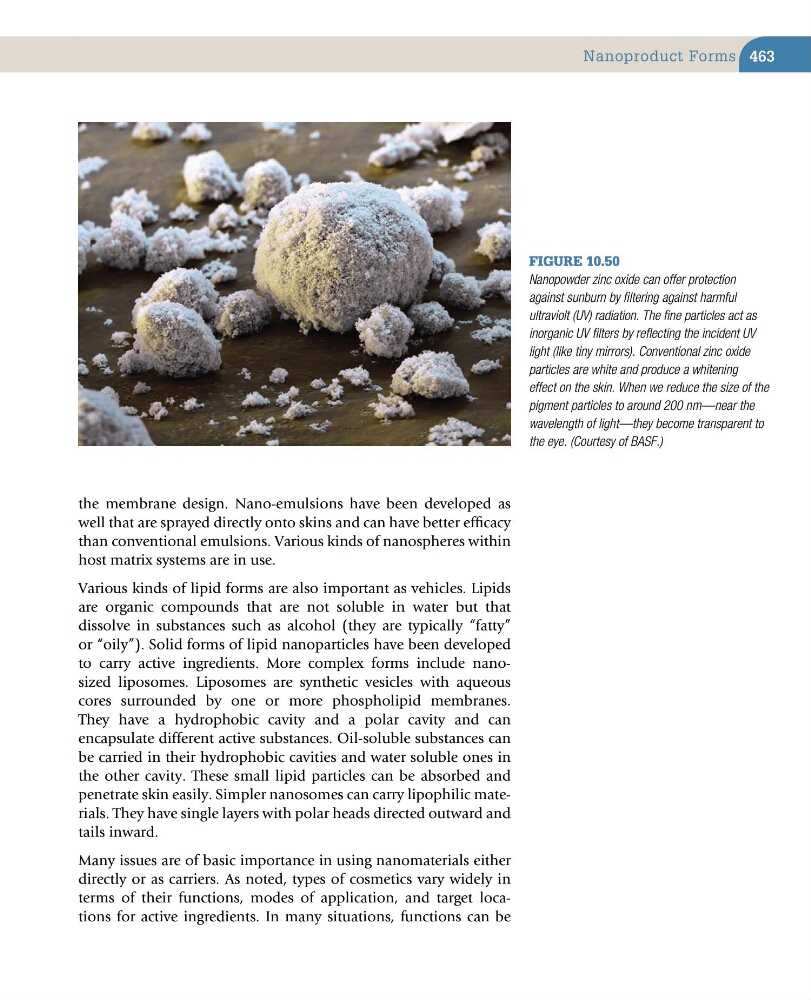
Figure 10.50
Nanopowder zinc oxide can offer protection
against sunburn by filtering against harmful
ultraviolt (UV) radiation. The fine particles act as
inorganic UV filters by reflecting the incident UV
light (like tiny mirrors). Conventional zinc oxide
particles are white and produce a whitening
effect on the skin. When we reduce the size of the
pigment particles to around 200 nm—near the
wavelength of light—they become transparent to
the eye. (Courtesy of BASF.)
Nanoproduct Forms
the membrane design. Nano-emulsions have been developed as
well that are sprayed directly onto skins and can have better efficacy
than conventional emulsions. Various kinds of nanospheres within
host matrix systems are in use.
Various kinds of lipid forms are also important as vehicles. Lipids
are organic compounds that are not soluble in water but that
dissolve in substances such as alcohol (they are typically “fatty”
or “oily”). Solid forms of lipid nanoparticles have been developed
to carry active ingredients. More complex forms include nanosized liposomes. Liposomes are synthetic vesicles with aqueous
cores surrounded by one or more phospholipid membranes.
They have a hydrophobic cavity and a polar cavity and can
en capsulate different active substances. Oil-soluble substances can
be carried in their hydrophobic cavities and water soluble ones in
the other cavity. These small lipid particles can be absorbed and
penetrate skin easily. Simpler nanosomes can carry lipophilic materials. They have single layers with polar heads directed outward and
tails inward.
Many issues are of basic importance in using nanomaterials either
directly or as carriers. As noted, types of cosmetics vary widely in
terms of their functions, modes of application, and target locations for active ingredients. In many situations, functions can be
Figure 10.50
Nanopowder zinc oxide can offer protection
against sunburn by filtering against harmful
ultraviolt (UV) radiation. The fine particles act as
inorganic UV filters by reflecting the incident UV
light (like tiny mirrors). Conventional zinc oxide
particles are white and produce a whitening
effect on the skin. When we reduce the size of the
pigment particles to around 200 nm—near the
wavelength of light—they become transparent to
the eye. (Courtesy of BASF.)
Nanoproduct Forms