

37
shrinking, and decaying, preservationists immediately treated it
with polyetheylene glycol (PEG) by intermittent spraying and slow
drying. It was moved to the Vasa Museum in Stockholm, where
alarming rates of acidity increases in the wood were observed and
again threatened the hull by acid wood hydrolysis. Sulfuric acids
were proving especially harmful. The development of sulfurs was
traced back to metabolic actions of bacteria in the harbor water
and was subsequently oxidized by the iron released from longcorroded bolts as well as from more recent ones put in during
salvaging. Preservation efforts focused on removing iron and sulfur
compounds. Neutralization treatments using alkali solutions
helped in only outer wood layers and can potentially cause cellulose degradation itself.
A new method of neutralizing the acids by the use of nanoparticles has recently been explored by the group from the University of Florence, mentioned previously. The immediate preservation
focus was to slow the production of acids inside the wood and,
if possible, remove the iron (or render it inactive) and sulfur.
Prior treatments and conditions further complicated the problem.
The Florence group focused on deacidification. Wood samples
were obtained from the Vasa and then treated with an alkaline
solution was used to remove the PEG, which would prevent
nanoparticles from penetrating the wood and provide neutralization. Nanoparticles of calcium hydroxide were synthesized and
samples soaked in an alkaline nanoparticle dispersion (see Figure
2.29). Progress of the penetration of the nanoparticles through
the wood was tracked with the aid of scanning electron microscopes (SEM analysis—see Chapter 7). The nanoparticles were
found to adhere to wall fibers and the dispersion medium volatized, leaving an alkaline presence. The application led to a
marked decrease in the pH levels present (reduced acidity). Other
benefits were noted as well.
Work with nanotechnology has only recently been emerging in the
conservation area, but initial results look very promising. Later
chapters will look at other nano-based techniques that may prove
beneficial in conserving our cultural heritage. For instance, the airborne pollutants from traffic or smog, which are known to attack
the surface of sculptures and architectural monuments made of
marble and other stones that form part of the cultural experience
of our finest urban environments, might be combated with the
self-cleaning actions of certain kinds of nanomaterials described in
Chapter 10. Indeed, the potential value of inert self-cleaning surface
treatments would be literally enormous, but considerable gaps
Nanomaterials in Art and Cultural Heritage
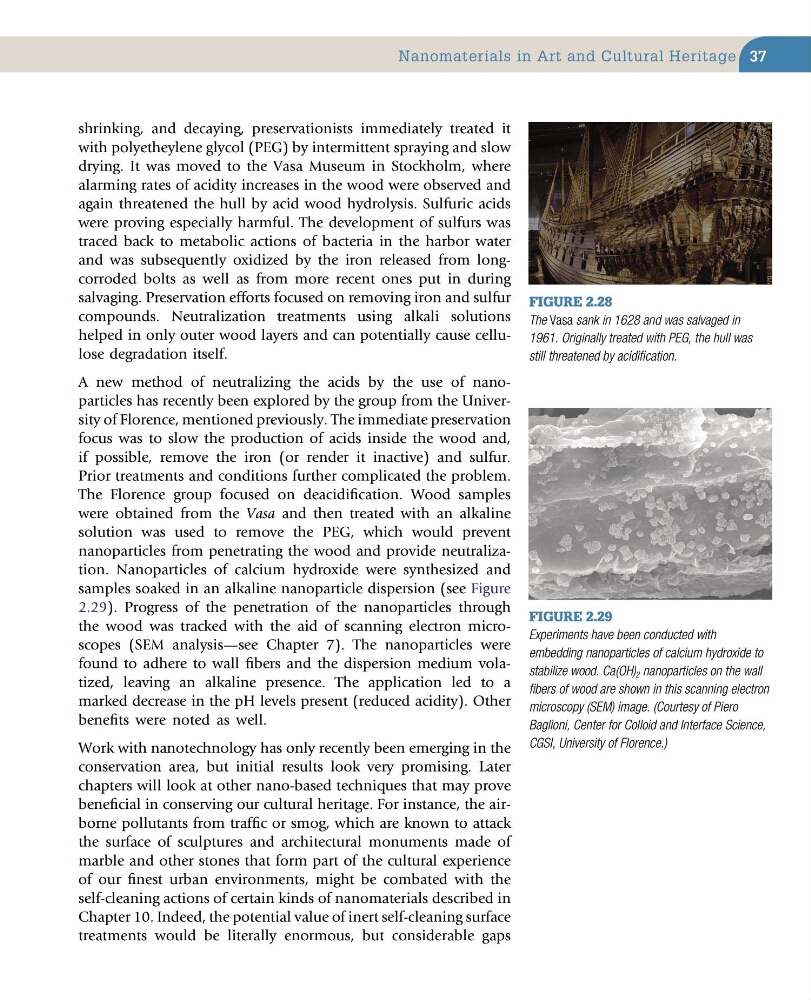
Figure 2.28
The Vasa sank in 1628 and was salvaged in
1961. Originally treated with PEG, the hull was
still threatened by acidification.
Figure 2.29
Experiments have been conducted with
embedding nanoparticles of calcium hydroxide to
stabilize wood. Ca(OH) 2 nanoparticles on the wall
fibers of wood are shown in this scanning electron
microscopy (SEM) image. (Courtesy of Piero
Baglioni, Center for Colloid and Interface Science,
CGSI, University of Florence.)
shrinking, and decaying, preservationists immediately treated it
with polyetheylene glycol (PEG) by intermittent spraying and slow
drying. It was moved to the Vasa Museum in Stockholm, where
alarming rates of acidity increases in the wood were observed and
again threatened the hull by acid wood hydrolysis. Sulfuric acids
were proving especially harmful. The development of sulfurs was
traced back to metabolic actions of bacteria in the harbor water
and was subsequently oxidized by the iron released from longcorroded bolts as well as from more recent ones put in during
salvaging. Preservation efforts focused on removing iron and sulfur
compounds. Neutralization treatments using alkali solutions
helped in only outer wood layers and can potentially cause cellulose degradation itself.
A new method of neutralizing the acids by the use of nanoparticles has recently been explored by the group from the University of Florence, mentioned previously. The immediate preservation
focus was to slow the production of acids inside the wood and,
if possible, remove the iron (or render it inactive) and sulfur.
Prior treatments and conditions further complicated the problem.
The Florence group focused on deacidification. Wood samples
were obtained from the Vasa and then treated with an alkaline
solution was used to remove the PEG, which would prevent
nanoparticles from penetrating the wood and provide neutralization. Nanoparticles of calcium hydroxide were synthesized and
samples soaked in an alkaline nanoparticle dispersion (see Figure
2.29). Progress of the penetration of the nanoparticles through
the wood was tracked with the aid of scanning electron microscopes (SEM analysis—see Chapter 7). The nanoparticles were
found to adhere to wall fibers and the dispersion medium volatized, leaving an alkaline presence. The application led to a
marked decrease in the pH levels present (reduced acidity). Other
benefits were noted as well.
Work with nanotechnology has only recently been emerging in the
conservation area, but initial results look very promising. Later
chapters will look at other nano-based techniques that may prove
beneficial in conserving our cultural heritage. For instance, the airborne pollutants from traffic or smog, which are known to attack
the surface of sculptures and architectural monuments made of
marble and other stones that form part of the cultural experience
of our finest urban environments, might be combated with the
self-cleaning actions of certain kinds of nanomaterials described in
Chapter 10. Indeed, the potential value of inert self-cleaning surface
treatments would be literally enormous, but considerable gaps
Nanomaterials in Art and Cultural Heritage
Figure 2.28
The Vasa sank in 1628 and was salvaged in
1961. Originally treated with PEG, the hull was
still threatened by acidification.
Figure 2.29
Experiments have been conducted with
embedding nanoparticles of calcium hydroxide to
stabilize wood. Ca(OH) 2 nanoparticles on the wall
fibers of wood are shown in this scanning electron
microscopy (SEM) image. (Courtesy of Piero
Baglioni, Center for Colloid and Interface Science,
CGSI, University of Florence.)