

CHApter 2 An evolutionary perspective
36
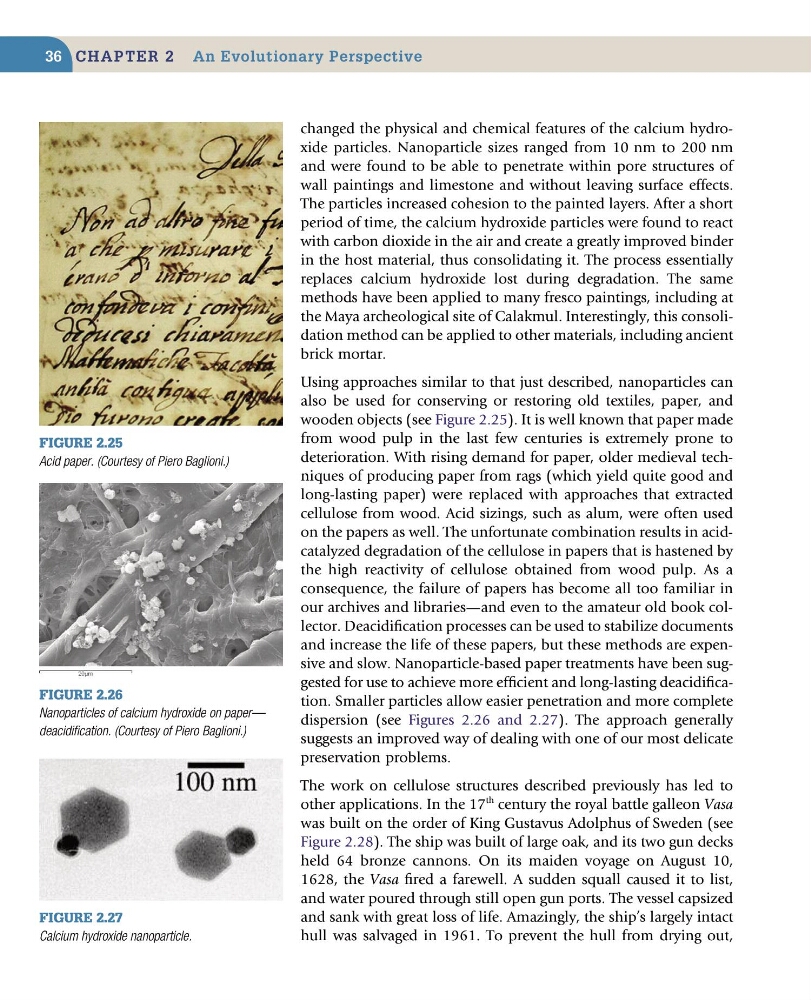
Figure 2.25
Acid paper. (Courtesy of Piero Baglioni.)
Figure 2.26
Nanoparticles of calcium hydroxide on paper—
deacidification. (Courtesy of Piero Baglioni.)
Figure 2.27
Calcium hydroxide nanoparticle.
changed the physical and chemical features of the calcium hydroxide particles. Nanoparticle sizes ranged from 10 nm to 200 nm
and were found to be able to penetrate within pore structures of
wall paintings and limestone and without leaving surface effects.
The particles increased cohesion to the painted layers. After a short
period of time, the calcium hydroxide particles were found to react
with carbon dioxide in the air and create a greatly improved binder
in the host material, thus consolidating it. The process essentially
replaces calcium hydroxide lost during degradation. The same
methods have been applied to many fresco paintings, including at
the Maya archeological site of Calakmul. Interestingly, this consolidation method can be applied to other materials, including ancient
brick mortar.
Using approaches similar to that just described, nanoparticles can
also be used for conserving or restoring old textiles, paper, and
wooden objects (see Figure 2.25). It is well known that paper made
from wood pulp in the last few centuries is extremely prone to
deterioration. With rising demand for paper, older medieval techniques of producing paper from rags (which yield quite good and
long-lasting paper) were replaced with approaches that extracted
cellulose from wood. Acid sizings, such as alum, were often used
on the papers as well. The unfortunate combination results in acidcatalyzed degradation of the cellulose in papers that is hastened by
the high reactivity of cellulose obtained from wood pulp. As a
consequence, the failure of papers has become all too familiar in
our archives and libraries—and even to the amateur old book collector. Deacidification processes can be used to stabilize documents
and increase the life of these papers, but these methods are expensive and slow. Nanoparticle-based paper treatments have been suggested for use to achieve more efficient and long-lasting deacidification. Smaller particles allow easier penetration and more complete
dispersion (see Figures 2.26 and 2.27). The approach generally
suggests an improved way of dealing with one of our most delicate
preservation problems.
The work on cellulose structures described previously has led to
other applications. In the 17
th century the royal battle galleon Vasa
was built on the order of King Gustavus Adolphus of Sweden (see
Figure 2.28). The ship was built of large oak, and its two gun decks
held 64 bronze cannons. On its maiden voyage on August 10,
1628, the Vasa fired a farewell. A sudden squall caused it to list,
and water poured through still open gun ports. The vessel capsized
and sank with great loss of life. Amazingly, the ship’s largely intact
hull was salvaged in 1961. To prevent the hull from drying out,
36
Figure 2.25
Acid paper. (Courtesy of Piero Baglioni.)
Figure 2.26
Nanoparticles of calcium hydroxide on paper—
deacidification. (Courtesy of Piero Baglioni.)
Figure 2.27
Calcium hydroxide nanoparticle.
changed the physical and chemical features of the calcium hydroxide particles. Nanoparticle sizes ranged from 10 nm to 200 nm
and were found to be able to penetrate within pore structures of
wall paintings and limestone and without leaving surface effects.
The particles increased cohesion to the painted layers. After a short
period of time, the calcium hydroxide particles were found to react
with carbon dioxide in the air and create a greatly improved binder
in the host material, thus consolidating it. The process essentially
replaces calcium hydroxide lost during degradation. The same
methods have been applied to many fresco paintings, including at
the Maya archeological site of Calakmul. Interestingly, this consolidation method can be applied to other materials, including ancient
brick mortar.
Using approaches similar to that just described, nanoparticles can
also be used for conserving or restoring old textiles, paper, and
wooden objects (see Figure 2.25). It is well known that paper made
from wood pulp in the last few centuries is extremely prone to
deterioration. With rising demand for paper, older medieval techniques of producing paper from rags (which yield quite good and
long-lasting paper) were replaced with approaches that extracted
cellulose from wood. Acid sizings, such as alum, were often used
on the papers as well. The unfortunate combination results in acidcatalyzed degradation of the cellulose in papers that is hastened by
the high reactivity of cellulose obtained from wood pulp. As a
consequence, the failure of papers has become all too familiar in
our archives and libraries—and even to the amateur old book collector. Deacidification processes can be used to stabilize documents
and increase the life of these papers, but these methods are expensive and slow. Nanoparticle-based paper treatments have been suggested for use to achieve more efficient and long-lasting deacidification. Smaller particles allow easier penetration and more complete
dispersion (see Figures 2.26 and 2.27). The approach generally
suggests an improved way of dealing with one of our most delicate
preservation problems.
The work on cellulose structures described previously has led to
other applications. In the 17
th century the royal battle galleon Vasa
was built on the order of King Gustavus Adolphus of Sweden (see
Figure 2.28). The ship was built of large oak, and its two gun decks
held 64 bronze cannons. On its maiden voyage on August 10,
1628, the Vasa fired a farewell. A sudden squall caused it to list,
and water poured through still open gun ports. The vessel capsized
and sank with great loss of life. Amazingly, the ship’s largely intact
hull was salvaged in 1961. To prevent the hull from drying out,