

445
forces and some capillary action (see Chapter 5 that discusses Van
der Waals’ forces). These are kinds of forces that hold small solids
and liquids together. They are relatively weak forces, but the high
contact area of the spatula results in an appreciable overall sticking force. Mimicking this adhesive behavior, particularly the reversibility (sticking and unsticking) necessary for the gecko to run up
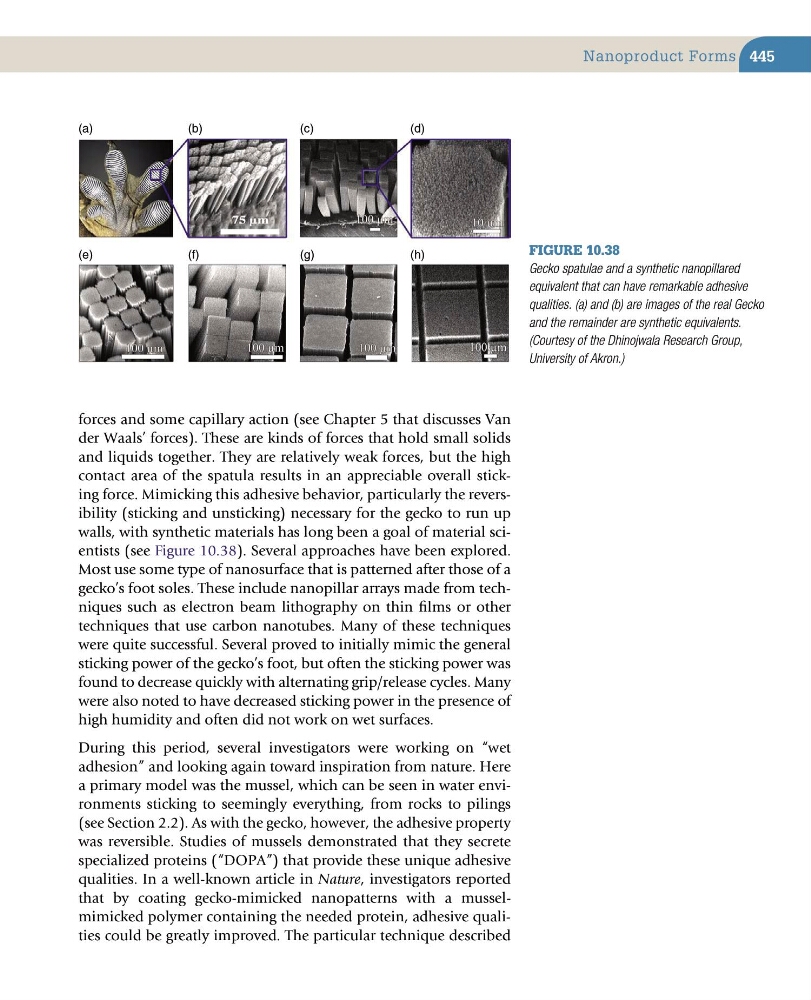
walls, with synthetic materials has long been a goal of material scientists (see Figure 10.38). Several approaches have been explored.
Most use some type of nanosurface that is patterned after those of a
gecko’s foot soles. These include nanopillar arrays made from techniques such as electron beam lithography on thin films or other
techniques that use carbon nanotubes. Many of these techniques
were quite successful. Several proved to initially mimic the general
sticking power of the gecko’s foot, but often the sticking power was
found to decrease quickly with alternating grip/release cycles. Many
were also noted to have decreased sticking power in the presence of
high humidity and often did not work on wet surfaces.
During this period, several investigators were working on “wet
adhesion” and looking again toward inspiration from nature. Here
a primary model was the mussel, which can be seen in water environments sticking to seemingly everything, from rocks to pilings
(see Section 2.2). As with the gecko, however, the adhesive property
was reversible. Studies of mussels demonstrated that they secrete
specialized proteins (“DOPA”) that provide these unique adhesive
qualities. In a well-known article in Nature, investigators reported
that by coating gecko-mimicked nanopatterns with a musselmimicked polymer containing the needed protein, adhesive qualities could be greatly improved. The particular technique described
Figure 10.38
Gecko spatulae and a synthetic nanopillared
equivalent that can have remarkable adhesive
qualities. (a) and (b) are images of the real Gecko
and the remainder are synthetic equivalents.
(Courtesy of the Dhinojwala Research Group,
University of Akron.)
(a)
(b)
(c)
(d)
(e)
(f)
(g)
(h)
Nanoproduct Forms
forces and some capillary action (see Chapter 5 that discusses Van
der Waals’ forces). These are kinds of forces that hold small solids
and liquids together. They are relatively weak forces, but the high
contact area of the spatula results in an appreciable overall sticking force. Mimicking this adhesive behavior, particularly the reversibility (sticking and unsticking) necessary for the gecko to run up
walls, with synthetic materials has long been a goal of material scientists (see Figure 10.38). Several approaches have been explored.
Most use some type of nanosurface that is patterned after those of a
gecko’s foot soles. These include nanopillar arrays made from techniques such as electron beam lithography on thin films or other
techniques that use carbon nanotubes. Many of these techniques
were quite successful. Several proved to initially mimic the general
sticking power of the gecko’s foot, but often the sticking power was
found to decrease quickly with alternating grip/release cycles. Many
were also noted to have decreased sticking power in the presence of
high humidity and often did not work on wet surfaces.
During this period, several investigators were working on “wet
adhesion” and looking again toward inspiration from nature. Here
a primary model was the mussel, which can be seen in water environments sticking to seemingly everything, from rocks to pilings
(see Section 2.2). As with the gecko, however, the adhesive property
was reversible. Studies of mussels demonstrated that they secrete
specialized proteins (“DOPA”) that provide these unique adhesive
qualities. In a well-known article in Nature, investigators reported
that by coating gecko-mimicked nanopatterns with a musselmimicked polymer containing the needed protein, adhesive qualities could be greatly improved. The particular technique described
Figure 10.38
Gecko spatulae and a synthetic nanopillared
equivalent that can have remarkable adhesive
qualities. (a) and (b) are images of the real Gecko
and the remainder are synthetic equivalents.
(Courtesy of the Dhinojwala Research Group,
University of Akron.)
(a)
(b)
(c)
(d)
(e)
(f)
(g)
(h)
Nanoproduct Forms