

C hapter 10 nanomaterial product Forms and Functions
444
let). Pressure-sensitive adhesives form bonds from molecular interactions, such as Van der Waals’ forces. Other types include contact
adhesives and simple solvent-based adhesives.
As with sealants and paints, rheological properties (viscosity, prevention of sagging when applied on vertical sheets, and so on) are
important. Nanomaterials help maintain good viscosity levels.
Since the solids content and viscosity of nanoadhesives are low,
thinner and more uniform coatings can be produced. General
mechanical properties are improved, including basic strengths of
set adhesives. Other properties, such as electrical conductivities,
can be imparted or enhanced via the use of nanometallic inclusions. Many of these improvements are the same as for nanosealants and paints. Antimicrobial properties can also be imparted (see
previous discussion).
Nanomaterial types used in adhesives vary considerably. Nanosized
silicates are often used, since resulting viscosities can be lower than
when traditional fumed silica-based materials are used. Adding
iron oxide nanomaterials allows electromagnetic heating that can
cause adhesive curing to occur very quickly. Carbon nanotubes and
carbon nanofibers have been used in adhesives to radically increase
their thermal conductivities. Resulting materials are often used in
situations in which electrostatic discharges are important, including in electronic or automotive products.
Among the most interesting and well-publicized nanoadhesive
approaches are those inspired by the study of nature, particularly
geckos and mussels (see Figure 10.37). In Chapter 2 many remarkable behaviors in nature were shown to be dependent on nanosized
structures, and the adhesive qualities of mussels and geckos were
noted. The ability of a gecko to scamper up walls and even upside
down across ceilings has inspired a number of new nano-based
approaches to making adhesives. This clinging ability, however,
does not come from any kind of natural glue. Glues would normally provide a fixed bond rather than the gripping/releasing cycle
needed for the gecko to run about. Rather, it results from the presence of many small hairs that cover their feet. These hairs are much
smaller than human hairs and are then divided into even smaller
hairs at their ends (called satae). At the ends of these multiple tiny
split hairs are spatulae that are cuplike and around 200 nm in size.
These spatulae radically increase the contact area between the hairs
and a surface. There is no real agreement about how many contact
points are present, but estimates range from the high millions
to the low billions. Adhesion results from intermolecular forces
between the spatulae and the surface, including Van der Waals’
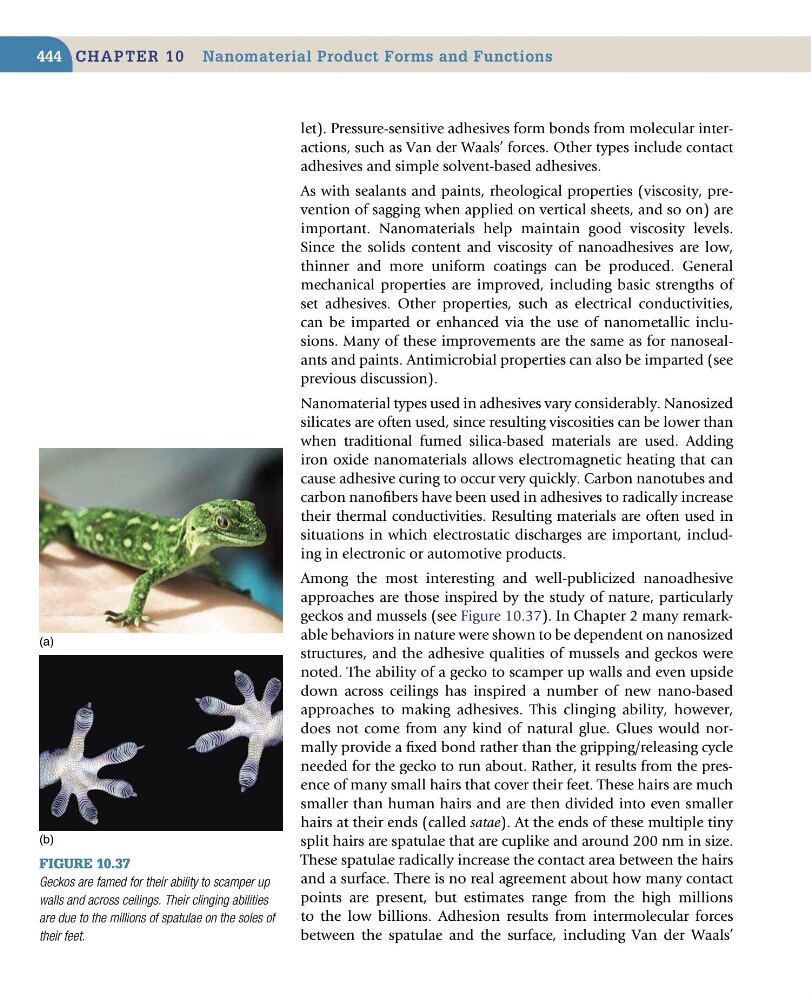
Figure 10.37
Geckos are famed for their ability to scamper up
walls and across ceilings. Their clinging abilities
are due to the millions of spatulae on the soles of
their feet.
(a)
(b)
444
let). Pressure-sensitive adhesives form bonds from molecular interactions, such as Van der Waals’ forces. Other types include contact
adhesives and simple solvent-based adhesives.
As with sealants and paints, rheological properties (viscosity, prevention of sagging when applied on vertical sheets, and so on) are
important. Nanomaterials help maintain good viscosity levels.
Since the solids content and viscosity of nanoadhesives are low,
thinner and more uniform coatings can be produced. General
mechanical properties are improved, including basic strengths of
set adhesives. Other properties, such as electrical conductivities,
can be imparted or enhanced via the use of nanometallic inclusions. Many of these improvements are the same as for nanosealants and paints. Antimicrobial properties can also be imparted (see
previous discussion).
Nanomaterial types used in adhesives vary considerably. Nanosized
silicates are often used, since resulting viscosities can be lower than
when traditional fumed silica-based materials are used. Adding
iron oxide nanomaterials allows electromagnetic heating that can
cause adhesive curing to occur very quickly. Carbon nanotubes and
carbon nanofibers have been used in adhesives to radically increase
their thermal conductivities. Resulting materials are often used in
situations in which electrostatic discharges are important, including in electronic or automotive products.
Among the most interesting and well-publicized nanoadhesive
approaches are those inspired by the study of nature, particularly
geckos and mussels (see Figure 10.37). In Chapter 2 many remarkable behaviors in nature were shown to be dependent on nanosized
structures, and the adhesive qualities of mussels and geckos were
noted. The ability of a gecko to scamper up walls and even upside
down across ceilings has inspired a number of new nano-based
approaches to making adhesives. This clinging ability, however,
does not come from any kind of natural glue. Glues would normally provide a fixed bond rather than the gripping/releasing cycle
needed for the gecko to run about. Rather, it results from the presence of many small hairs that cover their feet. These hairs are much
smaller than human hairs and are then divided into even smaller
hairs at their ends (called satae). At the ends of these multiple tiny
split hairs are spatulae that are cuplike and around 200 nm in size.
These spatulae radically increase the contact area between the hairs
and a surface. There is no real agreement about how many contact
points are present, but estimates range from the high millions
to the low billions. Adhesion results from intermolecular forces
between the spatulae and the surface, including Van der Waals’
Figure 10.37
Geckos are famed for their ability to scamper up
walls and across ceilings. Their clinging abilities
are due to the millions of spatulae on the soles of
their feet.
(a)
(b)