

433
An example of a commonly seen thin film is what we observe when
a drop of oil spreads across the surface of water. The same term,
however, means something quite different in the everyday architecture world. Here many physical films have been developed that
have far more appreciable thicknesses than previously described
and that are manufactured as products in the form of thin sheets
that have their own integrity and can stand alone (e.g., a very thin
sheet of plastic). These relatively thick sheets may well have nanomaterials incorporated into them or contain multiple layers of
nanoscale thin films deposited on them in a laminate form. In this
text, we generally refer to these as thin sheets.
In this context and in several other common usages, the term coating
refers to quite thick applications (and could include heavy paints,
for example) and is generally more descriptive of more specific
materials, application processes, and specific uses.
In many applications, several layers of nano-based materials are
built up sequentially. Various layers would normally have different
properties and would be intended to serve different functions. These
are often described as laminates and occasionally nanolaminates.
The following sections consider in turn these topics: nanocoatings,
nano-based thin films and laminates, nanopaints and nanosealants, nanotextiles, and nanoporous materials. As noted, there is
considerable overlap in the surface-based nanoforms, and descriptions should be collectively read.
nanocoatings
Coatings are thin coverings that are deposited on a base material to
enhance its surface characteristics or appearance. This broad definition includes coatings used to improve durability or wearing characteristics, provide corrosion resistance, or otherwise protect the
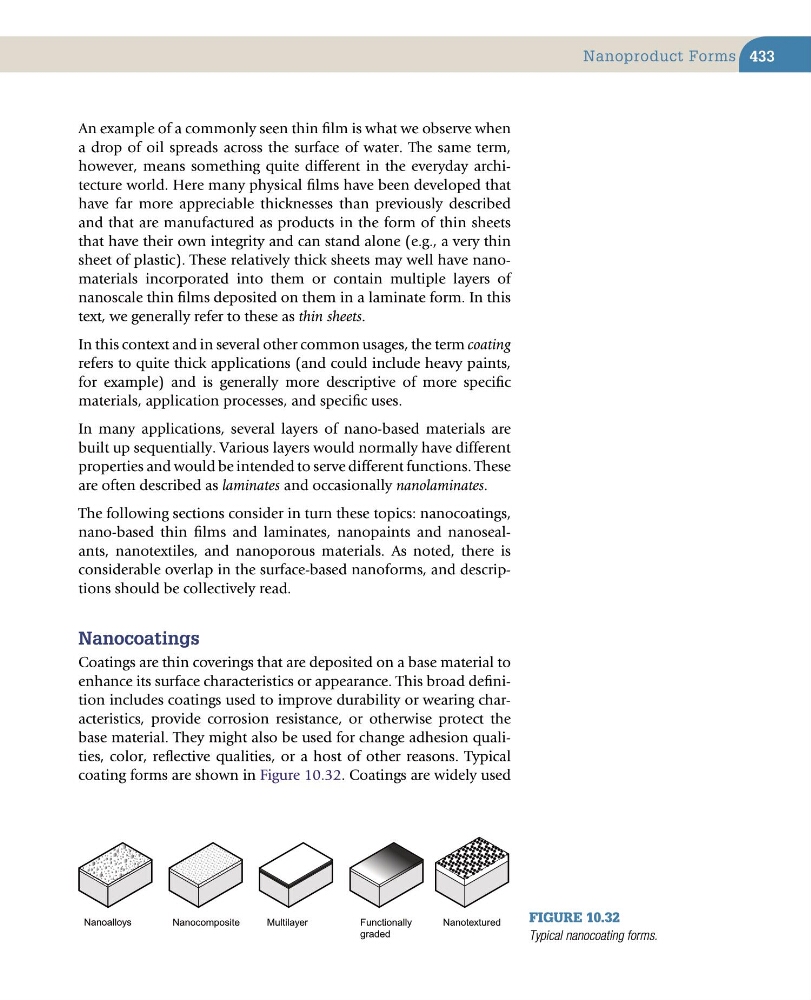
base material. They might also be used for change adhesion qualities, color, reflective qualities, or a host of other reasons. Typical
coating forms are shown in Figure 10.32. Coatings are widely used
Nanoproduct Forms
Nanocomposite
Multilayer
Functionally
graded
Nanotextured
Nanoalloys
Figure 10.32
Typical nanocoating forms.
An example of a commonly seen thin film is what we observe when
a drop of oil spreads across the surface of water. The same term,
however, means something quite different in the everyday architecture world. Here many physical films have been developed that
have far more appreciable thicknesses than previously described
and that are manufactured as products in the form of thin sheets
that have their own integrity and can stand alone (e.g., a very thin
sheet of plastic). These relatively thick sheets may well have nanomaterials incorporated into them or contain multiple layers of
nanoscale thin films deposited on them in a laminate form. In this
text, we generally refer to these as thin sheets.
In this context and in several other common usages, the term coating
refers to quite thick applications (and could include heavy paints,
for example) and is generally more descriptive of more specific
materials, application processes, and specific uses.
In many applications, several layers of nano-based materials are
built up sequentially. Various layers would normally have different
properties and would be intended to serve different functions. These
are often described as laminates and occasionally nanolaminates.
The following sections consider in turn these topics: nanocoatings,
nano-based thin films and laminates, nanopaints and nanosealants, nanotextiles, and nanoporous materials. As noted, there is
considerable overlap in the surface-based nanoforms, and descriptions should be collectively read.
nanocoatings
Coatings are thin coverings that are deposited on a base material to
enhance its surface characteristics or appearance. This broad definition includes coatings used to improve durability or wearing characteristics, provide corrosion resistance, or otherwise protect the
base material. They might also be used for change adhesion qualities, color, reflective qualities, or a host of other reasons. Typical
coating forms are shown in Figure 10.32. Coatings are widely used
Nanoproduct Forms
Nanocomposite
Multilayer
Functionally
graded
Nanotextured
Nanoalloys
Figure 10.32
Typical nanocoating forms.