

33
Paintings that are exposed to air and elements can become covered
with foreign particles that change visual appearances and begin to
act mechanically on the artifact. The paint itself as well as the substrate that has been painted on can begin to crack. There can be a
loss of cohesion between paint layers on various media. Particles
can flake off.
Among the greatest of our cultural treasures are Medieval wall paintings done in the fresco technique. They adorn many Medieval buildings, particularly in Italy. In the buon fresco method, pigments mixed
with water were applied to freshly placed and still-wet lime mortar
after initial carbonation, thus embedding the pigments well into
mortar (or, more precisely, into the crystalline structure of the newly
formed calcium carbonate). Paintings not only had marvelous color
and visual qualities, they were quite stable as well. With time,
however, salts can begin migrating through pore structures in the
mortar due to dampness and other reasons, and salt crystallization
can occur. The consequence is that severe degradation can occur in
the form of flaking of paint layers or powdering of colors. Deeper
damage can occur to the overall porous structures as well. Damaging
salts or particulates can also come from wind-blown sources.
Nanomaterials in Art and Cultural Heritage
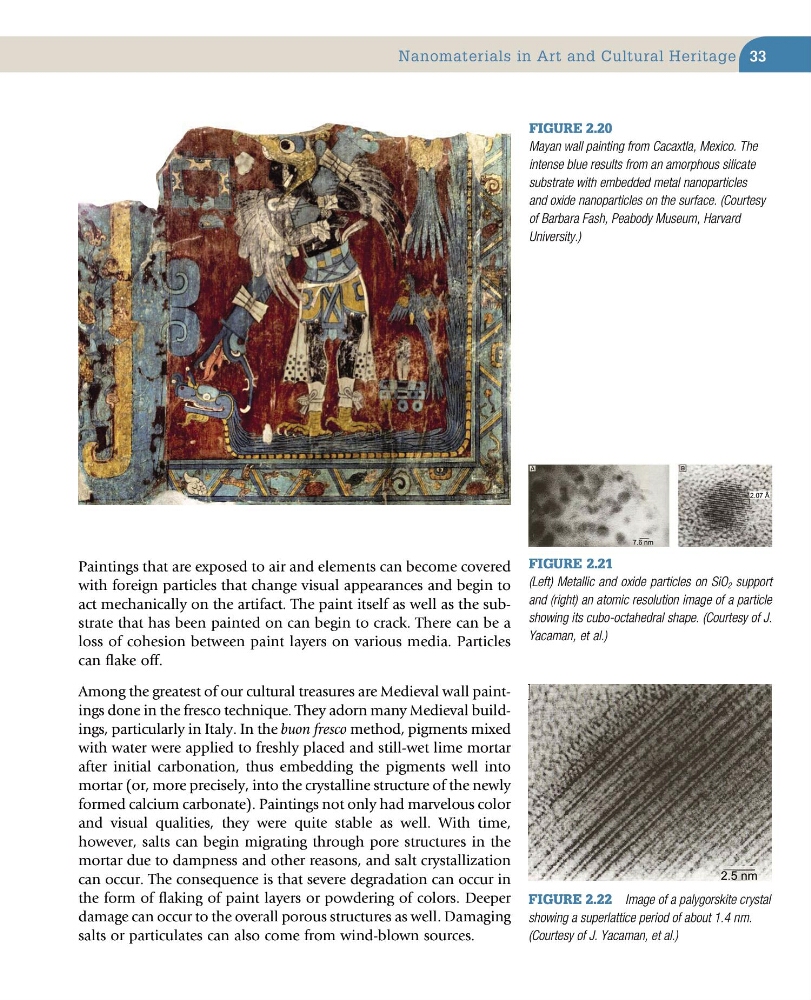
Figure 2.20
Mayan wall painting from Cacaxtla, Mexico. The
intense blue results from an amorphous silicate
substrate with embedded metal nanoparticles
and oxide nanoparticles on the surface. (Courtesy
of Barbara Fash, Peabody Museum, Harvard
University.)
Figure 2.21
(Left) Metallic and oxide particles on SiO 2 support
and (right) an atomic resolution image of a particle
showing its cubo-octahedral shape. (Courtesy of J.
Yacaman, et al.)
7.6 nm
2.07 Â
Figure 2.22 Image of a palygorskite crystal
showing a superlattice period of about 1.4 nm.
(Courtesy of J. Yacaman, et al.)
2.5 nm
Paintings that are exposed to air and elements can become covered
with foreign particles that change visual appearances and begin to
act mechanically on the artifact. The paint itself as well as the substrate that has been painted on can begin to crack. There can be a
loss of cohesion between paint layers on various media. Particles
can flake off.
Among the greatest of our cultural treasures are Medieval wall paintings done in the fresco technique. They adorn many Medieval buildings, particularly in Italy. In the buon fresco method, pigments mixed
with water were applied to freshly placed and still-wet lime mortar
after initial carbonation, thus embedding the pigments well into
mortar (or, more precisely, into the crystalline structure of the newly
formed calcium carbonate). Paintings not only had marvelous color
and visual qualities, they were quite stable as well. With time,
however, salts can begin migrating through pore structures in the
mortar due to dampness and other reasons, and salt crystallization
can occur. The consequence is that severe degradation can occur in
the form of flaking of paint layers or powdering of colors. Deeper
damage can occur to the overall porous structures as well. Damaging
salts or particulates can also come from wind-blown sources.
Nanomaterials in Art and Cultural Heritage
Figure 2.20
Mayan wall painting from Cacaxtla, Mexico. The
intense blue results from an amorphous silicate
substrate with embedded metal nanoparticles
and oxide nanoparticles on the surface. (Courtesy
of Barbara Fash, Peabody Museum, Harvard
University.)
Figure 2.21
(Left) Metallic and oxide particles on SiO 2 support
and (right) an atomic resolution image of a particle
showing its cubo-octahedral shape. (Courtesy of J.
Yacaman, et al.)
7.6 nm
2.07 Â
Figure 2.22 Image of a palygorskite crystal
showing a superlattice period of about 1.4 nm.
(Courtesy of J. Yacaman, et al.)
2.5 nm