

CHApter 2 An evolutionary perspective
32
would not in itself account for the many interesting properties of
Mayan blue. A predominant presence of palygorskite clays in the
paint that were found to have a plate- or needle-shaped internal
structure have been identified.
Within these clays very small amounts of impurities (iron -Fe,
manganese -Mn, chromium -Cr) were also found. The host clays
appear to have originated in a mine near Merida (and were subsequently heated to high temperatures), whereas the embedded
impurities came from the anil plant used to make the indigo. Most
of these impurities were in metallic states. Some oxidized elements
were near the surface. Detailed studies have been made of these
materials (see Figures 2.21 and 2.22). Interestingly, even minor
amounts of nanosized particles in the impurities can be expected
to have significant effects on optical properties due to the surface
plasmon excitation effects.
The particular blue color thus results from the exact type of absorption curve present, which is in turn influenced by the exact size,
shape, and dispersion of the nanoparticles. These effects, along
with those from the oxide metals, appear to help account for the
strong blue color. Meanwhile, it is the intercalation (insertion of
foreign atoms into the crystalline lattice of another material) of
indigo molecules within the clay that may account for the corrosion
resistance exhibited by the paint. Thus, the interesting properties
of the final product result from a complex sequence of circumstances involving naturally occurring nanomaterials. Like the glass
and ceramics examples described earlier, the process developed by
Mayan artisans did not involve an understanding of chemistry or
nanomaterials as we know them today but rather a persistent search
in visual effects in the service of fine art.
Conservation
Conservation and restoration of works of art and other forms of
cultural heritage have been a constantly evolving pursuit in which
nano-based techniques play increasingly valuable roles (see Figures
2.23 and 2.24). A great number of factors can play a role in the
degradation of artworks. For instance, microbial growth can have a
range of detrimental effects on various media. Significant damages
can be inflicted on both paintings and sculptures by the many pollutants in the atmosphere. The problem of nitric oxides in polluted
atmospheres slowly degrading the surfaces of marble statues and
marble buildings from ancient times is well known. In wood artifacts, acids can cause degradation of the cellulose structure present.
Figure 2.18
Medieval lusterware, circa 16
th century, Manises,
Spain. The glaze was made by firing metal oxides.
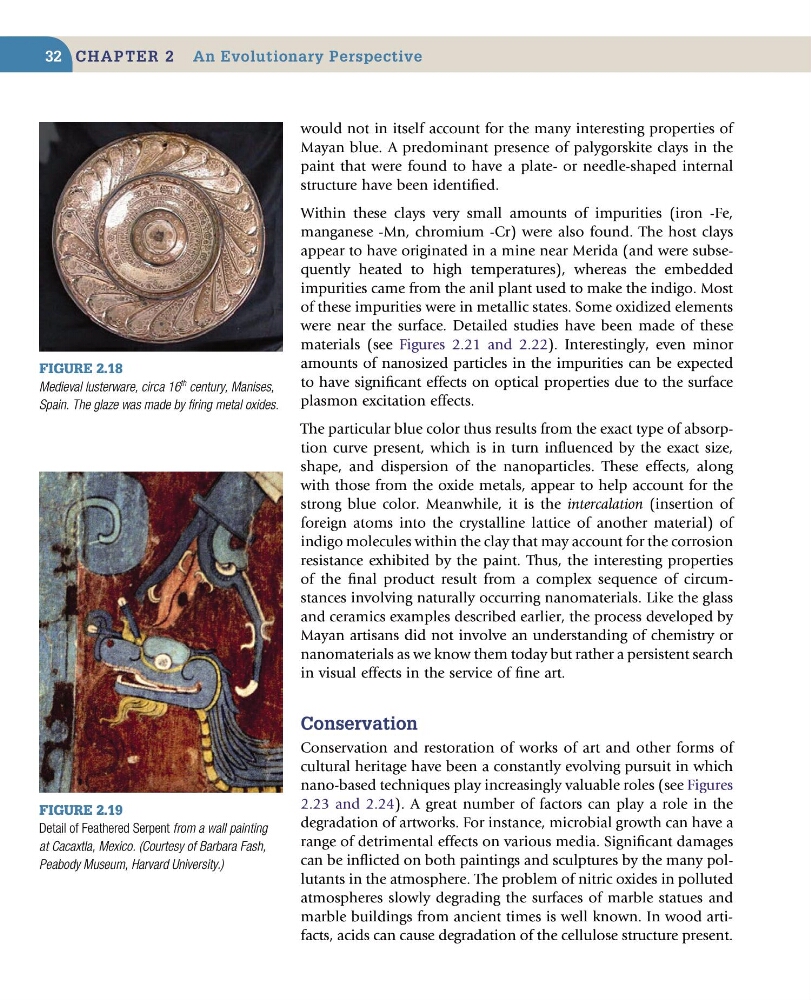
Figure 2.19
Detail of Feathered Serpent from a wall painting
at Cacaxtla, Mexico. (Courtesy of Barbara Fash,
Peabody Museum, Harvard University.)
32
would not in itself account for the many interesting properties of
Mayan blue. A predominant presence of palygorskite clays in the
paint that were found to have a plate- or needle-shaped internal
structure have been identified.
Within these clays very small amounts of impurities (iron -Fe,
manganese -Mn, chromium -Cr) were also found. The host clays
appear to have originated in a mine near Merida (and were subsequently heated to high temperatures), whereas the embedded
impurities came from the anil plant used to make the indigo. Most
of these impurities were in metallic states. Some oxidized elements
were near the surface. Detailed studies have been made of these
materials (see Figures 2.21 and 2.22). Interestingly, even minor
amounts of nanosized particles in the impurities can be expected
to have significant effects on optical properties due to the surface
plasmon excitation effects.
The particular blue color thus results from the exact type of absorption curve present, which is in turn influenced by the exact size,
shape, and dispersion of the nanoparticles. These effects, along
with those from the oxide metals, appear to help account for the
strong blue color. Meanwhile, it is the intercalation (insertion of
foreign atoms into the crystalline lattice of another material) of
indigo molecules within the clay that may account for the corrosion
resistance exhibited by the paint. Thus, the interesting properties
of the final product result from a complex sequence of circumstances involving naturally occurring nanomaterials. Like the glass
and ceramics examples described earlier, the process developed by
Mayan artisans did not involve an understanding of chemistry or
nanomaterials as we know them today but rather a persistent search
in visual effects in the service of fine art.
Conservation
Conservation and restoration of works of art and other forms of
cultural heritage have been a constantly evolving pursuit in which
nano-based techniques play increasingly valuable roles (see Figures
2.23 and 2.24). A great number of factors can play a role in the
degradation of artworks. For instance, microbial growth can have a
range of detrimental effects on various media. Significant damages
can be inflicted on both paintings and sculptures by the many pollutants in the atmosphere. The problem of nitric oxides in polluted
atmospheres slowly degrading the surfaces of marble statues and
marble buildings from ancient times is well known. In wood artifacts, acids can cause degradation of the cellulose structure present.
Figure 2.18
Medieval lusterware, circa 16
th century, Manises,
Spain. The glaze was made by firing metal oxides.
Figure 2.19
Detail of Feathered Serpent from a wall painting
at Cacaxtla, Mexico. (Courtesy of Barbara Fash,
Peabody Museum, Harvard University.)