

413
looking into in light of the definitional and nomenclature problems first noted in Chapter 6. According to a quote provided by
Dr. Kevin Sanderson, principal project manager from the On-Line
Coatings Technology Group,
Pilkington Activ™ has been described as an example of
nanotechnology. Due to the coatings’ thickness, Pilkington
Activ™ does fall under certain nanotechnology definitions,
e.g., IUPAC. It is critical to understand, however, that the
reason we fall under this description of nanotechnology is
that the thickness of the coating is <100 nm. However, the
unique properties are not derived from the nanotechnology
aspect. In fact none of our products contain pre-formed
nanoparticles. The films are all based on thin film
technology. We understand that some of our products
have been used as examples of nanotechnology but this is
simply due to them falling under this thickness requirement
and not because they contain pre formed nanoparticles,
which they do not. We believe that there is a distinct
difference between products based on thin film technology
(many of which have been out in the market place for 20
years plus) and which now fall under the arbitrary banner
of nanotechnology due to their thickness alone and the
next generation of nanotechnology involving pre-formed
nanoparticulates. Whilst this pre formed nanoparticulate
area is a very interesting one, at present we have no
products in this area.
This quote elegantly captures some of the nomenclature issues and
problems discussed earlier. As discussed in Chapter 6, this book
has adopted a less narrow approach than described in the quote
and indeed considers coatings of “nanoscale” thickness in this
and subsequent discussions, a position consistent with common
terminology.
Though there are significant advances here, research is still needed
into the actual long-term effectiveness of these applications. Certain
kinds of matter will not be oxidized by photocatalytic action. Many
surrounding environmental variables can also affect efficacies. The
amount of solar irradiation received is surely locational and context
dependent (from latitude to the shadows produced by surrounding
buildings).
Self-cleaning glasses or tiles are by no means a panacea. Some types
of thick deposits will not be responsive to photocatalytic action.
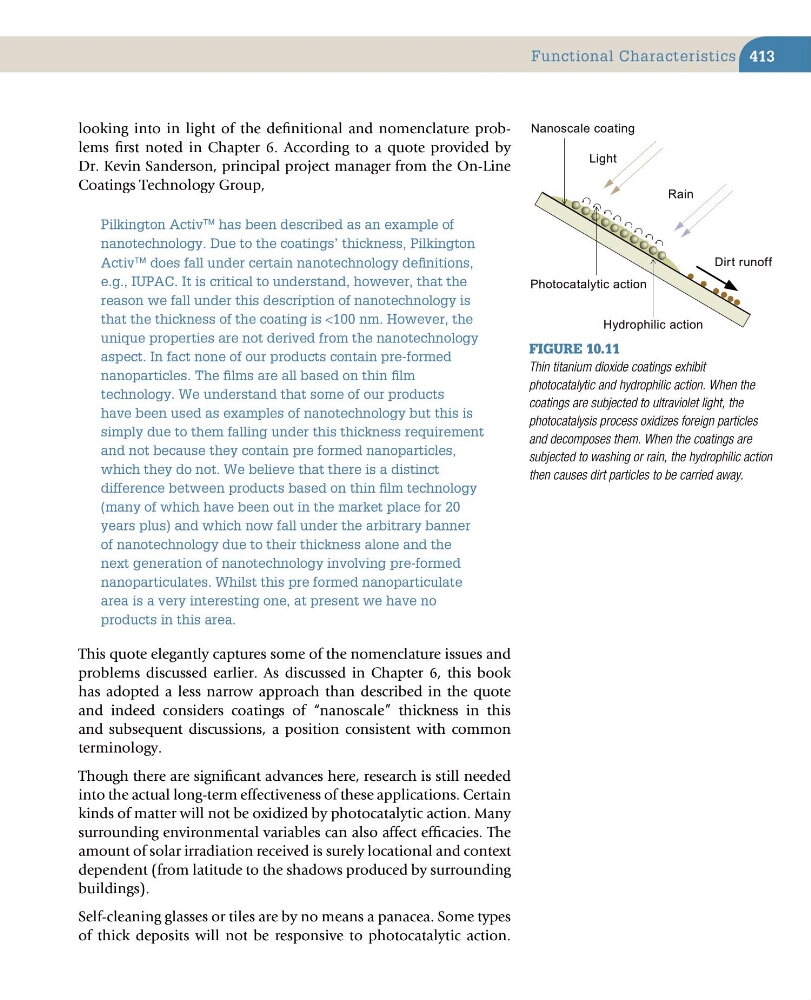
Figure 10.11
Thin titanium dioxide coatings exhibit
photocatalytic and hydrophilic action. When the
coatings are subjected to ultraviolet light, the
photocatalysis process oxidizes foreign particles
and decomposes them. When the coatings are
subjected to washing or rain, the hydrophilic action
then causes dirt particles to be carried away.
Light
Rain
Dirt runoff
Photocatalytic action
Hydrophilic action
Nanoscale coating
Functional Characteristics
looking into in light of the definitional and nomenclature problems first noted in Chapter 6. According to a quote provided by
Dr. Kevin Sanderson, principal project manager from the On-Line
Coatings Technology Group,
Pilkington Activ™ has been described as an example of
nanotechnology. Due to the coatings’ thickness, Pilkington
Activ™ does fall under certain nanotechnology definitions,
e.g., IUPAC. It is critical to understand, however, that the
reason we fall under this description of nanotechnology is
that the thickness of the coating is <100 nm. However, the
unique properties are not derived from the nanotechnology
aspect. In fact none of our products contain pre-formed
nanoparticles. The films are all based on thin film
technology. We understand that some of our products
have been used as examples of nanotechnology but this is
simply due to them falling under this thickness requirement
and not because they contain pre formed nanoparticles,
which they do not. We believe that there is a distinct
difference between products based on thin film technology
(many of which have been out in the market place for 20
years plus) and which now fall under the arbitrary banner
of nanotechnology due to their thickness alone and the
next generation of nanotechnology involving pre-formed
nanoparticulates. Whilst this pre formed nanoparticulate
area is a very interesting one, at present we have no
products in this area.
This quote elegantly captures some of the nomenclature issues and
problems discussed earlier. As discussed in Chapter 6, this book
has adopted a less narrow approach than described in the quote
and indeed considers coatings of “nanoscale” thickness in this
and subsequent discussions, a position consistent with common
terminology.
Though there are significant advances here, research is still needed
into the actual long-term effectiveness of these applications. Certain
kinds of matter will not be oxidized by photocatalytic action. Many
surrounding environmental variables can also affect efficacies. The
amount of solar irradiation received is surely locational and context
dependent (from latitude to the shadows produced by surrounding
buildings).
Self-cleaning glasses or tiles are by no means a panacea. Some types
of thick deposits will not be responsive to photocatalytic action.
Figure 10.11
Thin titanium dioxide coatings exhibit
photocatalytic and hydrophilic action. When the
coatings are subjected to ultraviolet light, the
photocatalysis process oxidizes foreign particles
and decomposes them. When the coatings are
subjected to washing or rain, the hydrophilic action
then causes dirt particles to be carried away.
Light
Rain
Dirt runoff
Photocatalytic action
Hydrophilic action
Nanoscale coating
Functional Characteristics