

C hapter 10 nanomaterial product Forms and Functions
412
medical settings.) Abrasions can also occur that destroy surface
characteristics.
self-Cleaning and easy-Cleaning materials
self-cleaning and easy-cleaning glasses and tiles
In architecture, the primary intended cleaning action is the removal
of everyday dirt, dust, or other things that naturally appear on
windows or other surfaces in buildings. So-called self-cleaning glasses
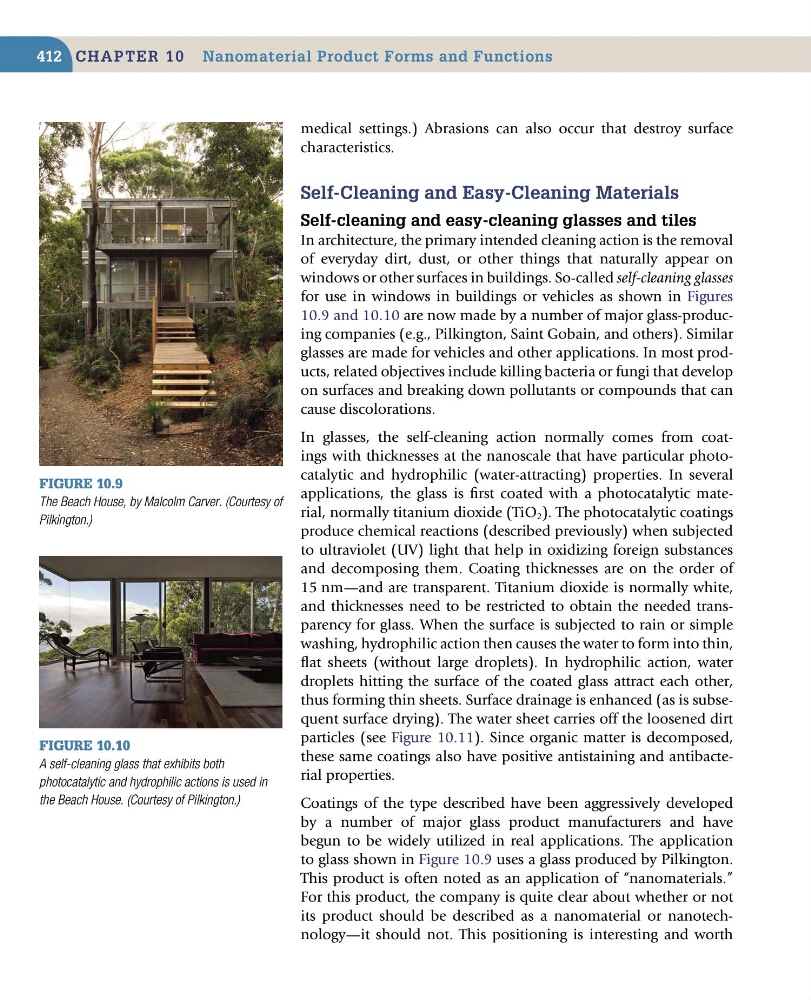
for use in windows in buildings or vehicles as shown in Figures
10.9 and 10.10 are now made by a number of major glass-producing companies (e.g., Pilkington, Saint Gobain, and others). Similar
glasses are made for vehicles and other applications. In most products, related objectives include killing bacteria or fungi that develop
on surfaces and breaking down pollutants or compounds that can
cause discolorations.
In glasses, the self-cleaning action normally comes from coatings with thicknesses at the nanoscale that have particular photocatalytic and hydrophilic (water-attracting) properties. In several
applications, the glass is first coated with a photocatalytic material, normally titanium dioxide (TiO 2 ). The photocatalytic coatings
produce chemical reactions (described previously) when subjected
to ultraviolet (UV) light that help in oxidizing foreign substances
and decomposing them. Coating thicknesses are on the order of
15 nm—and are transparent. Titanium dioxide is normally white,
and thicknesses need to be restricted to obtain the needed transparency for glass. When the surface is subjected to rain or simple
washing, hydrophilic action then causes the water to form into thin,
flat sheets (without large droplets). In hydrophilic action, water
droplets hitting the surface of the coated glass attract each other,
thus forming thin sheets. Surface drainage is enhanced (as is subsequent surface drying). The water sheet carries off the loosened dirt
particles (see Figure 10.11). Since organic matter is decomposed,
these same coatings also have positive antistaining and antibacterial properties.
Coatings of the type described have been aggressively developed
by a number of major glass product manufacturers and have
begun to be widely utilized in real applications. The application
to glass shown in Figure 10.9 uses a glass produced by Pilkington.
This product is often noted as an application of “nanomaterials.”
For this product, the company is quite clear about whether or not
its product should be described as a nanomaterial or nanotechnology—it should not. This positioning is interesting and worth
Figure 10.9
The Beach House, by Malcolm Carver. (Courtesy of
Pilkington.)
Figure 10.10
A self-cleaning glass that exhibits both
photocatalytic and hydrophilic actions is used in
the Beach House. (Courtesy of Pilkington.)
412
medical settings.) Abrasions can also occur that destroy surface
characteristics.
self-Cleaning and easy-Cleaning materials
self-cleaning and easy-cleaning glasses and tiles
In architecture, the primary intended cleaning action is the removal
of everyday dirt, dust, or other things that naturally appear on
windows or other surfaces in buildings. So-called self-cleaning glasses
for use in windows in buildings or vehicles as shown in Figures
10.9 and 10.10 are now made by a number of major glass-producing companies (e.g., Pilkington, Saint Gobain, and others). Similar
glasses are made for vehicles and other applications. In most products, related objectives include killing bacteria or fungi that develop
on surfaces and breaking down pollutants or compounds that can
cause discolorations.
In glasses, the self-cleaning action normally comes from coatings with thicknesses at the nanoscale that have particular photocatalytic and hydrophilic (water-attracting) properties. In several
applications, the glass is first coated with a photocatalytic material, normally titanium dioxide (TiO 2 ). The photocatalytic coatings
produce chemical reactions (described previously) when subjected
to ultraviolet (UV) light that help in oxidizing foreign substances
and decomposing them. Coating thicknesses are on the order of
15 nm—and are transparent. Titanium dioxide is normally white,
and thicknesses need to be restricted to obtain the needed transparency for glass. When the surface is subjected to rain or simple
washing, hydrophilic action then causes the water to form into thin,
flat sheets (without large droplets). In hydrophilic action, water
droplets hitting the surface of the coated glass attract each other,
thus forming thin sheets. Surface drainage is enhanced (as is subsequent surface drying). The water sheet carries off the loosened dirt
particles (see Figure 10.11). Since organic matter is decomposed,
these same coatings also have positive antistaining and antibacterial properties.
Coatings of the type described have been aggressively developed
by a number of major glass product manufacturers and have
begun to be widely utilized in real applications. The application
to glass shown in Figure 10.9 uses a glass produced by Pilkington.
This product is often noted as an application of “nanomaterials.”
For this product, the company is quite clear about whether or not
its product should be described as a nanomaterial or nanotechnology—it should not. This positioning is interesting and worth
Figure 10.9
The Beach House, by Malcolm Carver. (Courtesy of
Pilkington.)
Figure 10.10
A self-cleaning glass that exhibits both
photocatalytic and hydrophilic actions is used in
the Beach House. (Courtesy of Pilkington.)