

391
that opened up or closed down, visitors were encouraged to feel
gravity as a mass-warping time space. Many sensor-based systems of
this type involve complex display and sound and audio systems.
So-called smart systems have even more of a basis in complex sensorbased electronic and computational systems but frequently involve
“smart materials” as well. Again, many different approaches are
evolving here. Many of the materials that we have already described
have an apparent ability to change one or more of their properties
in response to changes in their surrounding thermal, radiant, electrical, mechanical, or chemical environments. Thermochromics, for
example, change their apparent color as the temperature of their surrounding environment increases and there is an input of thermal
energy into the material. Magnetorheological materials change their
viscosity when subjected to varying levels of magnetic fields.
As we will discuss in Section 10.2, these and other materials of this
type are often called smart materials because they exhibit useful
changes in properties in the presence of varying external stimuli.
Examples of smart systems based on these kinds of materials abound.
For example, there are many self-damping systems used for vibration control, including skis that have self-damping mechanisms
for reducing the troublesome “chatter” that can be experienced by
advanced skiers in difficult terrains. In the automotive industry,
there are “smart tires” or “smart suspension systems” that enhance
driving performance (see Section 12.2). In the aerospace industry
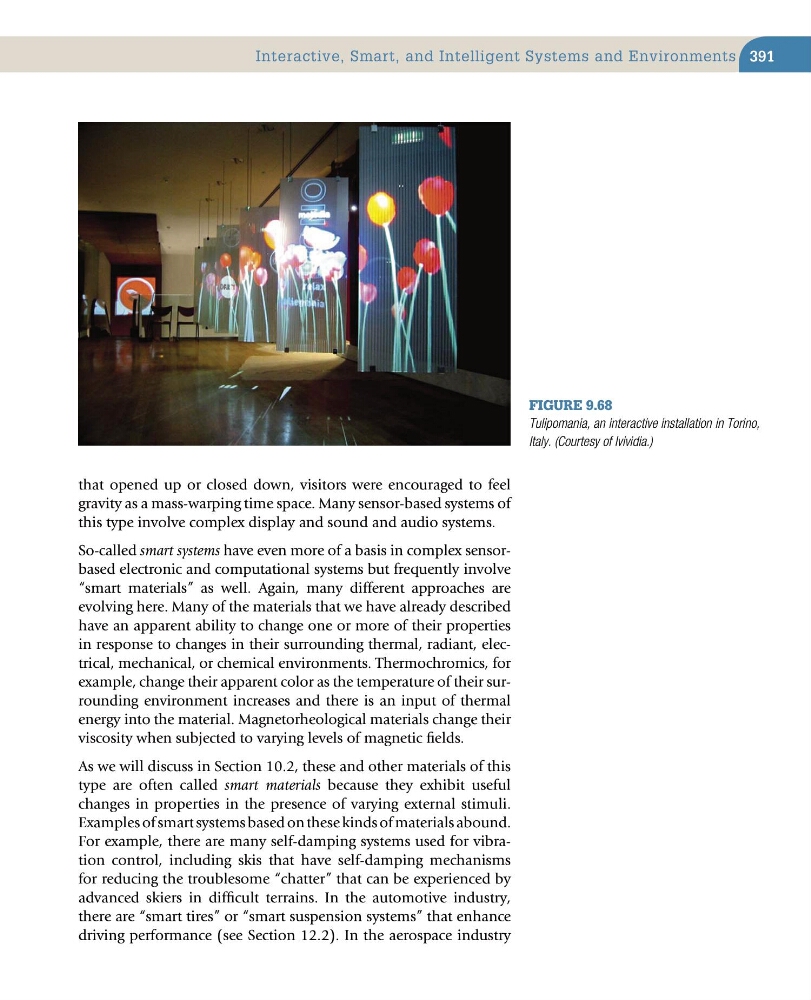
Figure 9.68
Tulipomania, an interactive installation in Torino,
Italy. (Courtesy of Ivividia.)
Interactive, Smart, and Intelligent Systems and Environments
that opened up or closed down, visitors were encouraged to feel
gravity as a mass-warping time space. Many sensor-based systems of
this type involve complex display and sound and audio systems.
So-called smart systems have even more of a basis in complex sensorbased electronic and computational systems but frequently involve
“smart materials” as well. Again, many different approaches are
evolving here. Many of the materials that we have already described
have an apparent ability to change one or more of their properties
in response to changes in their surrounding thermal, radiant, electrical, mechanical, or chemical environments. Thermochromics, for
example, change their apparent color as the temperature of their surrounding environment increases and there is an input of thermal
energy into the material. Magnetorheological materials change their
viscosity when subjected to varying levels of magnetic fields.
As we will discuss in Section 10.2, these and other materials of this
type are often called smart materials because they exhibit useful
changes in properties in the presence of varying external stimuli.
Examples of smart systems based on these kinds of materials abound.
For example, there are many self-damping systems used for vibration control, including skis that have self-damping mechanisms
for reducing the troublesome “chatter” that can be experienced by
advanced skiers in difficult terrains. In the automotive industry,
there are “smart tires” or “smart suspension systems” that enhance
driving performance (see Section 12.2). In the aerospace industry
Figure 9.68
Tulipomania, an interactive installation in Torino,
Italy. (Courtesy of Ivividia.)
Interactive, Smart, and Intelligent Systems and Environments