

C haptEr 9 design Environments and systems
390
systems alone define “smart” or “intelligent” environments? There
is a considerable degree of controversy over terminology here, even
though common dictionary definitions suggest clear distinctions
that largely hinge around the level of cognition involved. At one
time in the past, a sensor-controlled lighting system would surely
have been thought of as “smart,” but the definition bar has now
been generally heightened, although involved groups cannot really
agree on definitions that really capture the essence of smartness
or intelligence. All generally agree on the importance of enabling
sensor-based actuation and communication systems, but these may
be directly responsive only and not involve any kind of cognitive
action that one would somehow think necessary in something
called an “intelligent” environment.
These are not easy concepts to untangle, but it is clear that their
very fuzziness has engendered a great deal of confusion in what has
blossomed into an absolutely enormous area of study that draws
from many diverse fields, including materials science, electromechanical engineering, computer science (including expert systems
and artificial intelligence), product design, and architecture. Here
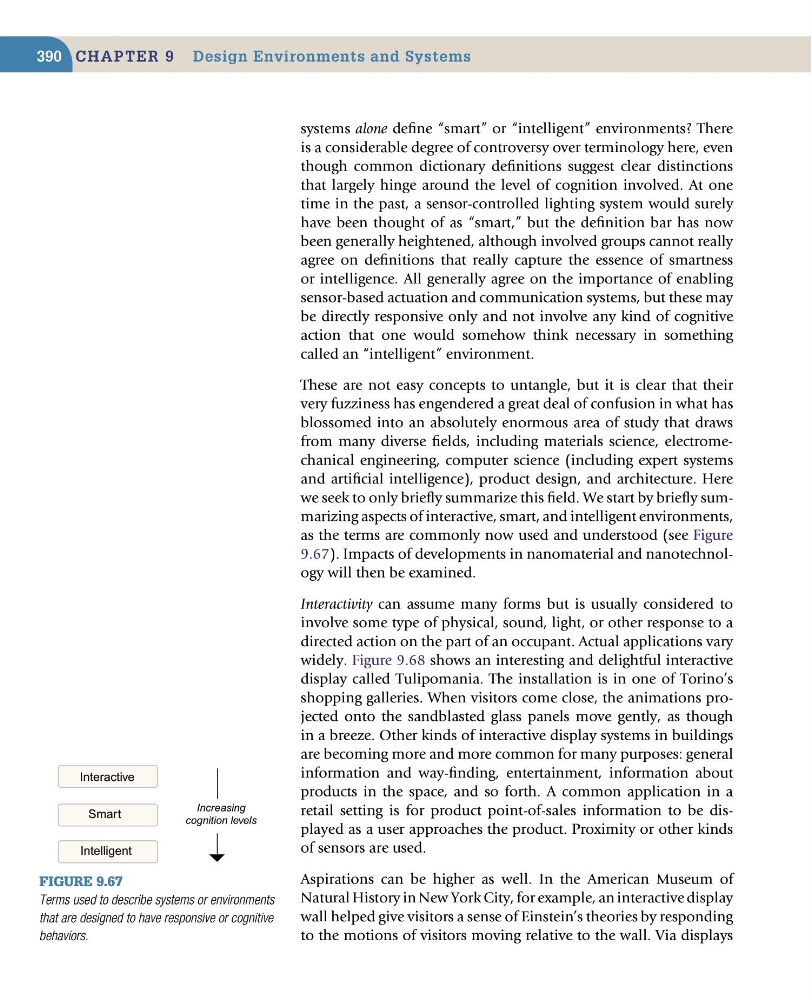
we seek to only briefly summarize this field. We start by briefly summarizing aspects of interactive, smart, and intelligent environments,
as the terms are commonly now used and understood (see Figure
9.67). Impacts of developments in nanomaterial and nanotechnology will then be examined.
Interactivity can assume many forms but is usually considered to
involve some type of physical, sound, light, or other response to a
directed action on the part of an occupant. Actual applications vary
widely. Figure 9.68 shows an interesting and delightful interactive
display called Tulipomania. The installation is in one of Torino’s
shopping galleries. When visitors come close, the animations projected onto the sandblasted glass panels move gently, as though
in a breeze. Other kinds of interactive display systems in buildings
are becoming more and more common for many purposes: general
information and way-finding, entertainment, information about
products in the space, and so forth. A common application in a
retail setting is for product point-of-sales information to be displayed as a user approaches the product. Proximity or other kinds
of sensors are used.
Aspirations can be higher as well. In the American Museum of
Natural History in New York City, for example, an interactive display
wall helped give visitors a sense of Einstein’s theories by responding
to the motions of visitors moving relative to the wall. Via displays
Figure 9.67
Terms used to describe systems or environments
that are designed to have responsive or cognitive
behaviors.
Interactive
Smart
Intelligent
Increasing
cognition levels
390
systems alone define “smart” or “intelligent” environments? There
is a considerable degree of controversy over terminology here, even
though common dictionary definitions suggest clear distinctions
that largely hinge around the level of cognition involved. At one
time in the past, a sensor-controlled lighting system would surely
have been thought of as “smart,” but the definition bar has now
been generally heightened, although involved groups cannot really
agree on definitions that really capture the essence of smartness
or intelligence. All generally agree on the importance of enabling
sensor-based actuation and communication systems, but these may
be directly responsive only and not involve any kind of cognitive
action that one would somehow think necessary in something
called an “intelligent” environment.
These are not easy concepts to untangle, but it is clear that their
very fuzziness has engendered a great deal of confusion in what has
blossomed into an absolutely enormous area of study that draws
from many diverse fields, including materials science, electromechanical engineering, computer science (including expert systems
and artificial intelligence), product design, and architecture. Here
we seek to only briefly summarize this field. We start by briefly summarizing aspects of interactive, smart, and intelligent environments,
as the terms are commonly now used and understood (see Figure
9.67). Impacts of developments in nanomaterial and nanotechnology will then be examined.
Interactivity can assume many forms but is usually considered to
involve some type of physical, sound, light, or other response to a
directed action on the part of an occupant. Actual applications vary
widely. Figure 9.68 shows an interesting and delightful interactive
display called Tulipomania. The installation is in one of Torino’s
shopping galleries. When visitors come close, the animations projected onto the sandblasted glass panels move gently, as though
in a breeze. Other kinds of interactive display systems in buildings
are becoming more and more common for many purposes: general
information and way-finding, entertainment, information about
products in the space, and so forth. A common application in a
retail setting is for product point-of-sales information to be displayed as a user approaches the product. Proximity or other kinds
of sensors are used.
Aspirations can be higher as well. In the American Museum of
Natural History in New York City, for example, an interactive display
wall helped give visitors a sense of Einstein’s theories by responding
to the motions of visitors moving relative to the wall. Via displays
Figure 9.67
Terms used to describe systems or environments
that are designed to have responsive or cognitive
behaviors.
Interactive
Smart
Intelligent
Increasing
cognition levels