

CHApter 2 An evolutionary perspective
30
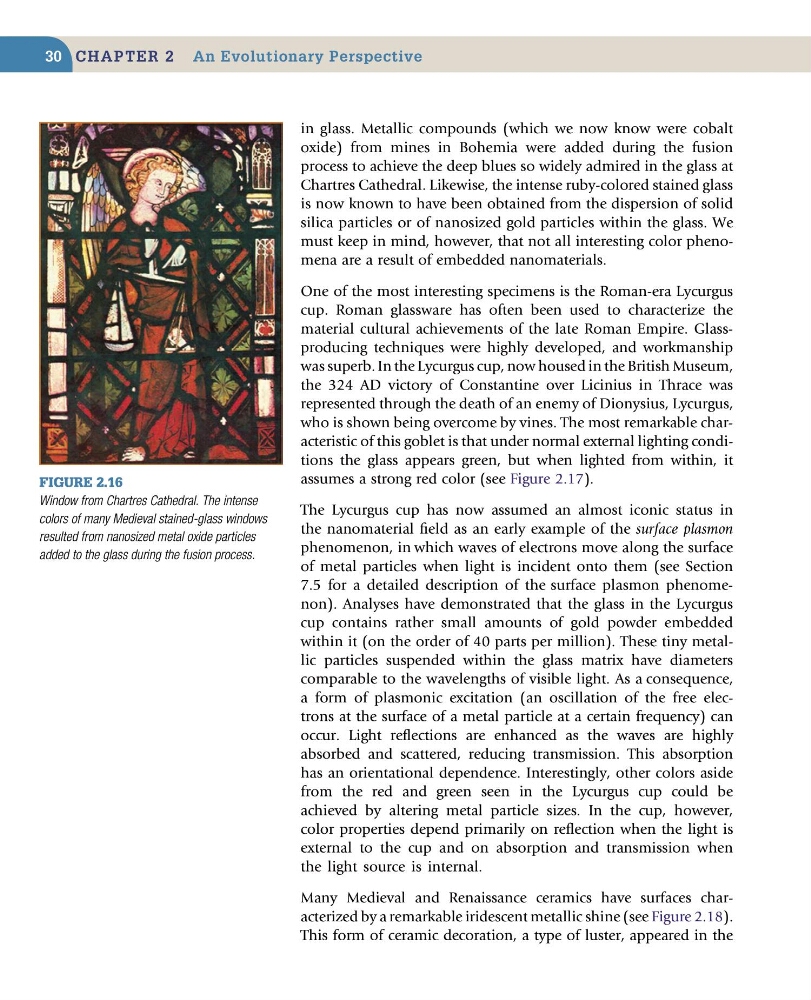
in glass. Metallic compounds (which we now know were cobalt
oxide) from mines in Bohemia were added during the fusion
process to achieve the deep blues so widely admired in the glass at
Chartres Cathedral. Likewise, the intense ruby-colored stained glass
is now known to have been obtained from the dispersion of solid
silica particles or of nanosized gold particles within the glass. We
must keep in mind, however, that not all interesting color phenomena are a result of embedded nanomaterials.
One of the most interesting specimens is the Roman-era Lycurgus
cup. Roman glassware has often been used to characterize the
material cultural achievements of the late Roman Empire. Glassproducing techniques were highly developed, and workmanship
was superb. In the Lycurgus cup, now housed in the British Museum,
the 324 AD victory of Constantine over Licinius in Thrace was
represented through the death of an enemy of Dionysius, Lycurgus,
who is shown being overcome by vines. The most remarkable characteristic of this goblet is that under normal external lighting conditions the glass appears green, but when lighted from within, it
assumes a strong red color (see Figure 2.17).
The Lycurgus cup has now assumed an almost iconic status in
the nanomaterial field as an early example of the surface plasmon
phenomenon, in which waves of electrons move along the surface
of metal particles when light is incident onto them (see Section
7.5 for a detailed description of the surface plasmon phenomenon). Analyses have demonstrated that the glass in the Lycurgus
cup contains rather small amounts of gold powder embedded
within it (on the order of 40 parts per million). These tiny metallic particles suspended within the glass matrix have diameters
comparable to the wavelengths of visible light. As a consequence,
a form of plasmonic excitation (an oscillation of the free electrons at the surface of a metal particle at a certain frequency) can
occur. Light reflections are enhanced as the waves are highly
absorbed and scattered, reducing transmission. This absorption
has an orientational dependence. Interestingly, other colors aside
from the red and green seen in the Lycurgus cup could be
achieved by altering metal particle sizes. In the cup, however,
color properties depend primarily on reflection when the light is
external to the cup and on absorption and transmission when
the light source is internal.
Many Medieval and Renaissance ceramics have surfaces characterized by a remarkable iridescent metallic shine (see Figure 2.18).
This form of ceramic decoration, a type of luster, appeared in the
Figure 2.16
Window from Chartres Cathedral. The intense
colors of many Medieval stained-glass windows
resulted from nanosized metal oxide particles
added to the glass during the fusion process.
30
in glass. Metallic compounds (which we now know were cobalt
oxide) from mines in Bohemia were added during the fusion
process to achieve the deep blues so widely admired in the glass at
Chartres Cathedral. Likewise, the intense ruby-colored stained glass
is now known to have been obtained from the dispersion of solid
silica particles or of nanosized gold particles within the glass. We
must keep in mind, however, that not all interesting color phenomena are a result of embedded nanomaterials.
One of the most interesting specimens is the Roman-era Lycurgus
cup. Roman glassware has often been used to characterize the
material cultural achievements of the late Roman Empire. Glassproducing techniques were highly developed, and workmanship
was superb. In the Lycurgus cup, now housed in the British Museum,
the 324 AD victory of Constantine over Licinius in Thrace was
represented through the death of an enemy of Dionysius, Lycurgus,
who is shown being overcome by vines. The most remarkable characteristic of this goblet is that under normal external lighting conditions the glass appears green, but when lighted from within, it
assumes a strong red color (see Figure 2.17).
The Lycurgus cup has now assumed an almost iconic status in
the nanomaterial field as an early example of the surface plasmon
phenomenon, in which waves of electrons move along the surface
of metal particles when light is incident onto them (see Section
7.5 for a detailed description of the surface plasmon phenomenon). Analyses have demonstrated that the glass in the Lycurgus
cup contains rather small amounts of gold powder embedded
within it (on the order of 40 parts per million). These tiny metallic particles suspended within the glass matrix have diameters
comparable to the wavelengths of visible light. As a consequence,
a form of plasmonic excitation (an oscillation of the free electrons at the surface of a metal particle at a certain frequency) can
occur. Light reflections are enhanced as the waves are highly
absorbed and scattered, reducing transmission. This absorption
has an orientational dependence. Interestingly, other colors aside
from the red and green seen in the Lycurgus cup could be
achieved by altering metal particle sizes. In the cup, however,
color properties depend primarily on reflection when the light is
external to the cup and on absorption and transmission when
the light source is internal.
Many Medieval and Renaissance ceramics have surfaces characterized by a remarkable iridescent metallic shine (see Figure 2.18).
This form of ceramic decoration, a type of luster, appeared in the
Figure 2.16
Window from Chartres Cathedral. The intense
colors of many Medieval stained-glass windows
resulted from nanosized metal oxide particles
added to the glass during the fusion process.