

29
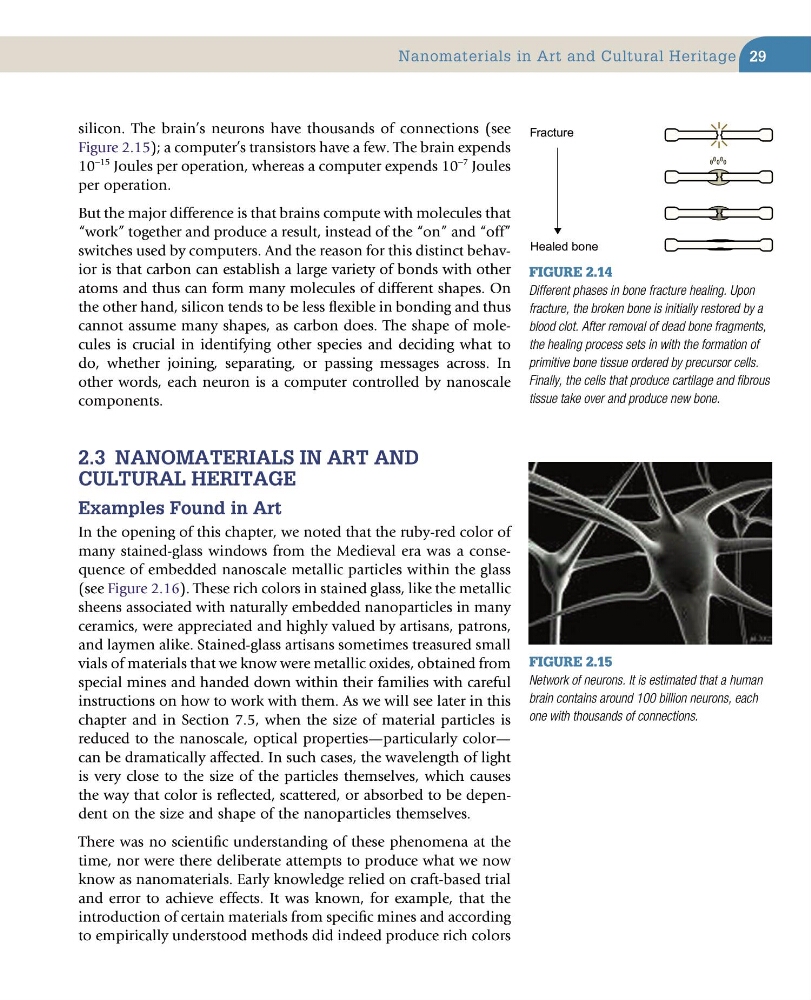
silicon. The brain’s neurons have thousands of connections (see
Figure 2.15); a computer’s transistors have a few. The brain expends
10
−15 Joules per operation, whereas a computer expends 10
−7 Joules
per operation.
But the major difference is that brains compute with molecules that
“work” together and produce a result, instead of the “on” and “off”
switches used by computers. And the reason for this distinct behavior is that carbon can establish a large variety of bonds with other
atoms and thus can form many molecules of different shapes. On
the other hand, silicon tends to be less flexible in bonding and thus
cannot assume many shapes, as carbon does. The shape of molecules is crucial in identifying other species and deciding what to
do, whether joining, separating, or passing messages across. In
other words, each neuron is a computer controlled by nanoscale
components.
2.3 NANoMAteriAls iN Art ANd
CulturAl HeritAge
examples found in Art
In the opening of this chapter, we noted that the ruby-red color of
many stained-glass windows from the Medieval era was a consequence of embedded nanoscale metallic particles within the glass
(see Figure 2.16). These rich colors in stained glass, like the metallic
sheens associated with naturally embedded nanoparticles in many
ceramics, were appreciated and highly valued by artisans, patrons,
and laymen alike. Stained-glass artisans sometimes treasured small
vials of materials that we know were metallic oxides, obtained from
special mines and handed down within their families with careful
instructions on how to work with them. As we will see later in this
chapter and in Section 7.5, when the size of material particles is
reduced to the nanoscale, optical properties—particularly color—
can be dramatically affected. In such cases, the wavelength of light
is very close to the size of the particles themselves, which causes
the way that color is reflected, scattered, or absorbed to be dependent on the size and shape of the nanoparticles themselves.
There was no scientific understanding of these phenomena at the
time, nor were there deliberate attempts to produce what we now
know as nanomaterials. Early knowledge relied on craft-based trial
and error to achieve effects. It was known, for example, that the
introduction of certain materials from specific mines and according
to empirically understood methods did indeed produce rich colors
Nanomaterials in Art and Cultural Heritage
Figure 2.14
Different phases in bone fracture healing. Upon
fracture, the broken bone is initially restored by a
blood clot. After removal of dead bone fragments,
the healing process sets in with the formation of
primitive bone tissue ordered by precursor cells.
Finally, the cells that produce cartilage and fibrous
tissue take over and produce new bone.
Fracture
Healed bone
Figure 2.15
Network of neurons. It is estimated that a human
brain contains around 100 billion neurons, each
one with thousands of connections.
silicon. The brain’s neurons have thousands of connections (see
Figure 2.15); a computer’s transistors have a few. The brain expends
10
−15 Joules per operation, whereas a computer expends 10
−7 Joules
per operation.
But the major difference is that brains compute with molecules that
“work” together and produce a result, instead of the “on” and “off”
switches used by computers. And the reason for this distinct behavior is that carbon can establish a large variety of bonds with other
atoms and thus can form many molecules of different shapes. On
the other hand, silicon tends to be less flexible in bonding and thus
cannot assume many shapes, as carbon does. The shape of molecules is crucial in identifying other species and deciding what to
do, whether joining, separating, or passing messages across. In
other words, each neuron is a computer controlled by nanoscale
components.
2.3 NANoMAteriAls iN Art ANd
CulturAl HeritAge
examples found in Art
In the opening of this chapter, we noted that the ruby-red color of
many stained-glass windows from the Medieval era was a consequence of embedded nanoscale metallic particles within the glass
(see Figure 2.16). These rich colors in stained glass, like the metallic
sheens associated with naturally embedded nanoparticles in many
ceramics, were appreciated and highly valued by artisans, patrons,
and laymen alike. Stained-glass artisans sometimes treasured small
vials of materials that we know were metallic oxides, obtained from
special mines and handed down within their families with careful
instructions on how to work with them. As we will see later in this
chapter and in Section 7.5, when the size of material particles is
reduced to the nanoscale, optical properties—particularly color—
can be dramatically affected. In such cases, the wavelength of light
is very close to the size of the particles themselves, which causes
the way that color is reflected, scattered, or absorbed to be dependent on the size and shape of the nanoparticles themselves.
There was no scientific understanding of these phenomena at the
time, nor were there deliberate attempts to produce what we now
know as nanomaterials. Early knowledge relied on craft-based trial
and error to achieve effects. It was known, for example, that the
introduction of certain materials from specific mines and according
to empirically understood methods did indeed produce rich colors
Nanomaterials in Art and Cultural Heritage
Figure 2.14
Different phases in bone fracture healing. Upon
fracture, the broken bone is initially restored by a
blood clot. After removal of dead bone fragments,
the healing process sets in with the formation of
primitive bone tissue ordered by precursor cells.
Finally, the cells that produce cartilage and fibrous
tissue take over and produce new bone.
Fracture
Healed bone
Figure 2.15
Network of neurons. It is estimated that a human
brain contains around 100 billion neurons, each
one with thousands of connections.