

353
behavior is the use of nanocrystalline silver halide particles that
are dispersed throughout the glass. Ionization in the silver halide
particles occurs and causes the color change. Other materials are
also often used as well, such as copper salts to sensitize the silver
halide particles to ultraviolet light. Thus an input of radiant energy
in the form of UV light causes a reversible change in the structure
of a photochromic material, which has different absorption spectra
and hence different color or transparency appearances. Other host
matrix materials and photochromic materials are also possible,
including the use of silver nanoparticles. A common need is to
keep particles dispersed, and approaches using nanoporous films
and other techniques have been explored.
Photochromics respond passively and cannot be electronically or
manually controlled. Hence they are not as useful as might be hoped
for controlling solar gains in architectural window or glazing applications. These applications normally require balancing solar gain
inputs in relation to indoor/outdoor temperature considerations.
Photochromics can darken on bright, cold days, when solar gains
are highly desirable. In large-scale applications, colors are limited
and optical transparency and quality can be poor (especially in
lower-cost photochromic polymers suitable for large applications).
Thermochromic materials passively change colors when external temperature environments changed. These materials are used in numerous products such as forehead thermometers and architectural
applications, for either their visual effects or as part of some type of
measurement device such as a battery tester. More recently, there has
been a spate of developments in displays based on thermochromic
behaviors. Thermochromic materials absorb heat, which leads to a
thermally induced chemical reaction or phase transformation that
in turn affects color appearance. Thermochromic materials come in
many forms, including liquid crystal forms used in thermochromic
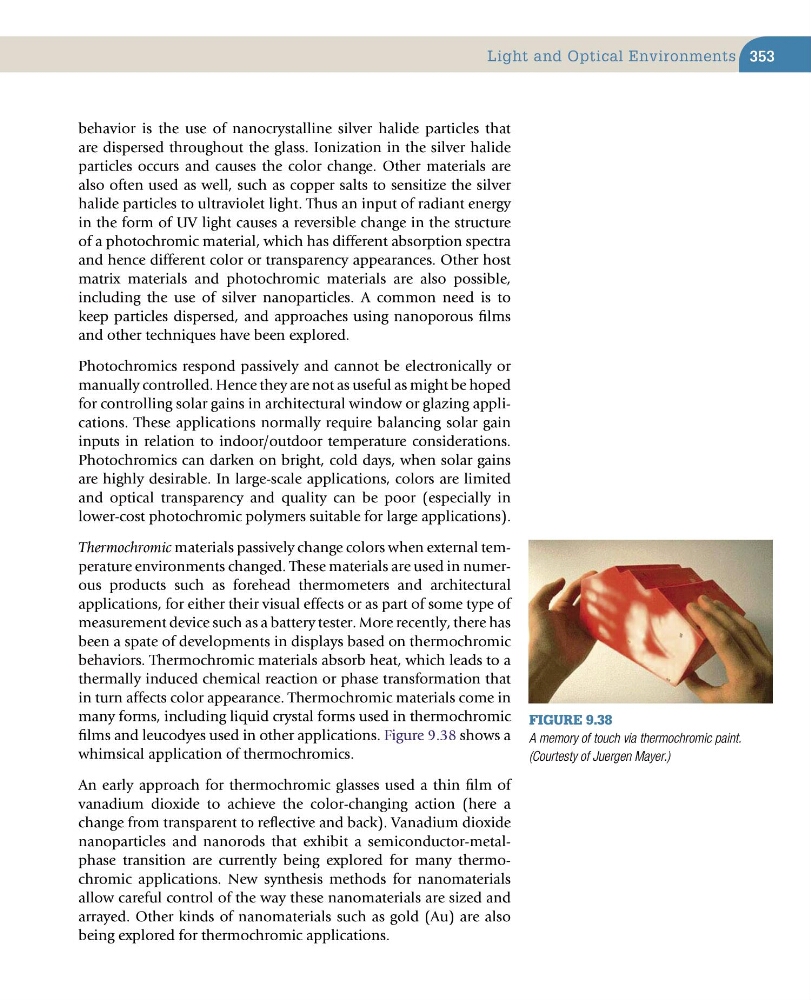
films and leucodyes used in other applications. Figure 9.38 shows a
whimsical application of thermochromics.
An early approach for thermochromic glasses used a thin film of
vanadium dioxide to achieve the color-changing action (here a
change from transparent to reflective and back). Vanadium dioxide
nanoparticles and nanorods that exhibit a semiconductor-metalphase transition are currently being explored for many thermochromic applications. New synthesis methods for nanomaterials
allow careful control of the way these nanomaterials are sized and
arrayed. Other kinds of nanomaterials such as gold (Au) are also
being explored for thermochromic applications.
Figure 9.38
A memory of touch via thermochromic paint.
(Courtesty of Juergen Mayer.)
Light and Optical Environments
behavior is the use of nanocrystalline silver halide particles that
are dispersed throughout the glass. Ionization in the silver halide
particles occurs and causes the color change. Other materials are
also often used as well, such as copper salts to sensitize the silver
halide particles to ultraviolet light. Thus an input of radiant energy
in the form of UV light causes a reversible change in the structure
of a photochromic material, which has different absorption spectra
and hence different color or transparency appearances. Other host
matrix materials and photochromic materials are also possible,
including the use of silver nanoparticles. A common need is to
keep particles dispersed, and approaches using nanoporous films
and other techniques have been explored.
Photochromics respond passively and cannot be electronically or
manually controlled. Hence they are not as useful as might be hoped
for controlling solar gains in architectural window or glazing applications. These applications normally require balancing solar gain
inputs in relation to indoor/outdoor temperature considerations.
Photochromics can darken on bright, cold days, when solar gains
are highly desirable. In large-scale applications, colors are limited
and optical transparency and quality can be poor (especially in
lower-cost photochromic polymers suitable for large applications).
Thermochromic materials passively change colors when external temperature environments changed. These materials are used in numerous products such as forehead thermometers and architectural
applications, for either their visual effects or as part of some type of
measurement device such as a battery tester. More recently, there has
been a spate of developments in displays based on thermochromic
behaviors. Thermochromic materials absorb heat, which leads to a
thermally induced chemical reaction or phase transformation that
in turn affects color appearance. Thermochromic materials come in
many forms, including liquid crystal forms used in thermochromic
films and leucodyes used in other applications. Figure 9.38 shows a
whimsical application of thermochromics.
An early approach for thermochromic glasses used a thin film of
vanadium dioxide to achieve the color-changing action (here a
change from transparent to reflective and back). Vanadium dioxide
nanoparticles and nanorods that exhibit a semiconductor-metalphase transition are currently being explored for many thermochromic applications. New synthesis methods for nanomaterials
allow careful control of the way these nanomaterials are sized and
arrayed. Other kinds of nanomaterials such as gold (Au) are also
being explored for thermochromic applications.
Figure 9.38
A memory of touch via thermochromic paint.
(Courtesty of Juergen Mayer.)
Light and Optical Environments