

C haptEr 9 design Environments and systems
346
quently see that this general behavior underlies many interesting
uses of nanomaterials in relation to light.
Many of the unique optical properties of nanomaterials can impact
many of the general types of behaviors we’ve noted as well as
others, since the wavelengths of light that are reflected, transmitted, or absorbed are affected by the use of nanoscale surface conditions or subsequent treatments. Surface plasmon effects stand
out as being particularly important in many applications, leading,
for example, to various colors of nanoparticles. As described in
Chapter 2, this effect was exploited in early works of art, such
as Medieval stained glass or lusterware, although it was by no
means understood. As described in Section 7.6, surface plasmon
effects result from a natural oscillation of an electron field inside
a nanoparticle. When nanoparticles are small compared to the
wavelength of light and when the wavelength of light is close
to that of the oscillating electron field, energy will be absorbed,
leading to a form of resonance of electrons on the surface. The
absorption can be extremely high in nanoparticles present at the
interface between a metal or metal oxide and a dialectric (a nonconductive material such as glass) because of their high surfaceto-volume ratios. The frequency of oscillation depends on the
dielectric function of the nanoparticles, their interparticle spacing,
and their shapes. Nanoparticles with different sizes and shapes
will exhibit different responses. Producing nanoparticles with particular characteristics can allow control of the resonant frequency
over a very large range of values. This in turn affects the colors
associated with various nanoparticle sizes. For many applications,
such as QLEDs, described in the following section, this size effect
allows fine tuning of emitted light frequencies by judicious mixing
of particle types and sizes.
Another characteristic of importance is the angular dependence of
colors of nanoparticles on viewing angles, a phenomenon related
to the effects we previously described. The use of nanomaterials is particularly interesting with respect to the development of
various kinds of light-related angular dependencies in films, coatings, or sheets. Figure 9.34 shows the influence of sizes and viewing
angle on color for particles near the nanoscale (usually defined as
1–100 nm). Figure 9.34 also illustrates a particularly interesting
property of strain (deformation) associated with flexible crystalline
films on color. In strained films, there is a shorter particle-to-particle distance perpendicular to the strain direction and therefore
shorter wavelengths of scattered light. Dichroic effects and products
are described more in the following discussion.
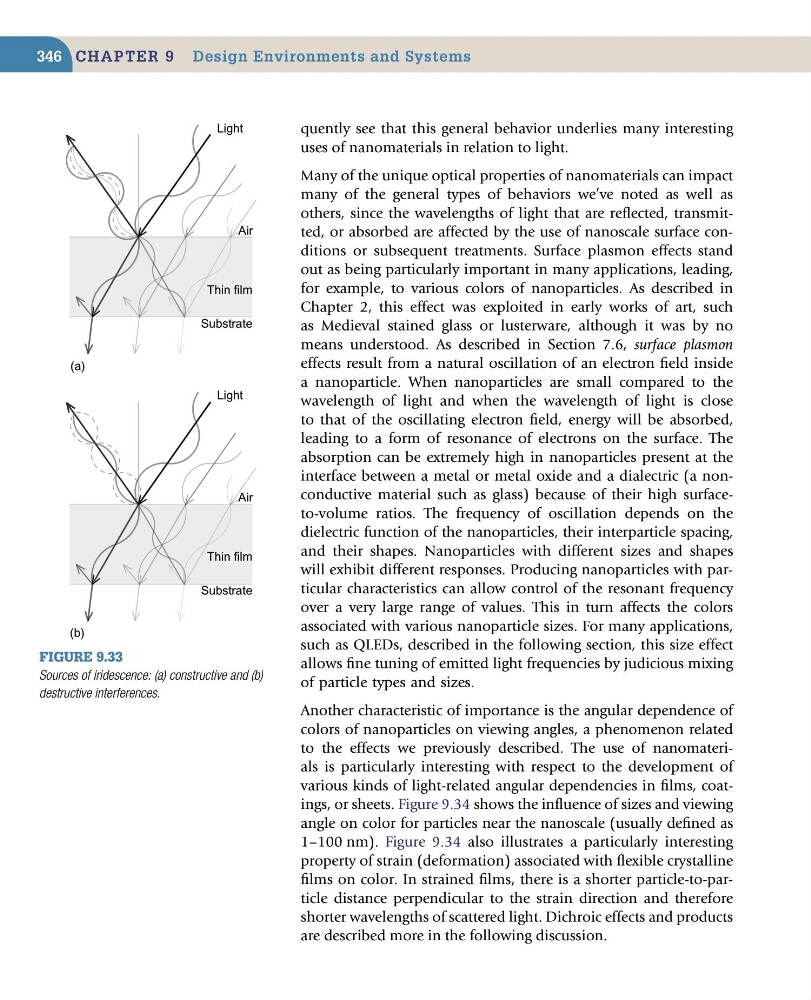
Figure 9.33
Sources of iridescence: (a) constructive and (b)
destructive interferences.
(a)
Thin film
Substrate
Air
Light
Thin film
Substrate
Air
Light
(b)
346
quently see that this general behavior underlies many interesting
uses of nanomaterials in relation to light.
Many of the unique optical properties of nanomaterials can impact
many of the general types of behaviors we’ve noted as well as
others, since the wavelengths of light that are reflected, transmitted, or absorbed are affected by the use of nanoscale surface conditions or subsequent treatments. Surface plasmon effects stand
out as being particularly important in many applications, leading,
for example, to various colors of nanoparticles. As described in
Chapter 2, this effect was exploited in early works of art, such
as Medieval stained glass or lusterware, although it was by no
means understood. As described in Section 7.6, surface plasmon
effects result from a natural oscillation of an electron field inside
a nanoparticle. When nanoparticles are small compared to the
wavelength of light and when the wavelength of light is close
to that of the oscillating electron field, energy will be absorbed,
leading to a form of resonance of electrons on the surface. The
absorption can be extremely high in nanoparticles present at the
interface between a metal or metal oxide and a dialectric (a nonconductive material such as glass) because of their high surfaceto-volume ratios. The frequency of oscillation depends on the
dielectric function of the nanoparticles, their interparticle spacing,
and their shapes. Nanoparticles with different sizes and shapes
will exhibit different responses. Producing nanoparticles with particular characteristics can allow control of the resonant frequency
over a very large range of values. This in turn affects the colors
associated with various nanoparticle sizes. For many applications,
such as QLEDs, described in the following section, this size effect
allows fine tuning of emitted light frequencies by judicious mixing
of particle types and sizes.
Another characteristic of importance is the angular dependence of
colors of nanoparticles on viewing angles, a phenomenon related
to the effects we previously described. The use of nanomaterials is particularly interesting with respect to the development of
various kinds of light-related angular dependencies in films, coatings, or sheets. Figure 9.34 shows the influence of sizes and viewing
angle on color for particles near the nanoscale (usually defined as
1–100 nm). Figure 9.34 also illustrates a particularly interesting
property of strain (deformation) associated with flexible crystalline
films on color. In strained films, there is a shorter particle-to-particle distance perpendicular to the strain direction and therefore
shorter wavelengths of scattered light. Dichroic effects and products
are described more in the following discussion.
Figure 9.33
Sources of iridescence: (a) constructive and (b)
destructive interferences.
(a)
Thin film
Substrate
Air
Light
Thin film
Substrate
Air
Light
(b)