

345
quantum dots and related technologies that provide light emission will develop quickly. They will find application in the many
products and devices that serve our society. Devices relying on now
ubiquitous LEDs, for example, will soon be looking toward a new
generation of LED technologies based on quantum dots (QLEDs)
that are both far more effective and far more energy efficient.
nano-related phenomena
As described in Section 7.6, many properties of nanomaterials are
light related. The study of light–matter interactions is among the
most interesting and potentially rich of all nano-related research
and application areas. Control of the interactions between material
responses and excitations and various electromagnetic radiation
types can have applications in a broad spectrum of areas.
Nanomaterials can be used in films, coatings, or sheets to produce
antireflective, dichroic, UV absorption, or other important lightrelated functions. Many serve broad architectural and product
design applications; others serve many scientific and industrial purposes, such as diffraction gratings and many types of filters. These
different applications are all founded in a thorough understanding of the principles of optics and related transmission, absorption,
and reflection behaviors. Principles of constructive and destructive
interference are particularly important. An interesting manifestation in nature of the many kinds of optical phenomena of interest
are the brilliant iridescent colors evident in the wings of dragonflies,
peacock feathers, butterflies, soap bubbles, or oil films on water
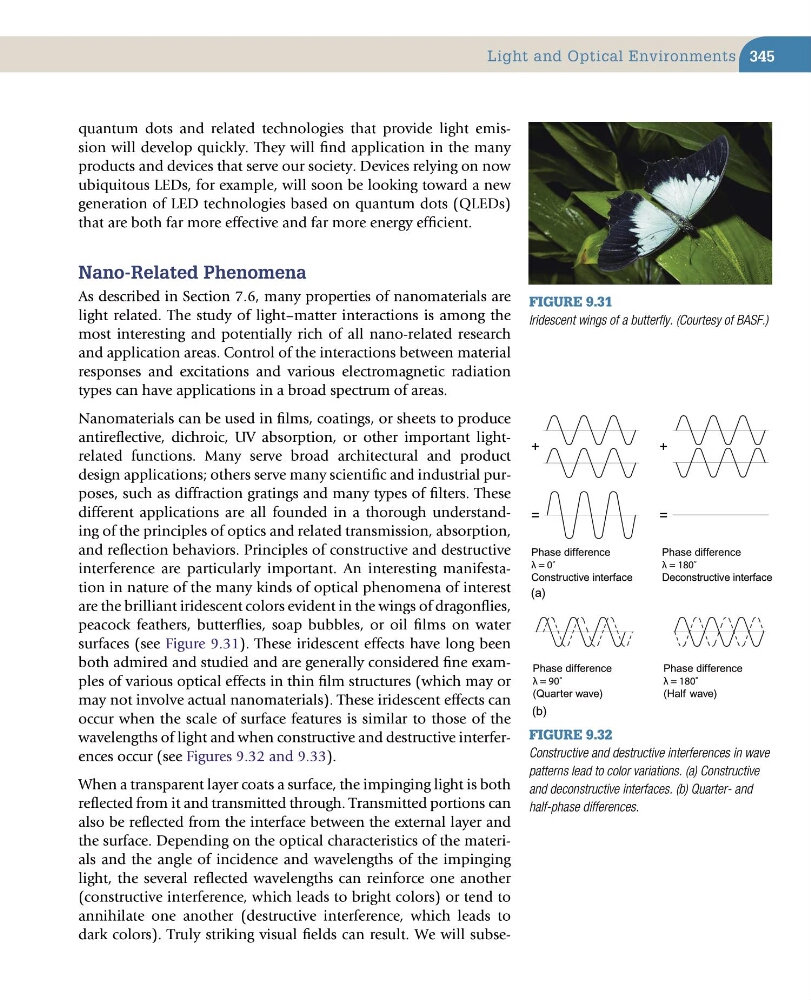
surfaces (see Figure 9.31). These iridescent effects have long been
both admired and studied and are generally considered fine examples of various optical effects in thin film structures (which may or
may not involve actual nanomaterials). These iridescent effects can
occur when the scale of surface features is similar to those of the
wavelengths of light and when constructive and destructive interferences occur (see Figures 9.32 and 9.33).
When a transparent layer coats a surface, the impinging light is both
reflected from it and transmitted through. Transmitted portions can
also be reflected from the interface between the external layer and
the surface. Depending on the optical characteristics of the materials and the angle of incidence and wavelengths of the impinging
light, the several reflected wavelengths can reinforce one another
(constructive interference, which leads to bright colors) or tend to
annihilate one another (destructive interference, which leads to
dark colors). Truly striking visual fields can result. We will subseFigure 9.31
Iridescent wings of a butterfly. (Courtesy of BASF.)
Figure 9.32
Constructive and destructive interferences in wave
patterns lead to color variations. (a) Constructive
and deconstructive interfaces. (b) Quarter- and
half-phase differences.
(a)
(b)
+
=
+
=
Phase difference
λ = 0˚
Constructive interface
Phase difference
λ = 90˚
(Quarter wave)
Phase difference
λ = 180˚
(Half wave)
Phase difference
λ = 180˚
Deconstructive interface
Light and Optical Environments
quantum dots and related technologies that provide light emission will develop quickly. They will find application in the many
products and devices that serve our society. Devices relying on now
ubiquitous LEDs, for example, will soon be looking toward a new
generation of LED technologies based on quantum dots (QLEDs)
that are both far more effective and far more energy efficient.
nano-related phenomena
As described in Section 7.6, many properties of nanomaterials are
light related. The study of light–matter interactions is among the
most interesting and potentially rich of all nano-related research
and application areas. Control of the interactions between material
responses and excitations and various electromagnetic radiation
types can have applications in a broad spectrum of areas.
Nanomaterials can be used in films, coatings, or sheets to produce
antireflective, dichroic, UV absorption, or other important lightrelated functions. Many serve broad architectural and product
design applications; others serve many scientific and industrial purposes, such as diffraction gratings and many types of filters. These
different applications are all founded in a thorough understanding of the principles of optics and related transmission, absorption,
and reflection behaviors. Principles of constructive and destructive
interference are particularly important. An interesting manifestation in nature of the many kinds of optical phenomena of interest
are the brilliant iridescent colors evident in the wings of dragonflies,
peacock feathers, butterflies, soap bubbles, or oil films on water
surfaces (see Figure 9.31). These iridescent effects have long been
both admired and studied and are generally considered fine examples of various optical effects in thin film structures (which may or
may not involve actual nanomaterials). These iridescent effects can
occur when the scale of surface features is similar to those of the
wavelengths of light and when constructive and destructive interferences occur (see Figures 9.32 and 9.33).
When a transparent layer coats a surface, the impinging light is both
reflected from it and transmitted through. Transmitted portions can
also be reflected from the interface between the external layer and
the surface. Depending on the optical characteristics of the materials and the angle of incidence and wavelengths of the impinging
light, the several reflected wavelengths can reinforce one another
(constructive interference, which leads to bright colors) or tend to
annihilate one another (destructive interference, which leads to
dark colors). Truly striking visual fields can result. We will subseFigure 9.31
Iridescent wings of a butterfly. (Courtesy of BASF.)
Figure 9.32
Constructive and destructive interferences in wave
patterns lead to color variations. (a) Constructive
and deconstructive interfaces. (b) Quarter- and
half-phase differences.
(a)
(b)
+
=
+
=
Phase difference
λ = 0˚
Constructive interface
Phase difference
λ = 90˚
(Quarter wave)
Phase difference
λ = 180˚
(Half wave)
Phase difference
λ = 180˚
Deconstructive interface
Light and Optical Environments