

C haptEr 9 design Environments and systems
338
As discussed in Section 4.7, light is invariably reflected in such a
way that the angle of all outgoing reflected light will be identical
to the angle of incidence of the incoming light, no matter what
the exact local shape of the surface happens to be. If the surface is
planar and completely smooth, it is easy to see how the angle of
incidence is equal to the angle of reflection. Polished, smooth surfaces reflect light in a specular way. If a surface is rough or irregular,
a spread will occur in the outgoing reflected rays. A matte surface
diffuses reflections in a wide range. In these latter cases, the angle
of incidence and angle of reflection of the impinging light are still
equal when considered at the microscopic level, but the gross effect
is one of spread or diffusivity.
When a light ray strikes a surface at a particular incident angle and
is transmitted through a material, several things happen. The speed,
wavelength, and direction of the related waves all change. As light
passes from air into glass, for example, the speed and wavelength
decrease and the angle at which the light passes through the glass is
slightly different than that of the original incident angle. The light
path is bent and is said to refract. Snell’s law, which defines the
relationship between the incident angle and the refraction angle as
dependent on the refraction indices of the interfaced materials, is
discussed in Section 4.7. When light passes through multiple layers
of materials, reflections and refractions occur at each interface. As
discussed in the following section, constructive and destructive
wave interferences can lead to highly interesting visual phenomena
and many useful applications, such as antireflective glass.
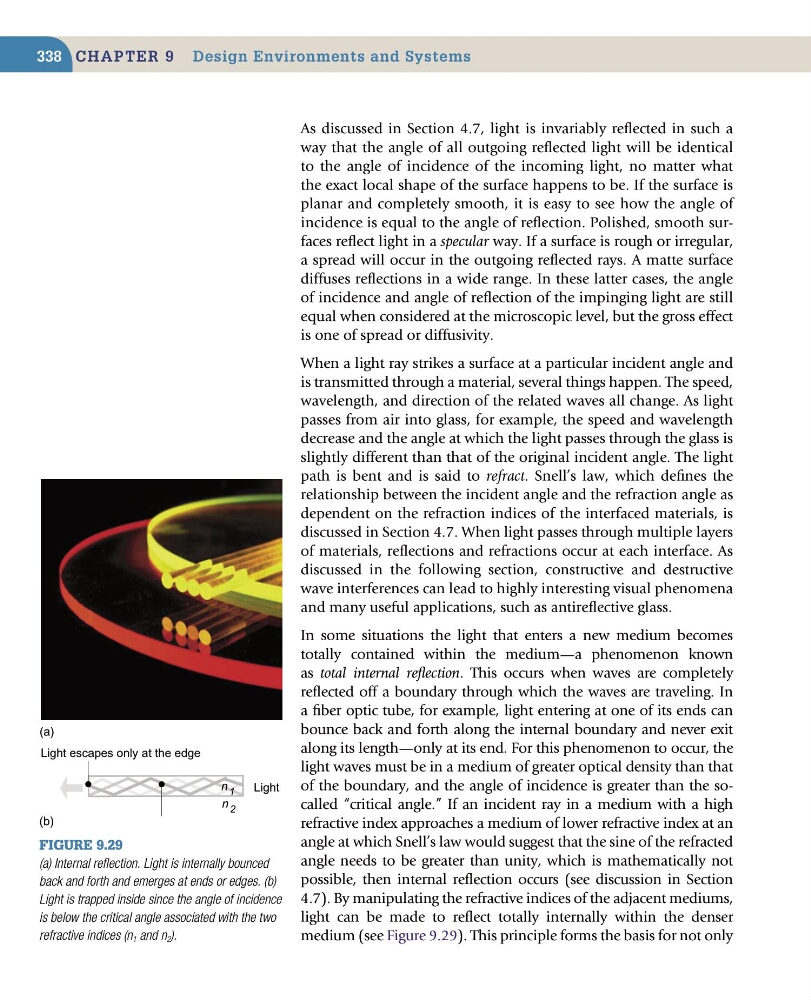
In some situations the light that enters a new medium becomes
totally contained within the medium—a phenomenon known
as total internal reflection. This occurs when waves are completely
reflected off a boundary through which the waves are traveling. In
a fiber optic tube, for example, light entering at one of its ends can
bounce back and forth along the internal boundary and never exit
along its length—only at its end. For this phenomenon to occur, the
light waves must be in a medium of greater optical density than that
of the boundary, and the angle of incidence is greater than the socalled “critical angle.” If an incident ray in a medium with a high
refractive index approaches a medium of lower refractive index at an
angle at which Snell’s law would suggest that the sine of the refracted
angle needs to be greater than unity, which is mathematically not
possible, then internal reflection occurs (see discussion in Section
4.7). By manipulating the refractive indices of the adjacent mediums,
light can be made to reflect totally internally within the denser
medium (see Figure 9.29). This principle forms the basis for not only
Figure 9.29
(a) Internal reflection. Light is internally bounced
back and forth and emerges at ends or edges. (b)
Light is trapped inside since the angle of incidence
is below the critical angle associated with the two
refractive indices (n 1 and n 2 ).
Light escapes only at the edge
(a)
(b)
Light
n 1
n 2
338
As discussed in Section 4.7, light is invariably reflected in such a
way that the angle of all outgoing reflected light will be identical
to the angle of incidence of the incoming light, no matter what
the exact local shape of the surface happens to be. If the surface is
planar and completely smooth, it is easy to see how the angle of
incidence is equal to the angle of reflection. Polished, smooth surfaces reflect light in a specular way. If a surface is rough or irregular,
a spread will occur in the outgoing reflected rays. A matte surface
diffuses reflections in a wide range. In these latter cases, the angle
of incidence and angle of reflection of the impinging light are still
equal when considered at the microscopic level, but the gross effect
is one of spread or diffusivity.
When a light ray strikes a surface at a particular incident angle and
is transmitted through a material, several things happen. The speed,
wavelength, and direction of the related waves all change. As light
passes from air into glass, for example, the speed and wavelength
decrease and the angle at which the light passes through the glass is
slightly different than that of the original incident angle. The light
path is bent and is said to refract. Snell’s law, which defines the
relationship between the incident angle and the refraction angle as
dependent on the refraction indices of the interfaced materials, is
discussed in Section 4.7. When light passes through multiple layers
of materials, reflections and refractions occur at each interface. As
discussed in the following section, constructive and destructive
wave interferences can lead to highly interesting visual phenomena
and many useful applications, such as antireflective glass.
In some situations the light that enters a new medium becomes
totally contained within the medium—a phenomenon known
as total internal reflection. This occurs when waves are completely
reflected off a boundary through which the waves are traveling. In
a fiber optic tube, for example, light entering at one of its ends can
bounce back and forth along the internal boundary and never exit
along its length—only at its end. For this phenomenon to occur, the
light waves must be in a medium of greater optical density than that
of the boundary, and the angle of incidence is greater than the socalled “critical angle.” If an incident ray in a medium with a high
refractive index approaches a medium of lower refractive index at an
angle at which Snell’s law would suggest that the sine of the refracted
angle needs to be greater than unity, which is mathematically not
possible, then internal reflection occurs (see discussion in Section
4.7). By manipulating the refractive indices of the adjacent mediums,
light can be made to reflect totally internally within the denser
medium (see Figure 9.29). This principle forms the basis for not only
Figure 9.29
(a) Internal reflection. Light is internally bounced
back and forth and emerges at ends or edges. (b)
Light is trapped inside since the angle of incidence
is below the critical angle associated with the two
refractive indices (n 1 and n 2 ).
Light escapes only at the edge
(a)
(b)
Light
n 1
n 2