

337
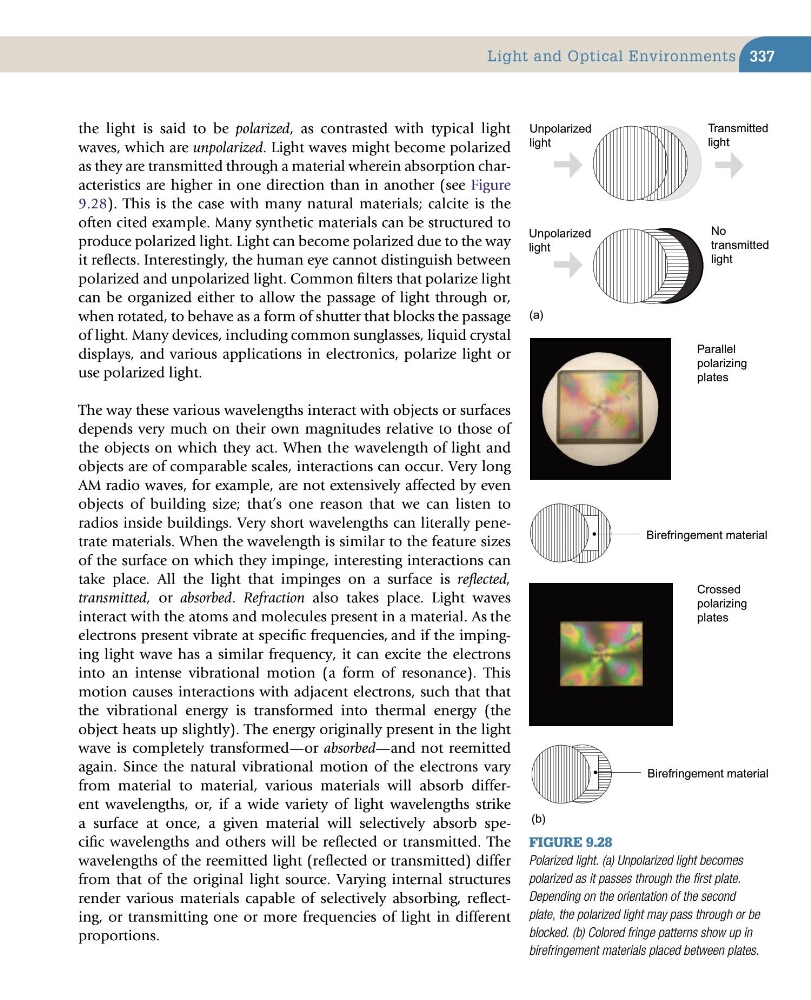
the light is said to be polarized, as contrasted with typical light
waves, which are unpolarized. Light waves might become polarized
as they are transmitted through a material wherein absorption characteristics are higher in one direction than in another (see Figure
9.28). This is the case with many natural materials; calcite is the
often cited example. Many synthetic materials can be structured to
produce polarized light. Light can become polarized due to the way
it reflects. Interestingly, the human eye cannot distinguish between
polarized and unpolarized light. Common filters that polarize light
can be organized either to allow the passage of light through or,
when rotated, to behave as a form of shutter that blocks the passage
of light. Many devices, including common sunglasses, liquid crystal
displays, and various applications in electronics, polarize light or
use polarized light.
The way these various wavelengths interact with objects or surfaces
depends very much on their own magnitudes relative to those of
the objects on which they act. When the wavelength of light and
objects are of comparable scales, interactions can occur. Very long
AM radio waves, for example, are not extensively affected by even
objects of building size; that’s one reason that we can listen to
radios inside buildings. Very short wavelengths can literally penetrate materials. When the wavelength is similar to the feature sizes
of the surface on which they impinge, interesting interactions can
take place. All the light that impinges on a surface is reflected,
transmitted, or absorbed. Refraction also takes place. Light waves
interact with the atoms and molecules present in a material. As the
electrons present vibrate at specific frequencies, and if the impinging light wave has a similar frequency, it can excite the electrons
into an intense vibrational motion (a form of resonance). This
motion causes interactions with adjacent electrons, such that that
the vibrational energy is transformed into thermal energy (the
object heats up slightly). The energy originally present in the light
wave is completely transformed—or absorbed—and not reemitted
again. Since the natural vibrational motion of the electrons vary
from material to material, various materials will absorb different wavelengths, or, if a wide variety of light wavelengths strike
a surface at once, a given material will selectively absorb specific wavelengths and others will be reflected or transmitted. The
wavelengths of the reemitted light (reflected or transmitted) differ
from that of the original light source. Varying internal structures
render various materials capable of selectively absorbing, reflecting, or transmitting one or more frequencies of light in different
proportions.
Figure 9.28
Polarized light. (a) Unpolarized light becomes
polarized as it passes through the first plate.
Depending on the orientation of the second
plate, the polarized light may pass through or be
blocked. (b) Colored fringe patterns show up in
birefringement materials placed between plates.
Unpolarized
light
Unpolarized
light
Transmitted
light
No
transmitted
light
Birefringement material
Birefringement material
(a)
Parallel
polarizing
plates
Crossed
polarizing
plates
(b)
Light and Optical Environments
the light is said to be polarized, as contrasted with typical light
waves, which are unpolarized. Light waves might become polarized
as they are transmitted through a material wherein absorption characteristics are higher in one direction than in another (see Figure
9.28). This is the case with many natural materials; calcite is the
often cited example. Many synthetic materials can be structured to
produce polarized light. Light can become polarized due to the way
it reflects. Interestingly, the human eye cannot distinguish between
polarized and unpolarized light. Common filters that polarize light
can be organized either to allow the passage of light through or,
when rotated, to behave as a form of shutter that blocks the passage
of light. Many devices, including common sunglasses, liquid crystal
displays, and various applications in electronics, polarize light or
use polarized light.
The way these various wavelengths interact with objects or surfaces
depends very much on their own magnitudes relative to those of
the objects on which they act. When the wavelength of light and
objects are of comparable scales, interactions can occur. Very long
AM radio waves, for example, are not extensively affected by even
objects of building size; that’s one reason that we can listen to
radios inside buildings. Very short wavelengths can literally penetrate materials. When the wavelength is similar to the feature sizes
of the surface on which they impinge, interesting interactions can
take place. All the light that impinges on a surface is reflected,
transmitted, or absorbed. Refraction also takes place. Light waves
interact with the atoms and molecules present in a material. As the
electrons present vibrate at specific frequencies, and if the impinging light wave has a similar frequency, it can excite the electrons
into an intense vibrational motion (a form of resonance). This
motion causes interactions with adjacent electrons, such that that
the vibrational energy is transformed into thermal energy (the
object heats up slightly). The energy originally present in the light
wave is completely transformed—or absorbed—and not reemitted
again. Since the natural vibrational motion of the electrons vary
from material to material, various materials will absorb different wavelengths, or, if a wide variety of light wavelengths strike
a surface at once, a given material will selectively absorb specific wavelengths and others will be reflected or transmitted. The
wavelengths of the reemitted light (reflected or transmitted) differ
from that of the original light source. Varying internal structures
render various materials capable of selectively absorbing, reflecting, or transmitting one or more frequencies of light in different
proportions.
Figure 9.28
Polarized light. (a) Unpolarized light becomes
polarized as it passes through the first plate.
Depending on the orientation of the second
plate, the polarized light may pass through or be
blocked. (b) Colored fringe patterns show up in
birefringement materials placed between plates.
Unpolarized
light
Unpolarized
light
Transmitted
light
No
transmitted
light
Birefringement material
Birefringement material
(a)
Parallel
polarizing
plates
Crossed
polarizing
plates
(b)
Light and Optical Environments